Hair Thinning and Nutrition: When Is Food a Factor?
Nutrition can matter when a deficiency or inadequate intake is part of the picture, but the pattern and timing of hair loss often point to other causes.
Food may be relevant if you have a nutritional deficiency or aren’t getting enough to eat, but thinning hair isn’t automatically a nutrition problem. Gradual thinning across the crown differs from increased shedding, and both can have more than one cause. A clinician can assess the pattern and decide whether tests are useful; iron or biotin supplements aren’t a good guesswork fix. 1 5
First, notice what kind of change you’re seeing
Hair that seems to come out more than usual during washing or brushing is different from hair that gradually looks less dense. Illness, weight loss, and iron deficiency can be associated with temporary hair loss; the American Academy of Dermatology also describes obvious shedding after having a baby. Female pattern hair loss more often develops gradually, with thinning around the central scalp while the front hairline is preserved. These patterns are clues, not a diagnosis, and more than one cause can be present at once. 1 2 5
Timing can help make the conversation more useful. For example, the American Academy of Dermatology describes a woman who notices obvious shedding a few months after giving birth but also has early hereditary hair loss. A postpartum change is a relevant part of the picture, but it doesn’t rule out another cause. Menopause can also coincide with hair changes, but that alone doesn’t show that a nutrient is responsible. 1 6
When nutrition deserves a closer look
A nutritional issue is more plausible when there’s a reason your intake or needs may have changed. Heavy menstrual bleeding raises the risk of iron deficiency. A very restrictive diet or major weight loss can also make it harder to meet nutritional needs. These details help guide an assessment; they don’t prove that nutrition caused the hair change. 2 3 4
Iron is one nutrient worth discussing when the context fits. Iron helps form hemoglobin, and menstrual blood loss is one reason people who menstruate can be at higher risk of low iron. Iron stores may fall before anemia develops, so a normal hemoglobin result alone may not describe the full picture. Ferritin is used to assess iron stores, but inflammation can affect its level; a clinician may interpret it alongside other information or tests. 4
Research linking nutrients and hair outcomes is still limited. A systematic review found associations involving nutrients such as iron and vitamin D, but concluded that further research is needed. An assessment of evidence for an iron-and-hair claim found that a causal relationship between iron intake and maintenance of normal hair growth had not been established. An association is not proof that adding a nutrient will regrow hair. 7 8
What a food-first approach can do
Food can help you meet ordinary nutritional needs, and there are several ways to include iron: meat and seafood provide heme iron; beans, lentils, tofu, nuts, vegetables, and iron-fortified grain products provide nonheme iron. Vitamin C can improve absorption of nonheme iron. These are useful options for a varied diet, not a hair-regrowth prescription. 3 4
If you eat little or no meat, iron from plant foods is less readily absorbed on average. That is a reason to consider your overall intake and discuss possible deficiency when appropriate, not a reason to assume you have one or start a high-dose supplement. 4
Food-first care also has limits: changing your diet cannot identify female pattern hair loss or another medical cause, and the evidence doesn’t establish a particular food as a treatment for thinning. If your diet has become restricted, mention that; it can help put your nutritional intake in context. 1 3 7
Why a broad hair supplement may miss the point
A supplement blend can contain nutrients you don’t need, while leaving the actual cause of hair loss unaddressed. The AAD advises taking iron, zinc, or biotin for hair loss only when blood testing shows a deficiency; taking too much iron can be harmful. If a deficiency is found, a clinician can discuss how to address it and whether a supplement is appropriate. 1
If you’re worried about your hair loss, you can arrange an assessment with a primary care clinician or dermatologist. Describe what changed and when: gradual widening or reduced density, more shedding, a recent pregnancy, heavy periods, significant weight loss, or a restrictive eating pattern. A dermatologist can examine the hair and scalp and, if a deficiency, hormone imbalance, infection, or disease is suspected, may recommend blood tests or another evaluation. Finding the cause matters because different kinds of hair loss need different approaches. 1 2
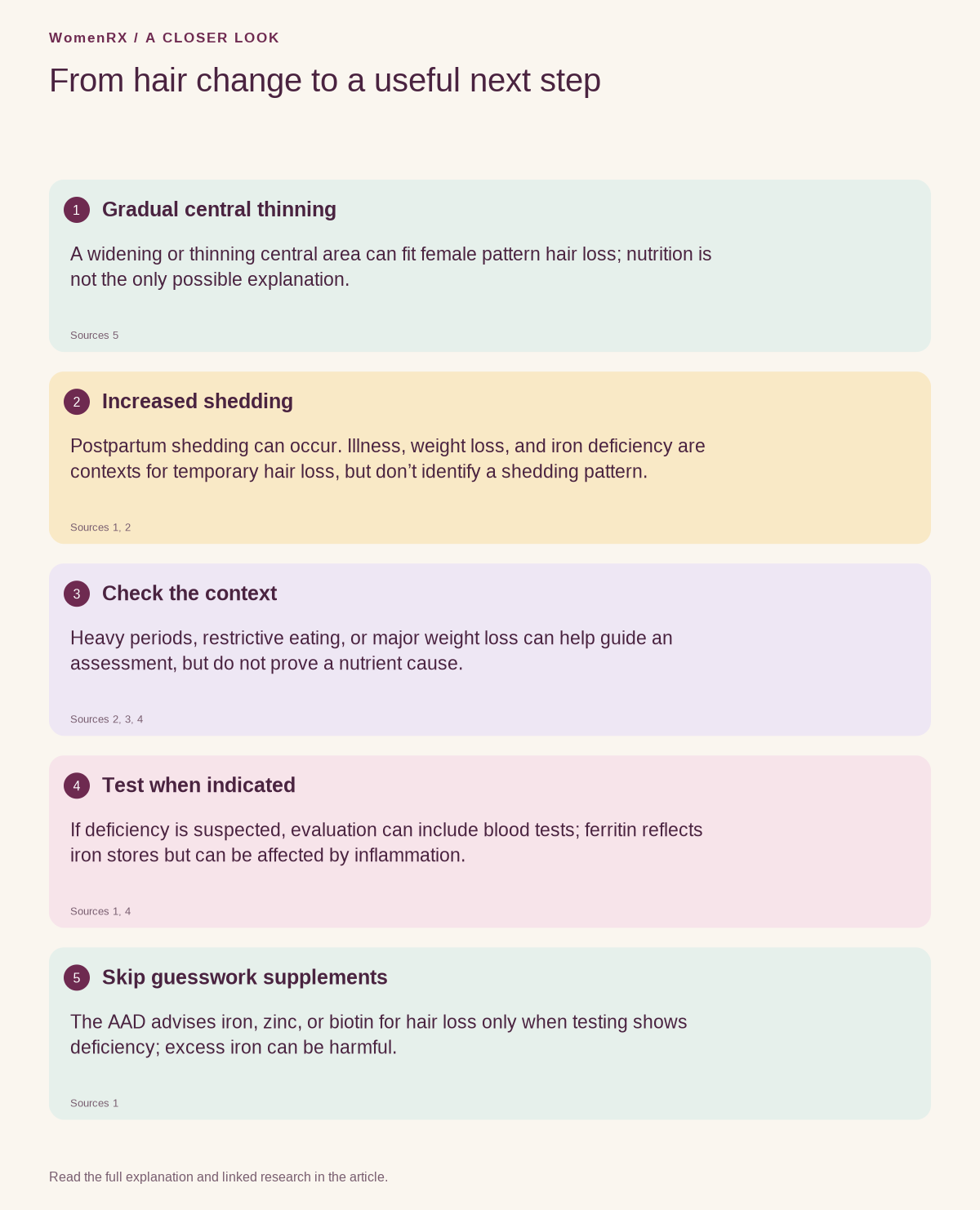
From hair change to a useful next step
Gradual central thinning: A widening or thinning central area can fit female pattern hair loss; nutrition is not the only possible explanation.5
Increased shedding: Postpartum shedding can occur. Illness, weight loss, and iron deficiency are contexts for temporary hair loss, but don’t identify a shedding pattern.12
Check the context: Heavy periods, restrictive eating, or major weight loss can help guide an assessment, but do not prove a nutrient cause.234
Test when indicated: If deficiency is suspected, evaluation can include blood tests; ferritin reflects iron stores but can be affected by inflammation.14
Skip guesswork supplements: The AAD advises iron, zinc, or biotin for hair loss only when testing shows deficiency; excess iron can be harmful.1
Read the figure as text
The pattern and timing can help frame whether nutrition is one factor to assess, without treating a clue as a diagnosis.- Gradual central thinning: A widening or thinning central area can fit female pattern hair loss; nutrition is not the only possible explanation.5
- Increased shedding: Postpartum shedding can occur. Illness, weight loss, and iron deficiency are contexts for temporary hair loss, but don’t identify a shedding pattern.12
- Check the context: Heavy periods, restrictive eating, or major weight loss can help guide an assessment, but do not prove a nutrient cause.234
- Test when indicated: If deficiency is suspected, evaluation can include blood tests; ferritin reflects iron stores but can be affected by inflammation.14
- Skip guesswork supplements: The AAD advises iron, zinc, or biotin for hair loss only when testing shows deficiency; excess iron can be harmful.1
More questions, answered
Does thinning hair mean I should take iron?
No. Heavy menstrual bleeding can raise the risk of iron deficiency, but hair thinning by itself doesn’t establish that your iron is low. A clinician can assess whether testing is appropriate; the AAD advises iron supplements for hair loss only when testing shows deficiency. 1 4
Can foods or supplements regrow hair?
A varied diet can help meet nutritional needs, and correcting a confirmed deficiency may be relevant to care. But the evidence doesn’t establish a particular food as a reliable hair-regrowth treatment. An assessment of iron intake and maintenance of normal hair growth did not establish a causal relationship; it did not test whether iron supplements treat hair loss. The cause and pattern of the hair loss still matter. 1 7 8
Sources you can check
- Hair loss: Diagnosis and treatmentAccessed 2026-09-25Return to first citation
- Hair loss - NHSAccessed 2026-09-25Return to first citation
- Nutrition: MedlinePlusAccessed 2026-09-25Return to first citation
- Iron - Health Professional Fact SheetAccessed 2026-09-25Return to first citation
- Female Pattern Hair Loss: An Overview with Focus on the Genetics.Ho CY, Chen JY, Hsu WL, Yu S, Chen WC, Chiu SH, Yang HR, Lin SY, Wu CY. · Genes · 2023Return to first citation
- Nutrition of women with hair loss problem during the period of menopause.Goluch-Koniuszy ZS. · Przeglad menopauzalny = Menopause review · 2016Return to first citation
- Assessing the relationship between dietary factors and hair health: A systematic review.Gomes N, Silva N, Teixeira B. · Nutrition and health · 2026Return to first citation
- Scientific Opinion on the substantiation of a health claim related to iron and maintenance of normal hair growth pursuant to Article 13(5) of Regulation (EC) No 1924/2006.EFSA Panel on Dietetic Products, Nutrition and Allergies (NDA). · EFSA journal. European Food Safety Authority · 2012Return to first citation