Hair Loss: Find the Cause Before Choosing Treatment
The difference between shedding, gradual thinning, patches, and breakage helps determine what to check and which treatments are worth discussing.
Start with what’s changing: hair coming out across the scalp, a gradual loss of density, distinct bare patches, or hairs breaking short. These clues can guide an evaluation, but they can’t confirm a diagnosis. A dermatologist can examine your hair and scalp, consider whether more than one cause is involved, and match treatment to what they find. 14
First, separate shedding from thinning
Hair collecting in the shower feels different from realizing you can see more scalp than you used to. That distinction is useful. Shedding describes hairs coming out; thinning describes a change in density. You can have both at once, so neither observation settles the cause on its own. The American Academy of Dermatology (AAD) gives postpartum shedding alongside early hereditary hair loss as an example of two causes that can coexist. 1
Notice whether the change came on quickly or developed gradually. If you’ve recently had a baby or been ill, include that timing when you describe the loss. Illness can be associated with temporary hair loss, but a recent event doesn’t rule out another cause. 12
What each pattern changes about the next step
Hair coming out across the scalp: An examination can help distinguish shedding from breakage and look for a second source of thinning. The useful question isn’t simply which shampoo might stop it. It’s whether the history and exam point to a temporary cause, an underlying condition, or overlapping causes. 12
A gradual drop in density: Female pattern hair loss is one possibility. In this condition, follicles progressively produce less hair density, but the appearance alone cannot confirm it. If the diagnosis fits, minoxidil and spironolactone are among the options to discuss. They address a different problem from an infection or hair damaged by styling. 14
One or more bare patches: A patch isn’t automatically alopecia areata. A dermatologist may consider corticosteroid injections for a few patches if alopecia areata is the diagnosis. A fungal scalp infection instead needs antifungal treatment. Tell the examiner if the area is painful or inflamed rather than assuming it’s ordinary pattern thinning; some other forms of hair loss involve inflammation and need different care. 1
Short, broken hairs: These may call for a closer look at the hair itself and at styling or hair-care habits. If those habits are damaging the hair, changing them may help. A treatment aimed at female pattern loss won’t address the same problem. 1
These are routes to better questions, not a home diagnostic test. If a patch is painful or inflamed, getting it assessed early matters: some types of hair loss may not regrow, even when treatment can help prevent further loss. 1
What an examination can add
A dermatologist will usually start with the timeline and a close look at the scalp, hair, nails, and any other areas of hair loss. They may gently pull on the hair to assess shedding and breakage. If the findings raise concern about a disease, nutrient deficiency, hormone imbalance, or infection, blood tests or a scalp biopsy may help. Those tests aren’t automatically needed for every person with hair loss. 1
A useful way to weigh a proposed test is to ask what it would help distinguish. For example, would it check a suspected deficiency, or would a scalp biopsy clarify a patch whose cause remains uncertain after the exam? That keeps the evaluation tied to the treatment decision. 1
Compare treatments by what they’re meant to do
Minoxidil can help with early hair loss, including female pattern hair loss, but it won’t restore an entire head of hair. The tradeoff is that its benefit depends on continued use: after stopping, the maintained thickness gradually fades. 12
Spironolactone may be an option for women diagnosed with female pattern hair loss. It’s a medication decision, not a general answer to sudden shedding or bare patches. Because it can raise potassium levels and interact with some medicines, including nonsteroidal anti-inflammatory drugs such as ibuprofen, the discussion should include what else you take. 13
Cause-specific care looks quite different. Corticosteroid injections may help a few patches of alopecia areata; a fungal infection calls for antifungal medication; and changing a damaging hairstyle or hair-care habit may help prevent further damage. If a medical condition is responsible for temporary loss, hair may recover as the condition resolves. None of these options is interchangeable. 12
Before committing to a treatment, ask what diagnosis it targets, whether the goal is to reduce further loss or encourage regrowth, and what happens if treatment stops. Those answers are more useful than a promise that one product works for every kind of hair loss. 1
What you see, and what to discuss
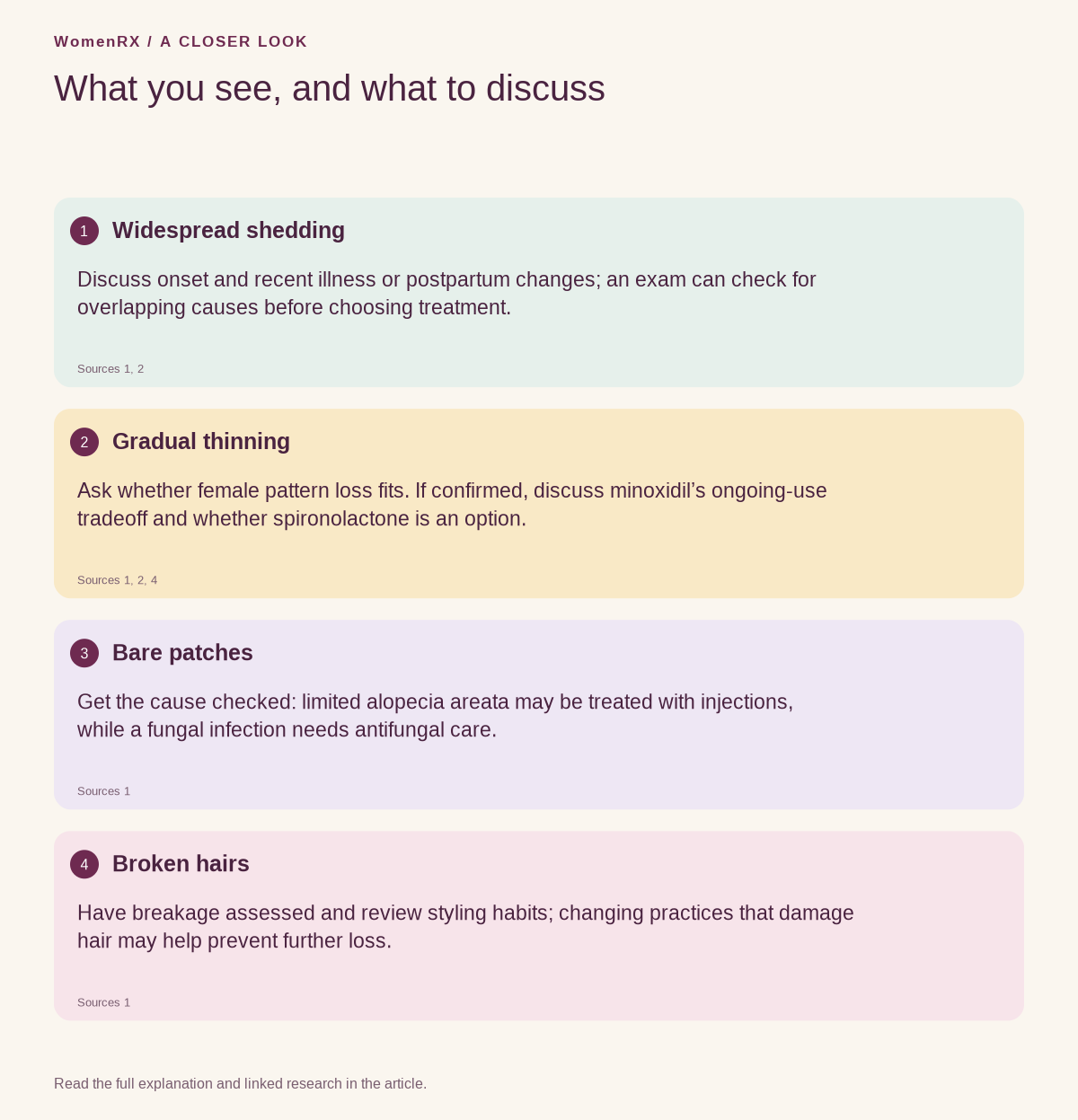
Widespread shedding: Discuss onset and recent illness or postpartum changes; an exam can check for overlapping causes before choosing treatment.12
Gradual thinning: Ask whether female pattern loss fits. If confirmed, discuss minoxidil’s ongoing-use tradeoff and whether spironolactone is an option.124
Bare patches: Get the cause checked: limited alopecia areata may be treated with injections, while a fungal infection needs antifungal care.1
Broken hairs: Have breakage assessed and review styling habits; changing practices that damage hair may help prevent further loss.1
Read the figure as text
Start with the change you notice, then use the corresponding route to focus an evaluation. None of these observations confirms a diagnosis.- Widespread shedding: Discuss onset and recent illness or postpartum changes; an exam can check for overlapping causes before choosing treatment.12
- Gradual thinning: Ask whether female pattern loss fits. If confirmed, discuss minoxidil’s ongoing-use tradeoff and whether spironolactone is an option.124
- Bare patches: Get the cause checked: limited alopecia areata may be treated with injections, while a fungal infection needs antifungal care.1
- Broken hairs: Have breakage assessed and review styling habits; changing practices that damage hair may help prevent further loss.1
More questions, answered
Should I try a hair supplement before finding the cause?
A supplement won’t tell you why hair is falling out. If an examination suggests a nutrient deficiency, testing may help clarify it. Supplements that concentrate a single nutrient can also provide too much, so it’s worth identifying what, if anything, needs correcting first. 1
Sources you can check
- Hair loss: Diagnosis and treatmentAccessed 2026-09-25Return to first citation
- Hair loss - NHSAccessed 2026-09-25Return to first citation
- Spironolactone - NHSAccessed 2026-09-25Return to first citation
- Causal Relationship Between Blood Metabolomics and Female Pattern Hair Loss: A Bidirectional Mendelian Randomization Study.Peng L, Zhao X, Shen L, Zhang L, Han Y, Li L, Jiang M. · Clinical, cosmetic and investigational dermatology · 2025Return to first citation