Shedding or Hair Loss? Clues in the Pattern
A sudden increase in loose hairs and a slowly widening part can point to different patterns, but they can also happen together.
Diffuse shedding that starts noticeably or quickly is different from the gradual thinning often seen with female pattern hair loss, which can make the part or crown look less dense. Patchy loss is another pattern. These clues can guide what to look for, but they don’t confirm a cause: shedding and patterned thinning may overlap. Scalp pain or inflammation is also a reason to get the area examined. 1 3 4
Start with the shape of the change
More loose hair on your brush or in the shower can be unsettling, but the amount you notice doesn’t tell you by itself what’s happening. A useful first distinction is whether you’re seeing more hairs coming out across the scalp, gradual thinning in particular areas, or one or more distinct bare patches.
These patterns offer clues, not a home diagnosis. Diffuse shedding and female pattern hair loss can occur together, and early pattern loss can be hard to recognize. 3 4
What the patterns may suggest
Diffuse shedding: Hair seems to come out more noticeably from across the scalp rather than leaving one clear bare area. Telogen effluvium is one possible cause of diffuse shedding, but the observation alone doesn’t establish that diagnosis. The timing matters: dermatologists ask how long the change has been happening and whether it began quickly. 1 3
Gradual thinning or a widening part: Female pattern hair loss often develops gradually. The part may look wider, or hair density may lessen over the crown or front of the scalp. It’s usually nonscarring, but early pattern loss may not look obvious, and shedding can occur alongside it. 3 5
Patchy loss: A clearly defined area with less hair is different from diffuse shedding or a widening part. Several conditions can cause hair loss, so a patch’s appearance alone doesn’t identify the cause. A scalp examination helps distinguish among possibilities. 1
Pay attention to how the scalp feels, too. Painful inflammation can occur with frontal fibrosing alopecia, a form of hair loss that needs assessment. Pain doesn’t identify the cause on its own, but it’s a reason to have the scalp examined rather than judging the pattern from shed hairs alone. 1
You may also notice breakage rather than hairs shedding from the root. A dermatologist can examine the hair and gently test it to help assess whether it is growing normally or prone to breaking. 1
Timing adds context, not a diagnosis
Write down when you first noticed the change and whether it came on quickly or gradually. If it followed childbirth, note when you first noticed it in relation to the birth and whether it has continued or changed since. If you’ve had a change in menstrual patterns or are going through menopause, include that timing too. It gives a clinician context, but reproductive timing alone can’t tell you whether you’re seeing diffuse shedding, patterned thinning, or both. 1 3
Menopause is associated with some forms of hair loss, particularly female pattern hair loss and frontal fibrosing alopecia, in a systematic review. The review also describes limitations in the research, including varied study populations and less consistent findings for menopausal hormone therapy. Menopausal status is one piece of the picture, not a way to diagnose your hair loss. 2
When an examination can help
Consider an evaluation if the change is continuing, the part seems to be widening, you see patches, your scalp is painful or inflamed, or you’re unsure what pattern you’re seeing. A dermatologist can ask about the timeline, examine your scalp and hair, and use a gentle hair-pull test. 1
Blood tests or a scalp biopsy may be considered when the examination suggests a possible medical condition, deficiency, hormone imbalance, or infection. They aren’t automatically needed for every person with hair loss. 1
Bring a simple timeline rather than relying on a hair count: when you noticed the change, whether it is diffuse, patterned, or patchy, and any relevant changes in health or reproductive stage. A count by itself can’t show whether the underlying pattern is shedding, gradual thinning, or a combination. Getting the cause right matters because different types of hair loss may need different approaches. 1 3 4
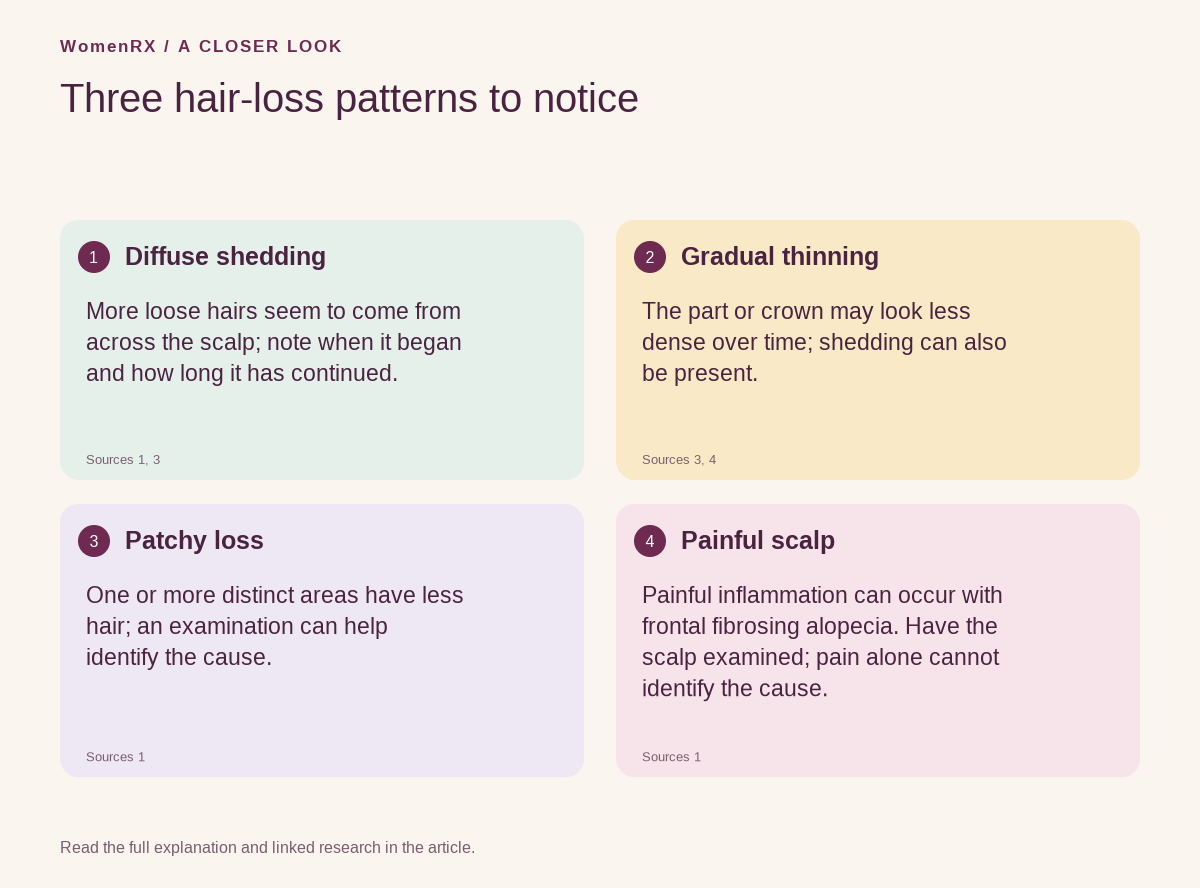
Three hair-loss patterns to notice
Diffuse shedding: More loose hairs seem to come from across the scalp; note when it began and how long it has continued.13
Gradual thinning: The part or crown may look less dense over time; shedding can also be present.34
Patchy loss: One or more distinct areas have less hair; an examination can help identify the cause.1
Painful scalp: Painful inflammation can occur with frontal fibrosing alopecia. Have the scalp examined; pain alone cannot identify the cause.1
Read the figure as text
The pattern and its course can help you describe what’s changing, but they do not diagnose the cause.- Diffuse shedding: More loose hairs seem to come from across the scalp; note when it began and how long it has continued.13
- Gradual thinning: The part or crown may look less dense over time; shedding can also be present.34
- Patchy loss: One or more distinct areas have less hair; an examination can help identify the cause.1
- Painful scalp: Painful inflammation can occur with frontal fibrosing alopecia. Have the scalp examined; pain alone cannot identify the cause.1
More questions, answered
Can shedding and a widening part happen at the same time?
Yes. Diffuse shedding can occur alongside female pattern hair loss, and shedding may make an early pattern harder to distinguish. A clinician can assess the overall pattern rather than relying on one clue. 3 4
Sources you can check
- Hair loss: Diagnosis and treatmentAccessed 2026-09-25Return to first citation
- Menopause and Common Dermatoses: A Systematic Review.Roster K, Fleshner L, Karatas TB, Ecanow A, Sayegh A, Farabi B, Marmon S. · American journal of clinical dermatology · 2026Return to first citation
- Trichoscopic Features, Clinical Correlates, and Risk Prediction in Female Pattern Hair Loss: A Retrospective Case-Control Study.Long B, Long Q, Pan W, Chen S, Ye Z, Guo H. · Clinical, cosmetic and investigational dermatology · 2026Return to first citation
- Female pattern alopecia and telogen effluvium: figuring out diffuse alopecia.Torres F, Tosti A. · Seminars in cutaneous medicine and surgery · 2015Return to first citation
- Recent Advances in Understanding of the Etiopathogenesis, Diagnosis, and Management of Hair Loss Diseases.Kinoshita-Ise M, Fukuyama M, Ohyama M. · Journal of clinical medicine · 2023Return to first citation