Hair Loss After Stress or Hormonal Change: What Clues Matter?
Diffuse shedding that starts a few months after an illness, major stress, or childbirth can fit telogen effluvium, while gradual patterned thinning points to a different possibility.
Timing and distribution offer clues, not a diagnosis. Telogen effluvium often causes diffuse shedding that begins about two to three months after a trigger such as illness, major stress, or the postpartum state. Gradual thinning may also show as reduced hair density along the midline part, a feature clinicians assess for female pattern hair loss. 3 5
Start with the pattern, then look back
When shedding begins, try to separate two questions: Is a lot of hair coming out across the scalp, or is thinning becoming more noticeable in a particular pattern? Then consider what happened in the months before it started. These clues can help frame the possibilities, but a stressful event or life-stage change alone can’t establish the cause.
Telogen effluvium (TE) is a form of diffuse shedding associated with a shift in the hair cycle. It may follow a health issue, major stress, or the postpartum state. One review describes shedding commonly starting about two to three months after a trigger. So if your hair begins shedding noticeably a few months after an illness or childbirth, the timing may fit TE, though it doesn’t prove that was the cause. 5
Diffuse shedding or gradual thinning?
With TE, shedding is usually diffuse, meaning it’s spread over the scalp rather than forming a distinct bald patch. The review describes TE as typically nonscarring and often reversible when the trigger subsides, although individual causes and courses vary. A stressful period may be relevant, but it’s not enough on its own to identify TE. 5 6
Female pattern hair loss is a different possibility. In this condition, hair follicles gradually become smaller, contributing to progressive thinning. One concrete place to notice a change is along the midline part: clinicians assess midline hair density when evaluating early female pattern hair loss. Hormonal, genetic, and environmental factors may all be involved; the name doesn’t mean a recent hormone change must be the cause. A clinical assessment may consider pattern hair loss alongside other explanations, including chronic TE. 2 3
The distinction isn’t always obvious from how much hair you see in the shower or brush. Different forms of hair loss can be difficult to tell apart without examining the scalp. A review of hair-loss evaluation describes tools such as scalp imaging and hair-pull testing; these are clinical assessment methods, not home diagnostic tests. 2 3
How childbirth, periods, and menopause fit in
Childbirth is identified as a possible TE trigger, and the delay between a trigger and noticeable shedding means the change may not appear right away. Postpartum timing can be a useful clue, but it doesn’t prove that hormones are the only factor. 5
A change in menstrual pattern or reaching menopause is also useful context to mention when describing when your hair changed. But timing alone can’t show that hormones caused the loss. Hair loss has several possible forms and causes, and female pattern hair loss itself has complex contributing factors. 2 3
A practical next step
Make a short timeline for yourself: when the shedding or thinning began; whether it seems diffuse or more patterned, including any change in density along the midline part; and whether an illness, major stress, childbirth, or menstrual change came beforehand. This isn’t a diagnostic checklist. It’s a way to make the sequence clearer when you speak with a clinician.
If loss is worrying you, continuing, or becoming more noticeable, arrange an evaluation rather than assuming stress or hormones explain it. Hair loss has multiple possible causes, and some forms need timely identification. An examination can help distinguish among them and guide what to do next. 1 4
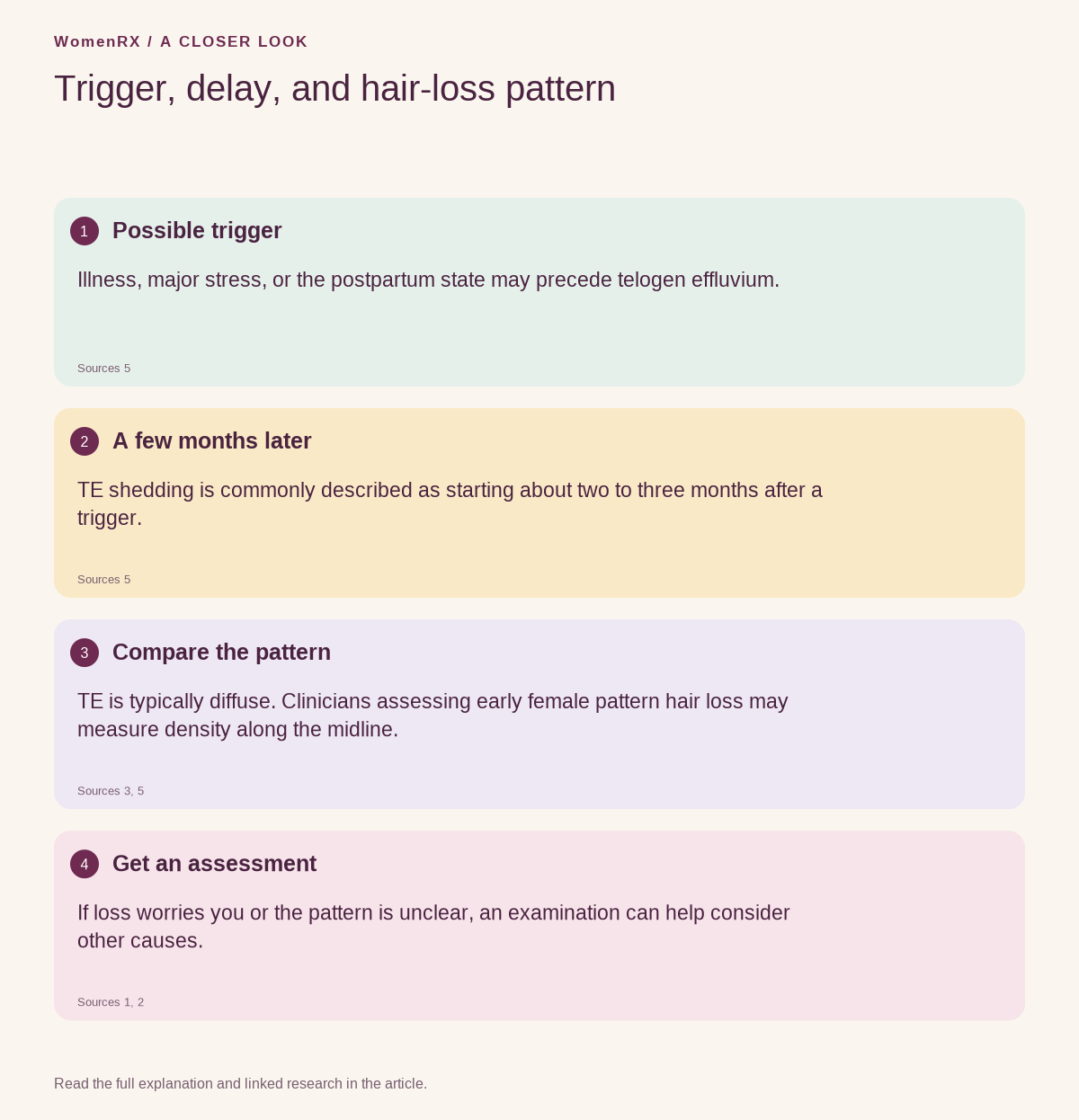
Trigger, delay, and hair-loss pattern
Possible trigger: Illness, major stress, or the postpartum state may precede telogen effluvium.5
A few months later: TE shedding is commonly described as starting about two to three months after a trigger.5
Compare the pattern: TE is typically diffuse. Clinicians assessing early female pattern hair loss may measure density along the midline.35
Get an assessment: If loss worries you or the pattern is unclear, an examination can help consider other causes.12
Read the figure as text
A possible trigger may precede diffuse shedding by months. Comparing that timing with hair distribution, including midline density, can guide what to discuss but cannot prove the cause.- Possible trigger: Illness, major stress, or the postpartum state may precede telogen effluvium.5
- A few months later: TE shedding is commonly described as starting about two to three months after a trigger.5
- Compare the pattern: TE is typically diffuse. Clinicians assessing early female pattern hair loss may measure density along the midline.35
- Get an assessment: If loss worries you or the pattern is unclear, an examination can help consider other causes.12
More questions, answered
Does shedding after childbirth prove hormones caused it?
No. The postpartum state is a possible trigger for telogen effluvium, which often involves diffuse shedding after a delay. That timing is a clue, not proof that hormones alone caused the loss. 5
Can stress be the cause if shedding starts later?
It may be relevant: telogen effluvium can begin about two to three months after a trigger. But a stressful event by itself can’t confirm the diagnosis, and other causes may need consideration. 5 2
Sources you can check
- Hair loss - NHSAccessed 2026-09-25Return to first citation
- Androgenetic Alopecia in Women: A Narrative Review of Pathophysiology, Clinical Evaluation, and Treatments.Kearney CA, Brinks AL, Lawrence CN, Maas DE, Spindler AJ, Coric C, Gener-Pangilinan LA, Lasheras-Pérez MA, Shapiro J, Lo Sicco KI. · American journal of clinical dermatology · 2026Return to first citation
- Recent Advances in Understanding of the Etiopathogenesis, Diagnosis, and Management of Hair Loss Diseases.Kinoshita-Ise M, Fukuyama M, Ohyama M. · Journal of clinical medicine · 2023Return to first citation
- Bitemporal Scalp Hair Loss: Differential Diagnosis of Nonscarring and Scarring Conditions.De Souza B, Tovar-Garza A, Uwakwe LN, McMichael A. · The Journal of clinical and aesthetic dermatology · 2021Return to first citation
- Exploring the Potential Links between Telogen Effluvium, Alopecia Areata, Pressure-Induced Alopecia, and General Anesthesia: A Narrative Review.Poniatowska O, Anand ŁS, Jakubczyk-Słabicka A, Płaza D, Gammazza AM, Barańska-Rybak W, Owczuk R, Górska-Ponikowska M. · Dermatology and therapy · 2026Return to first citation
- Telogen effluvium: a 360 degree review.Jimeno Ortega I, Stefanato CM. · Italian journal of dermatology and venereology · 2023Return to first citation