Telogen Effluvium: Why Shedding Can Start Months Later
Diffuse shedding may appear three to four months after a trigger, so the pattern and your recent history both matter.
Telogen effluvium is diffuse hair shedding that may begin about three to four months after a triggering event. That delay can make the cause hard to spot, and shedding alone can’t identify it. Note when shedding began, what was happening in the months before, and whether hair is thinning diffusely, in patches, or in a pattern. Ongoing shedding or a different pattern is a reason to seek assessment. 4 3

Why the timing can be confusing
Telogen effluvium (TE) is a type of diffuse hair shedding. A review describes shedding of telogen hairs beginning about three to four months after a triggering event. If you notice more hair coming out now, it can help to look back several months. The delay is a clue to discuss, not proof of what caused your shedding. 4
Illness and physical or emotional events may be relevant to the history, but shedding alone doesn’t identify a cause. Stress is one detail to consider, not an explanation to assume. An illness can also be followed by temporary hair loss, which doesn’t by itself confirm TE. 5 1 4
If shedding began after childbirth, record the delivery date and when the shedding started. That timing is useful context, but it doesn’t by itself establish the cause. Do the same with medication start or stop dates: record them so they can be considered alongside other events, rather than treating them as confirmed triggers.
A history that helps distinguish patterns
Before an assessment, jot down a few details:
- Timing: When did shedding start? What significant events happened in the months before it, such as illness or major stress? Include childbirth and medication changes as timeline details, not conclusions about cause.
- Pattern: Is hair coming out across the scalp, are there distinct patches, or is thinning following a pattern? Diffuse shedding, focal loss, and patterned thinning can point toward different diagnoses. 3
- Course and scalp: Is the shedding continuing or changing? Mention any scalp changes. History and scalp inspection help guide evaluation. 3
- Health and nutrition: Share relevant health or nutrition concerns. Iron status may be one assessment question, but hair shedding alone doesn’t show that you have iron deficiency. 2 3
This timeline can make it easier to describe what changed and when without settling on a cause before the pattern has been assessed.
When to get an assessment
Seek an assessment if shedding is ongoing, if the loss is patchy or patterned rather than diffuse, or if you’re worried about it. Hair-loss evaluation often starts with the history and scalp examination. Depending on what those show, tests may include thyroid-stimulating hormone, a complete blood count, or iron studies; that doesn’t mean everyone needs every test. 1 3
TE is usually self-limiting, but it may become chronic if a trigger isn’t identified and corrected. Persistent shedding deserves a closer look rather than an assumption that an earlier stressful event explains everything. 5
Iron testing also needs context. Ferritin is a measure of iron stores, but inflammation can affect it, and providers may use more than one measurement to assess iron status. So iron is a reasonable question to raise when relevant, not a reason to start supplementation based on shedding alone. 2
A timeline for diffuse shedding
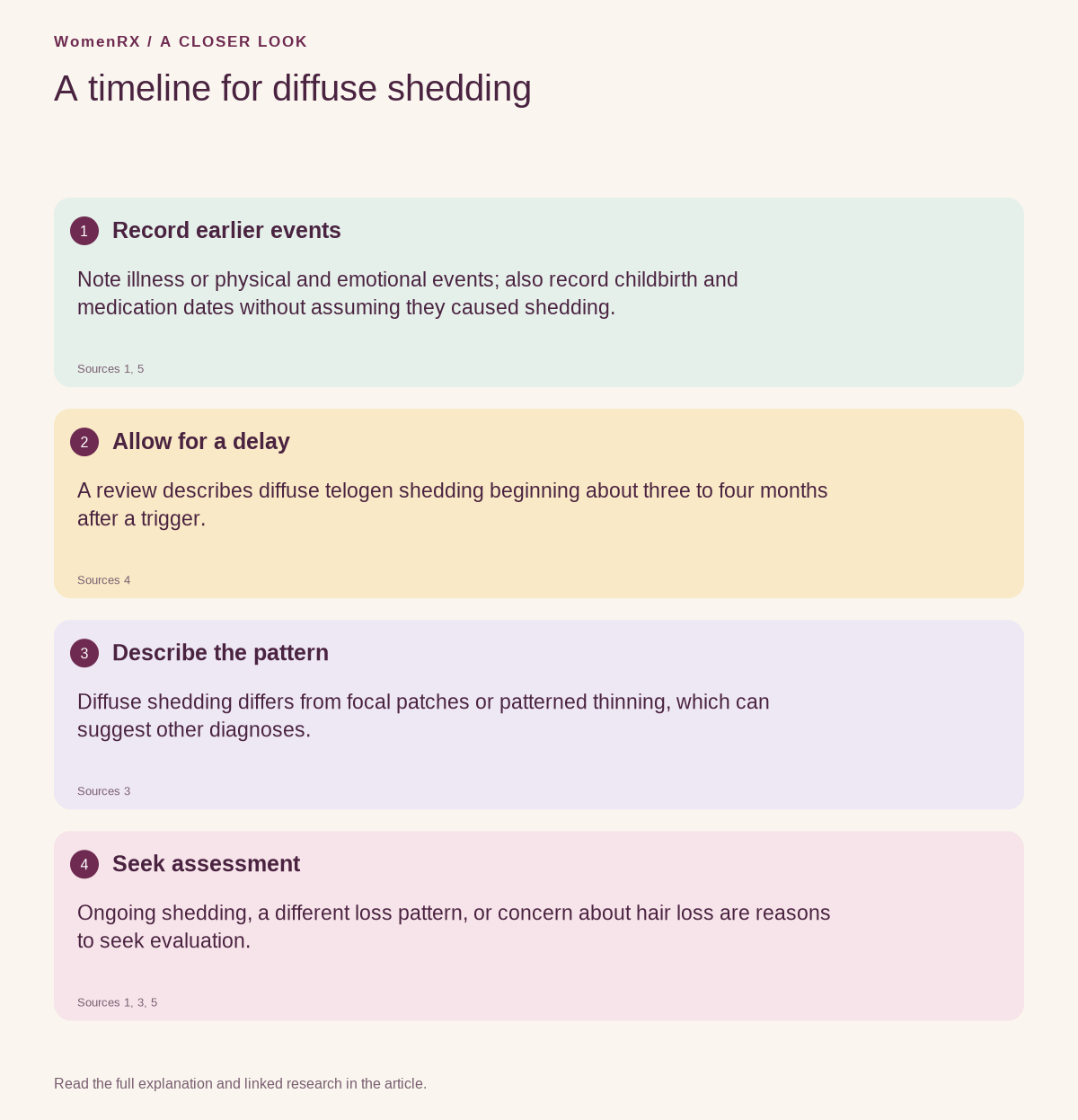
Record earlier events: Note illness or physical and emotional events; also record childbirth and medication dates without assuming they caused shedding.15
Allow for a delay: A review describes diffuse telogen shedding beginning about three to four months after a trigger.4
Describe the pattern: Diffuse shedding differs from focal patches or patterned thinning, which can suggest other diagnoses.3
Seek assessment: Ongoing shedding, a different loss pattern, or concern about hair loss are reasons to seek evaluation.135
Read the figure as text
Use the sequence to organize what happened and when. The delay can fit TE, but it cannot prove a cause.- Record earlier events: Note illness or physical and emotional events; also record childbirth and medication dates without assuming they caused shedding.15
- Allow for a delay: A review describes diffuse telogen shedding beginning about three to four months after a trigger.4
- Describe the pattern: Diffuse shedding differs from focal patches or patterned thinning, which can suggest other diagnoses.3
- Seek assessment: Ongoing shedding, a different loss pattern, or concern about hair loss are reasons to seek evaluation.135
More questions, answered
Does shedding mean I have low iron?
No. Hair loss alone doesn’t diagnose iron deficiency. Ferritin reflects iron stores and can be affected by inflammation, so iron status may require more than one blood measure. 2 3
Sources you can check
- Hair loss - NHSAccessed 2026-09-25Return to first citation
- Iron - Health Professional Fact SheetAccessed 2026-09-25Return to first citation
- Hair loss: A systematic approach to evaluation, diagnosis, and management.Walker CW, Champigny D, Hartman T, Hulsey B, Hoffart C. · JAAPA : official journal of the American Academy of Physician Assistants · 2026Return to first citation
- Telogen Effluvium: A Review.Malkud S. · Journal of clinical and diagnostic research : JCDR · 2015Return to first citation
- Shedding: how to manage a common cause of hair loss.Bergfeld WF, Mulinari-Brenner F. · Cleveland Clinic journal of medicine · 2001Return to first citation