Minoxidil Shedding: What to Track and When to Check In
Early shedding can happen with topical minoxidil, but its timing alone can’t tell you whether to keep waiting or have your hair loss reassessed.
A small study observed a temporary increase in shedding during the first 12 weeks of topical minoxidil use, but that isn’t a deadline for your hair to settle. 1 Note when you started, which product you use, how the loss is changing, and any scalp symptoms. Seek advice if shedding is severe or worsening, or if you notice patches, redness, or tenderness rather than assuming minoxidil explains it. 2 3
What the timing does and doesn’t tell you
Seeing more hair in the shower after starting minoxidil can be unsettling. It can also be hard to tell whether the treatment is involved or whether the hair loss you started treating is still changing.
In a 2025 retrospective study, researchers recorded shedding every four weeks in 49 people using topical 2% or 5% minoxidil for patterned hair loss. They detected a temporary increase during the first 12 weeks. That describes what happened in this small group, not how much shedding you should expect or the week it should stop. The study does not establish a women-specific timetable. 1
In a small, open-label study of topical minoxidil for telogen effluvium, hair-cycle measurements in some participants suggested possible initial shedding. The study included 12 people, nine of them women, but it wasn’t designed to define the onset or duration of treatment-associated shedding. 4 In short, early shedding is possible; a predictable personal end date is not established.
Why the pattern matters as much as the start date
Minoxidil may not be the only thing affecting your hair. Telogen effluvium can cause diffuse shedding after a trigger such as an illness, childbirth, or psychological stress. 4 A study of 43 people seeking care for hair loss after COVID-19 found that telogen effluvium was the most common acute diagnosis in that particular group. It illustrates why a recent illness belongs in the story you tell about your hair loss, not why every new shed is telogen effluvium. 2
Changes that look different from broad shedding deserve a closer look. In the post-COVID study, clinicians also identified patchy alopecia in two participants. 2 Redness, tenderness, itching, and scalp irritation can accompany other hair-loss conditions; a small case series of people with biopsy-confirmed lichen planopilaris described these symptoms. Those signs don’t identify a diagnosis by themselves, but they’re not a reason to assume you’re seeing an ordinary minoxidil shed. 3
Keep a review log, not a hair count
A few consistent notes can help you describe the change without counting every strand. Once or twice a week, jot down:
- The product and start date: Is it topical foam or solution, or an oral prescription? Include the strength or dose printed on your product and any change in how you’ve used it. The first-12-weeks observation comes from topical minoxidil users, so don’t apply it automatically to oral treatment. 1
- The direction of change: Does shedding seem to be easing, staying similar, or increasing? Note whether thinning is spread across the scalp or appears in distinct patches. Photos taken with a similar part, hairstyle, and lighting may help you compare.
- The scalp itself: Record new redness, itching, irritation, or tenderness, including when it began. 3
- Other possible triggers: Note a recent illness, childbirth, or major stress, especially if shedding was already changing before minoxidil. 4
If you’re pregnant, breastfeeding, or planning a pregnancy, include that when you discuss the exact product with your clinician or pharmacist. In particular, oral and topical minoxidil should not be treated as interchangeable: a review of oral minoxidil identifies pregnancy as a contraindication, while the early-shedding timing study examined topical use. 5 1 The log is a way to make that conversation more specific, not a test that determines the cause of shedding.
When waiting is the wrong assumption
Check in with the clinician managing your hair loss if shedding feels severe, continues to worsen, or hasn’t begun to ease over the period you discussed when starting treatment. You needn’t wait for a particular week on a calendar: the 12-week research observation is not a safe-waiting rule. 1 Seek an assessment if you see distinct patches of loss or develop marked redness, tenderness, or irritation, since those changes may call for a look at the diagnosis or the scalp itself. 2 3
If shedding is mild and you have no other concerning changes, its appearance alone doesn’t establish that minoxidil is harming your hair or that you need to stop. Share your notes and product details with the person managing your treatment before deciding what the change means for you.
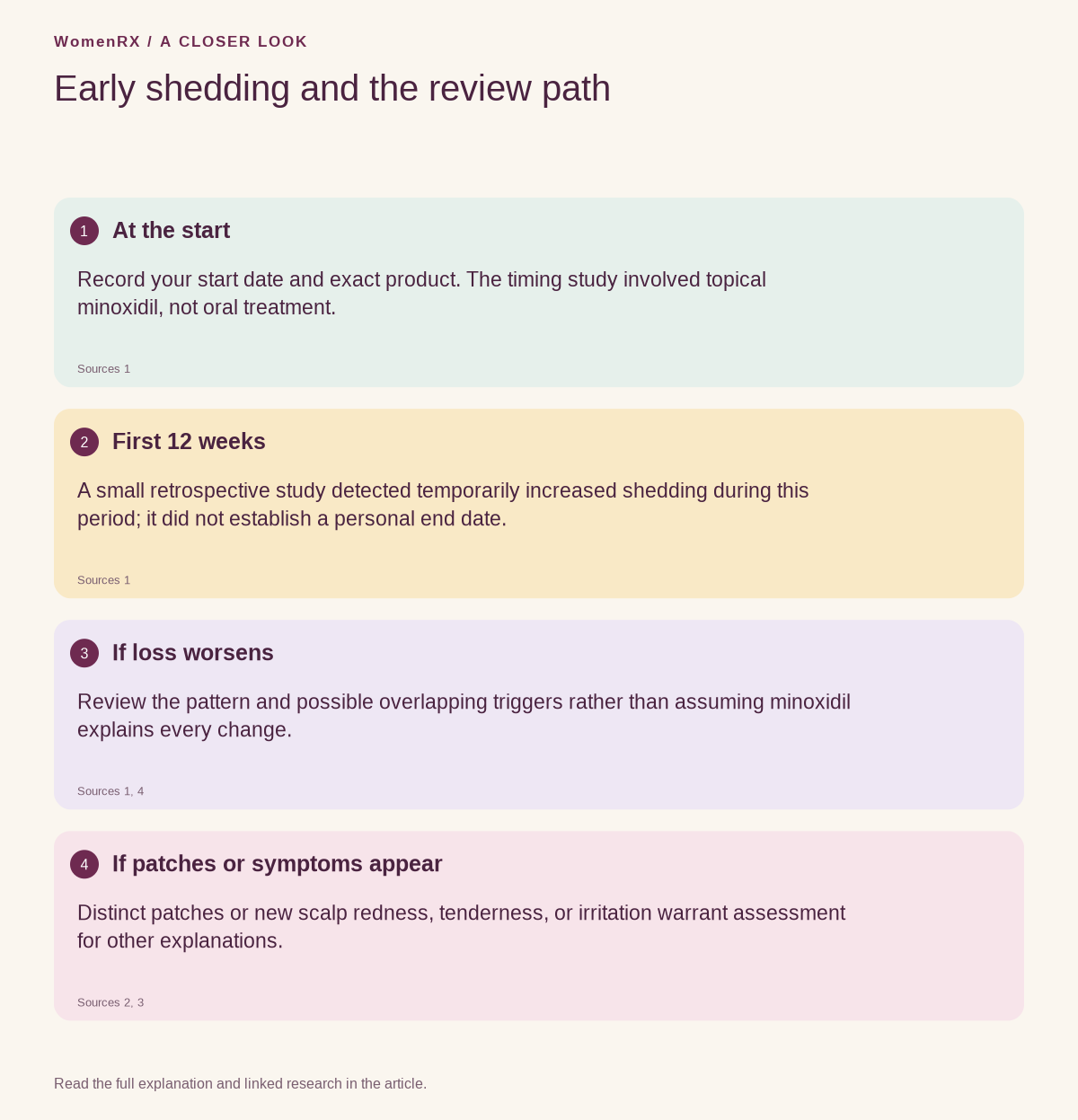
Early shedding and the review path
At the start: Record your start date and exact product. The timing study involved topical minoxidil, not oral treatment.1
First 12 weeks: A small retrospective study detected temporarily increased shedding during this period; it did not establish a personal end date.1
If loss worsens: Review the pattern and possible overlapping triggers rather than assuming minoxidil explains every change.14
If patches or symptoms appear: Distinct patches or new scalp redness, tenderness, or irritation warrant assessment for other explanations.23
Read the figure as text
This timeline separates one topical-minoxidil study’s observation from changes that merit a fresh look, without setting a universal waiting period.- At the start: Record your start date and exact product. The timing study involved topical minoxidil, not oral treatment.1
- First 12 weeks: A small retrospective study detected temporarily increased shedding during this period; it did not establish a personal end date.1
- If loss worsens: Review the pattern and possible overlapping triggers rather than assuming minoxidil explains every change.14
- If patches or symptoms appear: Distinct patches or new scalp redness, tenderness, or irritation warrant assessment for other explanations.23
More questions, answered
Does shedding mean minoxidil is working?
No reliable individual prediction follows from shedding alone. The 49-person retrospective study found associations between some shedding measures and later improvement, but those associations differed by minoxidil strength and outcome measure. 1
Is the early-shedding timeline the same for oral minoxidil?
The first-12-weeks observation was made in people using topical minoxidil. It doesn’t establish a timeline for oral minoxidil, so tell the clinician managing your treatment which form you take. 1
Sources you can check
- Whether the transient hair shedding phase exist after minoxidil treatment and does it predict treatment efficacy? A retrospective study in androgenetic alopecia patients.Bi L, Kan H, Wang J, Ding Y, Huang Y, Wang C, Du Y, Lu C, Zhao M, Sun W, Su T, Fan W. · The Journal of dermatological treatment · 2025Return to first citation
- Characteristics of hair loss in COVID-19 patients in Thailand.Triwongwaranat D, Thanomkitti K, Korviriyakamol T, Saengthong-Aram P, Varothai S, Thuangtong R. · Medicine · 2023Return to first citation
- Lichen Planopilaris Responsive to a Novel Phytoactive Botanical Treatment: A Case Series.Umar S, Kan P, Carter MJ, Shitabata P, Novosilska M. · Dermatology and therapy · 2022Return to first citation
- Use of 5% Topical Minoxidil Application for Telogen Effluvium: An Open-Label Single-Arm Clinical Trial.Ohyama M, Irisawa R, Uchiyama M, Mori M, Aoki K, Ueda Y, Fujita T. · The Journal of dermatology · 2025Return to first citation
- Oral Minoxidil for Alopecia Treatment: Risks, Benefits, and Recommendations.Ong MM, Li Y, Lipner SR. · American journal of clinical dermatology · 2026Return to first citation