More Shedding After Minoxidil: What to Check
A change in shedding after starting minoxidil deserves a closer look at the treatment, your scalp, and what else was happening before you began.
Some people report temporary shedding with oral minoxidil, but shedding after you start treatment isn’t proof that the medicine caused it. Redness, itching, or scaling after topical minoxidil points instead toward a possible scalp reaction. Note when shedding began, whether it’s worsening, your formulation, and any recent illness or childbirth. Contact your prescriber about a scalp reaction, swelling while taking oral minoxidil, or substantial or continuing hair loss. 5321
Start with what changed, and when
A fuller hairbrush soon after starting minoxidil can feel alarming. The first useful comparison is with your own shedding before treatment: Was hair already coming out in the shower? Did shedding increase after the first application, or did you notice it much later? Has it stayed steady, eased, or kept increasing? Write down the date you started, the date you noticed a change, and whether your treatment is a scalp product or a pill.
That history helps, but it doesn’t establish a cause. A review of oral minoxidil reports transient shedding as an adverse effect. It does not give you a reliable start date or a rule for deciding that any particular episode of shedding is harmless. Nor should findings about oral treatment be assumed to describe what happens with a topical product. 5
Check your scalp, not just the fallen hair
If you apply minoxidil to your scalp, look for new itching, redness, or scaling where it goes. Those are common signs in reports of contact dermatitis associated with topical minoxidil. The reaction may involve minoxidil itself or a component of the solution, so switching products on your own may not solve the problem. A clinician can assess the scalp and consider patch testing when an allergy is suspected. 3
Record the product name and whether it’s a solution or foam, along with when the scalp symptoms appeared relative to application. Contact the clinician managing your hair loss if your scalp becomes red, itchy, or scaly. Don’t dismiss those symptoms as a necessary part of getting results. 3
If you take oral minoxidil, mention new peripheral swelling to your prescriber promptly. Peripheral edema is a reported adverse effect of low-dose oral treatment; a scalp-product reaction and a pill-related symptom call for different assessments. 53
Look back before blaming the new treatment
Minoxidil is used for female pattern hair loss, but not every kind of hair fall is pattern hair loss. Illness can cause temporary hair loss, and a few months after childbirth, falling estrogen levels can bring on temporary postpartum shedding, also called telogen effluvium. Postpartum shedding often peaks around four months after birth. If that timing overlaps with the start of minoxidil, the sequence alone cannot tell you which is responsible. 21
Ask yourself whether the original diagnosis was confirmed or whether you began minoxidil because your hair looked thinner. Note any recent illness, childbirth, or change in the pattern of loss. For example, steadily widening part-line thinning and a sudden increase in hairs shed are different observations worth describing, not diagnoses you need to make yourself. If shedding is substantial, continues to worsen, or the reason for your hair loss was never clear, arrange a review rather than assuming you have to wait it out. An assessment can help identify the cause before deciding whether a treatment fits it. 2
Make a decision that fits your situation
If shedding is modest, you feel otherwise well, and your scalp has no new symptoms, keep a brief record of how it changes and raise it with the clinician who recommended minoxidil. That is monitoring, not a test that proves the shedding is normal. If the loss is distressing or clearly increasing, you don’t need to wait for an arbitrary amount of time to ask for help. 2
Pregnancy plans belong in that conversation too. Tell your prescriber if you’re pregnant, planning pregnancy, or breastfeeding, and specify whether you use topical or oral minoxidil. A consensus for hair-transplant patients with pattern hair loss advises avoiding minoxidil during pregnancy and breastfeeding in that setting. An older observational study of topical solution found no apparent increase in adverse pregnancy outcomes, but that finding does not establish that use during pregnancy is safe. 46
The most useful notes are short: when treatment and extra shedding began; which formulation you use; whether loss is easing or worsening; any itching, redness, scaling, or swelling; recent illness or childbirth; and whether your hair-loss diagnosis was confirmed. Those details give you and your clinician a better basis for the next decision than a hair count from one shower. 3512
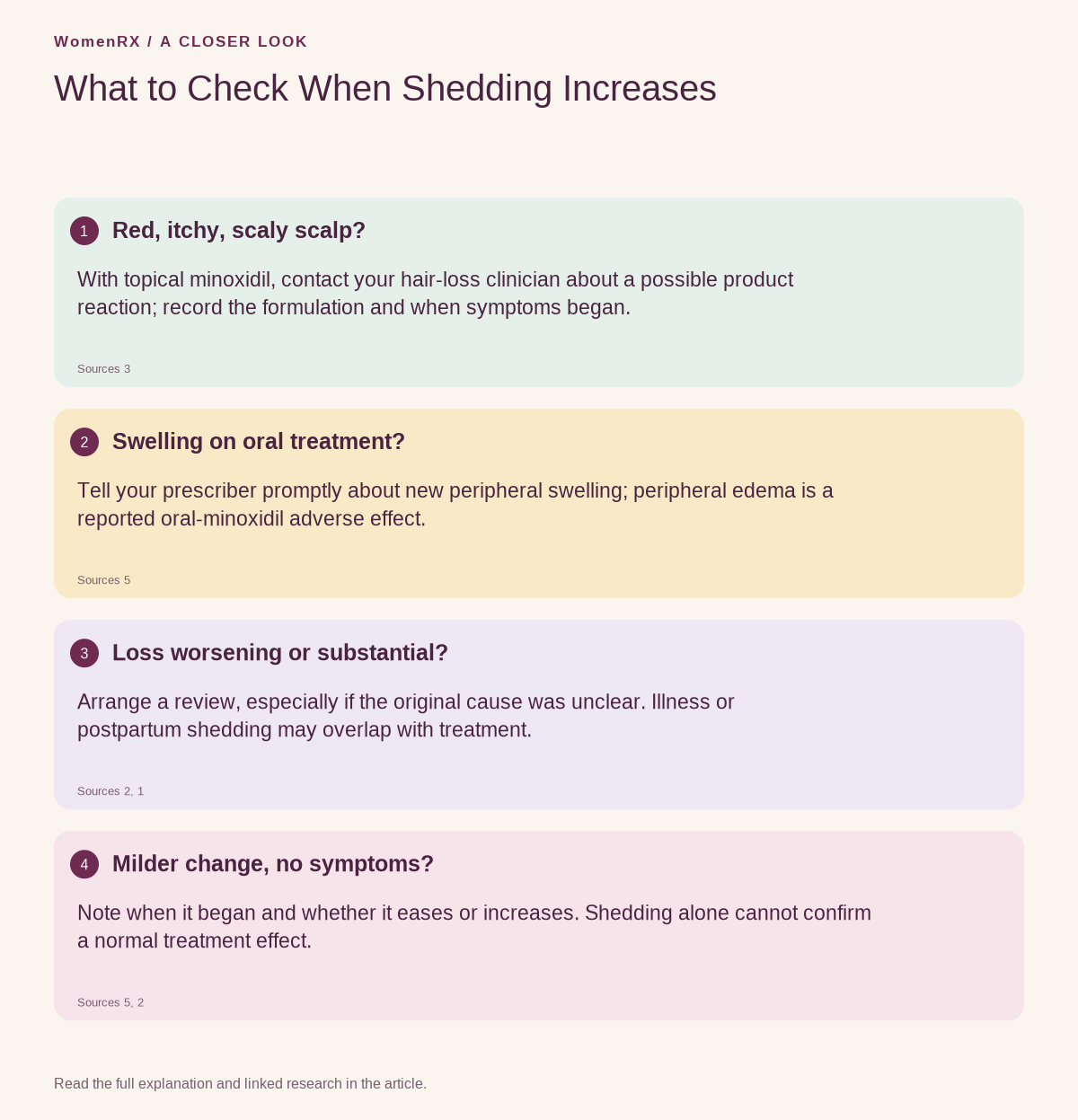
What to Check When Shedding Increases
Red, itchy, scaly scalp?: With topical minoxidil, contact your hair-loss clinician about a possible product reaction; record the formulation and when symptoms began.3
Swelling on oral treatment?: Tell your prescriber promptly about new peripheral swelling; peripheral edema is a reported oral-minoxidil adverse effect.5
Loss worsening or substantial?: Arrange a review, especially if the original cause was unclear. Illness or postpartum shedding may overlap with treatment.21
Milder change, no symptoms?: Note when it began and whether it eases or increases. Shedding alone cannot confirm a normal treatment effect.52
Read the figure as text
Use these branches to choose what to document and when to seek a review. They are not a diagnostic test.- Red, itchy, scaly scalp?: With topical minoxidil, contact your hair-loss clinician about a possible product reaction; record the formulation and when symptoms began.3
- Swelling on oral treatment?: Tell your prescriber promptly about new peripheral swelling; peripheral edema is a reported oral-minoxidil adverse effect.5
- Loss worsening or substantial?: Arrange a review, especially if the original cause was unclear. Illness or postpartum shedding may overlap with treatment.21
- Milder change, no symptoms?: Note when it began and whether it eases or increases. Shedding alone cannot confirm a normal treatment effect.52
More questions, answered
Does extra shedding mean minoxidil is working?
No. Temporary shedding has been reported with oral minoxidil, but shedding by itself cannot show that treatment is working or rule out another cause of hair loss. The pattern over time, your symptoms, and the original diagnosis matter. 52
Could a scalp reaction be caused by something other than minoxidil?
Yes. Reports of allergic contact dermatitis include reactions to minoxidil itself and to ingredients in the product’s vehicle. A clinician can assess whether patch testing would help distinguish them. 3
Sources you can check
- Hair loss in new moms: Dermatologist tipsAccessed 2026-09-25Return to first citation
- Hair loss - NHSAccessed 2026-09-25Return to first citation
- Contact Dermatitis Caused by Topical Minoxidil: Allergy or Just Irritation.Junge A, Radonjic-Hoesli S, Bossart S, Simon D, De Viragh P, Hunger RE, Heidemeyer K, Seyed Jafari SM. · Acta dermato-venereologica · 2025Return to first citation
- Low-dose oral minoxidil (LDOM) and topical minoxidil: consensus recommendations for managing male and female pattern hair loss in hair transplant patients using a modified Delphi process.Gupta AK, Talukder M, Williams G, Abdelhamid H, Akiska YM, Alpeter D, Boden SA, Erfan R, Farjo B, Farjo N, Gabel S, Harris JA, Hekimian KJ, Keene S, Krejci-Manwaring J, Leonard RT,... · Expert opinion on pharmacotherapy · 2026Return to first citation
- Oral Minoxidil for Alopecia Treatment: Risks, Benefits, and Recommendations.Ong MM, Li Y, Lipner SR. · American journal of clinical dermatology · 2026Return to first citation
- Safety of topical minoxidil solution: a one-year, prospective, observational study.Shapiro J. · Journal of cutaneous medicine and surgery · 2003Return to first citation