Minoxidil Side Effects: What Changes by Route
Scalp irritation is a concern with topical minoxidil; oral minoxidil also calls for attention to dizziness, heartbeat changes and swelling.
If you apply minoxidil to your scalp, watch for itching, rash-like irritation or unwanted facial hair. If you take it by mouth, also pay attention to lightheadedness, a faster heartbeat or swelling. Ask a clinician or pharmacist about symptoms that are new, persistent or worsening. Pregnancy, pregnancy planning and breastfeeding call for a separate review of whether and how you use it. 1 2 3
Start with the form you use
Minoxidil comes as a scalp treatment and as an oral medicine. The distinction matters when you’re deciding what a new symptom might mean. Topical minoxidil is more often associated with problems at or near where it’s applied, such as itching, contact dermatitis and unwanted facial hair. Oral minoxidil travels through the body, so its reported effects also include lightheadedness, a faster heartbeat and fluid-related swelling. None of these effects is inevitable. 1
With topical minoxidil, look at your scalp and skin
An itchy, irritated or rash-like area where you apply minoxidil is worth noticing, especially if it persists or worsens. Unwanted facial hair is another reported effect. A review describes low blood pressure or a fast heartbeat as exceedingly rare in healthy people using topical minoxidil, rather than typical topical side effects. 1
If scalp irritation is getting worse or makes the product difficult to use, ask a pharmacist or clinician to review it. Tell them which product you use and where the reaction appears. That’s more useful than assuming every itch is something you have to put up with, or assuming minoxidil must be the cause.
With oral minoxidil, notice changes beyond your hair
Oral minoxidil is used off label for hair loss. Extra hair growth away from the scalp is its most frequently reported adverse effect. Lightheadedness, a faster heartbeat and fluid retention or swelling have also been reported. In studies of low-dose oral use, cardiovascular and fluid-related effects were uncommon overall, but their frequency varied across study groups. 1 2
For perspective, a multicenter study described in a review included 1,404 men and women taking low-dose oral minoxidil for various hair-loss disorders. It reported extra hair growth in 15.1% of patients, lightheadedness in 1.7%, fluid retention in 1.3% and a faster heartbeat in 0.9%. Those are results from that mixed-sex group, not a prediction of an individual woman’s risk; women’s results for the latter three effects were not reported separately in the cited summary. 1
Tell the prescribing clinician about new palpitations, ongoing lightheadedness or swelling, particularly if a symptom persists or worsens. Include when it began and whether it changed after you started oral minoxidil. Your prescriber can consider that timing alongside your health history and other medicines without assuming minoxidil is automatically responsible. 1 2
Pregnancy and breastfeeding are separate decisions
If you’re pregnant or planning pregnancy, review minoxidil use with a qualified professional before starting or continuing it. A review lists pregnancy as a contraindication for oral minoxidil. Don’t treat that oral-use finding as an answer about the safety of a topical product during pregnancy. 2
Breastfeeding calls for a route-specific conversation too. A lactation reference says topical minoxidil may be acceptable once breastfeeding is established, but warns against an infant touching treated skin because the infant could absorb the medicine. It advises particular caution with oral minoxidil, especially while breastfeeding a newborn. Discuss your situation rather than applying the same rule to both forms. 3
What to mention when you ask for advice
Say whether you apply minoxidil or take it by mouth, and describe the change plainly. For example, an itchy patch where you apply a scalp product is a different question from new lightheadedness while taking a tablet. If you take oral minoxidil, have your current medicines and supplements handy and ask the clinician or pharmacist to review them alongside your symptoms. If you’re pregnant, planning pregnancy or breastfeeding, mention that at the start so the discussion addresses the right decision. 1 2 3
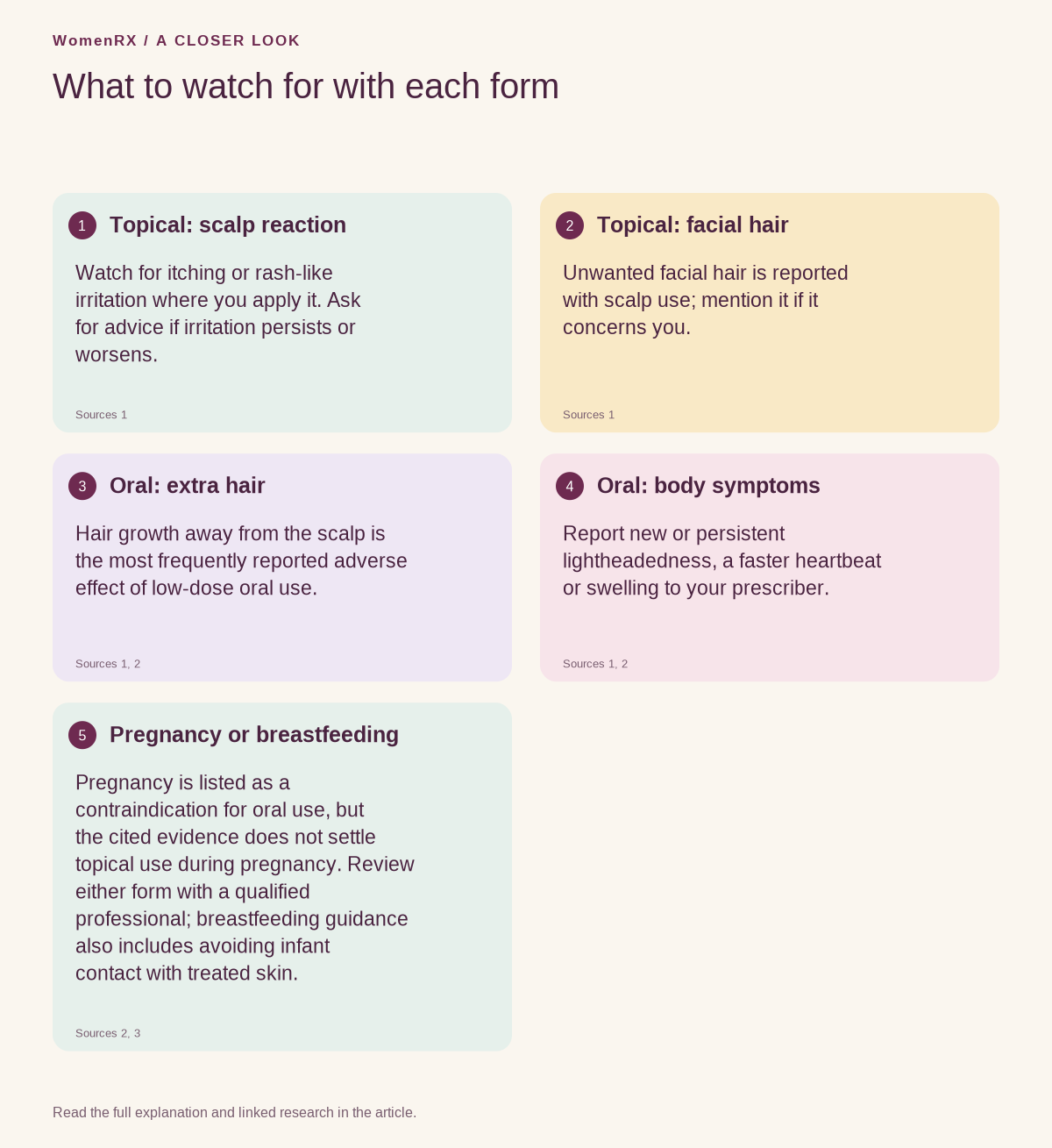
What to watch for with each form
Topical: scalp reaction: Watch for itching or rash-like irritation where you apply it. Ask for advice if irritation persists or worsens.1
Topical: facial hair: Unwanted facial hair is reported with scalp use; mention it if it concerns you.1
Oral: extra hair: Hair growth away from the scalp is the most frequently reported adverse effect of low-dose oral use.12
Oral: body symptoms: Report new or persistent lightheadedness, a faster heartbeat or swelling to your prescriber.12
Pregnancy or breastfeeding: Pregnancy is listed as a contraindication for oral use, but the cited evidence does not settle topical use during pregnancy. Review either form with a qualified professional; breastfeeding guidance also includes avoiding infant contact with treated skin.23
Read the figure as text
The form of minoxidil helps distinguish reported skin concerns from symptoms that warrant a review of oral use.- Topical: scalp reaction: Watch for itching or rash-like irritation where you apply it. Ask for advice if irritation persists or worsens.1
- Topical: facial hair: Unwanted facial hair is reported with scalp use; mention it if it concerns you.1
- Oral: extra hair: Hair growth away from the scalp is the most frequently reported adverse effect of low-dose oral use.12
- Oral: body symptoms: Report new or persistent lightheadedness, a faster heartbeat or swelling to your prescriber.12
- Pregnancy or breastfeeding: Pregnancy is listed as a contraindication for oral use, but the cited evidence does not settle topical use during pregnancy. Review either form with a qualified professional; breastfeeding guidance also includes avoiding infant contact with treated skin.23
Sources you can check
- Expanding the therapeutic landscape of minoxidil for androgenetic alopecia: topical, oral and sublingual formulations.Dias FR, Yong SS, FitzGerald H, Sinclair RD, Bhoyrul B. · Frontiers in pharmacology · 2025Return to first citation
- Oral Minoxidil for Alopecia Treatment: Risks, Benefits, and Recommendations.Ong MM, Li Y, Lipner SR. · American journal of clinical dermatology · 2026Return to first citation
- Minoxidil2006Return to first citation