Estrogen Treatment Side Effects: How Route and Dose Matter
The side effects to watch for depend partly on whether estrogen acts throughout your body or mainly in vaginal tissue, and whether your treatment includes a progestogen.
Systemic estrogen can cause headache, breast tenderness or pain, and nausea; patches may also irritate the skin. Low-dose vaginal estrogen more often causes local irritation or discharge and usually has minimal systemic absorption. The biggest safety distinction is whether you have a uterus: systemic estrogen is generally paired with a progestogen to protect the uterine lining. Unexpected postmenopausal bleeding needs prompt attention. 1 2 4
Start with the route
“Estrogen” can mean treatments with different effects. Pills, patches, gels, and sprays are systemic: they deliver estrogen through the body and may be prescribed for symptoms such as hot flashes. Low-dose vaginal products are intended mainly for symptoms in the vagina and urinary tract, such as dryness or pain with sex. They typically have minimal systemic absorption and may cause local irritation or discharge; they don’t reliably treat hot flashes. 4
For systemic treatment, headache, breast tenderness or pain, and nausea are among the commonly reported effects. What you notice can depend on the product and dose. A patch can also cause a reaction where it sticks to the skin; with a gel or spray, the practical experience is different. These effects aren’t a guarantee that anything is wrong, but persistent or bothersome symptoms are a good reason to ask whether the product, route, or dose should be reviewed. 1 2 4
The details can be very product-specific. For example, in a one-year study of 212 postmenopausal women using the combined Climara Pro patch, treatment-emergent application-site reactions were reported by 40.6%, breast pain by 18.9%, and vaginal bleeding by 36.8%. These reports weren’t necessarily judged to have been caused by treatment, and the figures shouldn’t be applied to other estrogen products or routes. 1
Local treatment and systemic treatment aren’t interchangeable
If your main concern is vaginal or urinary discomfort, low-dose vaginal estrogen is a different option from systemic treatment. Its effects are directed mainly to local tissue, and it usually won’t relieve whole-body symptoms like hot flashes. Local irritation or discharge can happen. Ask whether the product you were prescribed is a low-dose local treatment or a systemic dose, especially if the label or name is unfamiliar. 4
Systemic route can also matter to risk. A review describes transdermal estrogen as having less effect on some liver-related clotting factors and a lower impact on venous clot risk than oral estrogen. That does not mean a patch has no serious risks or is automatically right for you. The major Women’s Health Initiative findings cited in product information came from specific oral estrogen regimens; their exact relevance to other products, doses, and routes isn’t known. 2 4
Your uterus changes the regimen
If you have a uterus and use systemic estrogen, a progestogen is generally added to reduce the risk of estrogen thickening the uterine lining. Estrogen without that protection can increase the risk of endometrial cancer. A progestogen is generally not needed with estrogen after hysterectomy, though a history of endometriosis can be an exception. 2
Estrogen alone and estrogen combined with a progestogen also aren’t the same regimen when considering longer-term risks. In the WHI trials described in product information, the estrogen-plus-progestin and estrogen-alone groups used different specific oral treatments. Those findings can’t establish the precise risks for every formulation or route. Your own history and the reason for treatment matter when weighing benefits and risks. 1 2
Bleeding deserves a clear plan
Unexpected vaginal bleeding after menopause is not a side effect to simply ignore. Product information advises reporting unusual bleeding; persistent or recurring abnormal bleeding may need evaluation to find the cause. This matters particularly if you have a uterus and are using systemic estrogen, because the uterine lining needs protection. 1 2
For other serious concerns, product information identifies blood clots and stroke as risks for some estrogen regimens, but the specific warning signs aren’t the same as routine effects like a mild headache or breast tenderness. Ask your prescriber or pharmacist what symptoms should prompt emergency care for your particular product and health history. 2
Questions that make a medication review useful
Bring the product name or a photo of its label, then ask:
- Is this systemic estrogen or low-dose vaginal estrogen, and which symptoms should it help?
- Could the headache, breast tenderness, nausea, skin reaction, or local irritation I’m noticing fit this product?
- Given my uterus and medical history, should this regimen include a progestogen?
- What bleeding should I report, and what symptoms would mean I need urgent or emergency care?
- If my symptoms are controlled or I’m having side effects, how will we decide whether to adjust the dose or route?
There isn’t one estrogen dose that suits everyone. For transdermal estradiol, dose decisions are generally guided by symptom response and individual treatment goals, rather than one universal blood level. Don’t change a prescribed regimen on your own; ask what adjustment, if any, fits your situation. 3
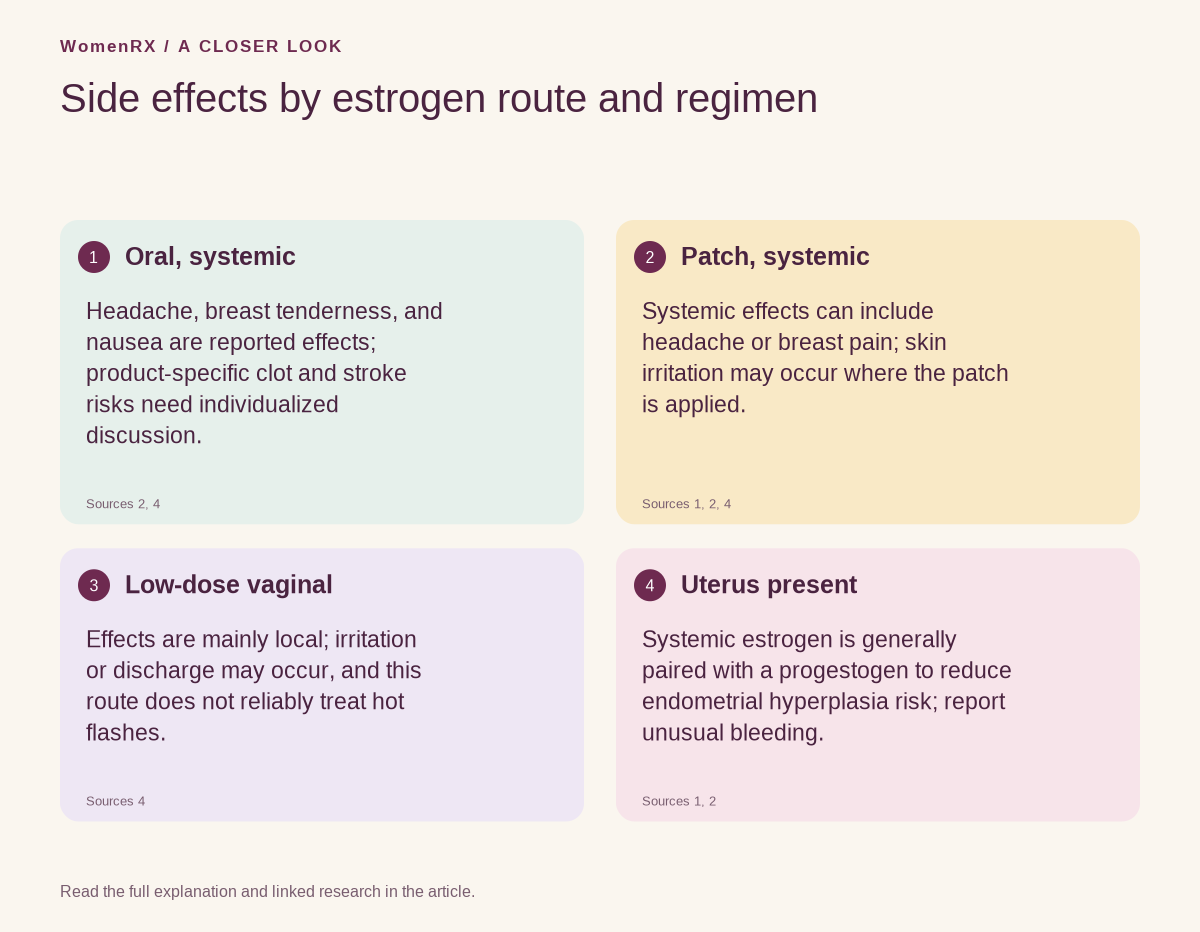
Side effects by estrogen route and regimen
Oral, systemic: Headache, breast tenderness, and nausea are reported effects; product-specific clot and stroke risks need individualized discussion.24
Patch, systemic: Systemic effects can include headache or breast pain; skin irritation may occur where the patch is applied.124
Low-dose vaginal: Effects are mainly local; irritation or discharge may occur, and this route does not reliably treat hot flashes.4
Uterus present: Systemic estrogen is generally paired with a progestogen to reduce endometrial hyperplasia risk; report unusual bleeding.12
Read the figure as text
The route helps explain where effects are most likely to show up; uterine status adds a separate safety consideration for systemic treatment.- Oral, systemic: Headache, breast tenderness, and nausea are reported effects; product-specific clot and stroke risks need individualized discussion.24
- Patch, systemic: Systemic effects can include headache or breast pain; skin irritation may occur where the patch is applied.124
- Low-dose vaginal: Effects are mainly local; irritation or discharge may occur, and this route does not reliably treat hot flashes.4
- Uterus present: Systemic estrogen is generally paired with a progestogen to reduce endometrial hyperplasia risk; report unusual bleeding.12
Sources you can check
- CLIMARA PRO (ESTRADIOL AND LEVONORGESTREL) PATCH [BAYER HEALTHCARE PHARMACEUTICALS INC.] | US prescribing information and patient instructionsAccessed 2026-09-25Return to first citation
- CLIMARA (ESTRADIOL) PATCH [BAYER HEALTHCARE PHARMACEUTICALS INC.] | US prescribing information and patient instructionsAccessed 2026-09-25Return to first citation
- Tailoring transdermal estradiol dose to maximize benefits and minimize risks.Glynne SJ, Simon JA. · Menopause (New York, N.Y.) · 2026Return to first citation
- Menopausal Hormone Therapy-Risks, Benefits and Emerging Options: A Narrative Review.Arnautu AM, Nimigean VR, Nacea-Radu CA, Tilici DM, Paun DL. · International journal of molecular sciences · 2025Return to first citation