How Do Estrogen Risks Depend on Route, Dose, and Health History?
The risk discussion changes with your treatment goal, how estrogen is taken, whether you have a uterus, and when you start.
There isn’t one safety verdict for estrogen therapy. Systemic estrogen taken by mouth has different clot and stroke considerations from estrogen delivered through the skin. Low-dose vaginal estrogen is a treatment option for menopause-related vaginal and urinary symptoms, not a substitute for systemic treatment of hot flashes. Menopause timing, your health history, and whether you have a uterus also shape the discussion. 1 5
Begin with the symptom you want to treat
Estrogen therapy can be used for bothersome hot flashes and night sweats, and hormone therapy can help with menopause-related vaginal and urinary symptoms and prevent bone loss. But the treatment goal matters: systemic therapy is used for symptoms such as hot flashes, while low-dose vaginal estrogen is an option for bothersome genitourinary symptoms when systemic therapy isn’t indicated. These are different treatment contexts, so start by naming the symptoms you want to address. 5
Hormone therapy isn’t recommended to prevent heart disease. If heart protection is the main reason you’re considering estrogen, that’s a different goal from treating menopause symptoms and calls for another discussion. 4
Oral and transdermal estrogen have different risk findings
For blood clots in veins, called venous thromboembolism (VTE), route matters. NICE guidance reports increased VTE risk with oral hormone therapy and no increased risk with transdermal therapy, such as estrogen delivered through the skin. A population-based case-control study also found that transdermal menopausal hormone therapy wasn’t associated with increased pulmonary embolism risk. That study was observational, so it shows an association rather than proving cause and effect. 1 2
Stroke findings also differ by route, but the distinction here is specifically about combined hormone therapy, which includes estrogen and a progestogen. NICE reports that stroke risk is unlikely to increase with combined therapy containing transdermal estrogen, while it increases with combined therapy containing oral estrogen. For oral treatment, the reported increase is greater with higher estrogen doses and longer use, and varies with age when treatment is first started. The guidance’s stroke table applies to people without a personal history of stroke, so it doesn’t settle the question for someone who has had one. 1
Dose belongs in the conversation alongside route. A review reports that VTE risk with oral estrogen may be higher at higher doses than at lower doses. That doesn’t establish a universally safe dose or mean a lower dose removes risk. The aim is to match the treatment to its purpose and consider the dose and route together. 3 4
A uterus changes the systemic-treatment discussion
If you have a uterus, systemic estrogen is generally paired with a progestogen to protect the uterine lining. The regimen matters. NICE reports that breast cancer risk with combined hormone therapy rises with duration of use; its guidance also reports lower risk with sequential combined therapy than with continuous combined therapy, but higher risk than with no hormone therapy. Those breast cancer findings apply to people without a personal history of breast cancer. 1 3
Endometrial findings differ, too. NICE reports that continuous combined therapy decreases endometrial cancer risk, while sequential combined therapy may slightly increase it. The increase may be greater with longer use, fewer days of progestogen in each cycle, or a higher estrogen dose. These differences are one reason the regimen, not just the word “estrogen,” matters. 1
Vaginal estrogen for genitourinary symptoms is a separate option from systemic therapy. The menopause position statement recommends low-dose vaginal estrogen for bothersome symptoms not relieved by over-the-counter treatments in women without an indication for systemic hormone therapy. If you have a personal history that could affect treatment choices, bring it into that discussion rather than assuming that guidance for systemic treatment applies in the same way to vaginal treatment. 5
Timing and health history can shift the balance
For women without contraindications, the North American Menopause Society describes the benefit-risk balance as generally favorable for treating bothersome hot flashes or preventing bone loss when therapy starts before age 60 or within 10 years of menopause onset. Starting later is associated with a less favorable balance because the absolute risks of coronary heart disease, stroke, VTE, and dementia are greater. This is a framework for discussion, not a verdict based on age alone. 5
Your health history matters alongside timing. Cardiovascular disease and estrogen-dependent cancers are examples of conditions that can affect whether hormone therapy is a suitable option. A personal history of stroke also matters when interpreting route-specific stroke findings, because the NICE comparisons cited above don’t cover people with a history of stroke. 1 6
A focused conversation might include: What symptom or goal are we treating? Is this systemic or vaginal estrogen, and is the systemic option oral or transdermal? If I have a uterus, what protects its lining? How do my menopause timing and health history affect the options? If you continue treatment, the menopause position statement recommends periodic reevaluation of its benefits and risks. 5
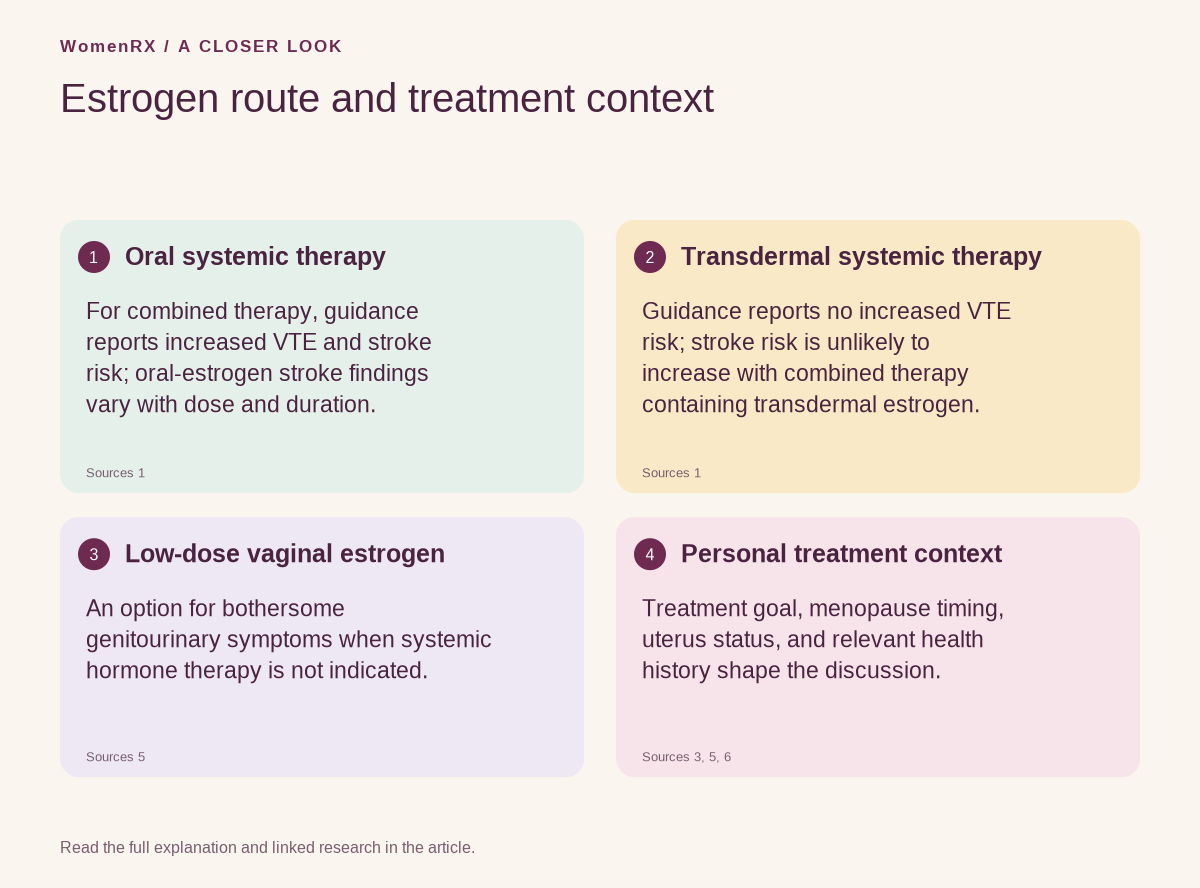
Estrogen route and treatment context
Oral systemic therapy: For combined therapy, guidance reports increased VTE and stroke risk; oral-estrogen stroke findings vary with dose and duration.1
Transdermal systemic therapy: Guidance reports no increased VTE risk; stroke risk is unlikely to increase with combined therapy containing transdermal estrogen.1
Low-dose vaginal estrogen: An option for bothersome genitourinary symptoms when systemic hormone therapy is not indicated.5
Personal treatment context: Treatment goal, menopause timing, uterus status, and relevant health history shape the discussion.356
Read the figure as text
Compare the treatment goal and route first; the clot and stroke findings differ by route and regimen.- Oral systemic therapy: For combined therapy, guidance reports increased VTE and stroke risk; oral-estrogen stroke findings vary with dose and duration.1
- Transdermal systemic therapy: Guidance reports no increased VTE risk; stroke risk is unlikely to increase with combined therapy containing transdermal estrogen.1
- Low-dose vaginal estrogen: An option for bothersome genitourinary symptoms when systemic hormone therapy is not indicated.5
- Personal treatment context: Treatment goal, menopause timing, uterus status, and relevant health history shape the discussion.356
More questions, answered
Should estrogen be used to prevent heart disease?
No. Menopausal hormone therapy shouldn’t be used for primary or secondary prevention of coronary heart disease. Treating symptoms or preventing bone loss is a different goal. 4
Sources you can check
- Recommendations | Menopause: identification and management | Guidance | NICEAccessed 2026-09-25Return to first citation
- Pulmonary embolism in menopausal hormone therapy: a population-based register study.Sundell M, Spetz Holm AC, Fredrikson M, Hammar M, Hoffmann M, Brynhildsen J. · Climacteric : the journal of the International Menopause Society · 2022Return to first citation
- Menopausal hormone therapy and venous thromboembolism.Bińkowska M. · Przeglad menopauzalny = Menopause review · 2014Return to first citation
- Cardiovascular Risk/Benefit Profile of MHT.Villa P, Amar ID, Shachor M, Cipolla C, Ingravalle F, Scambia G. · Medicina (Kaunas, Lithuania) · 2019Return to first citation
- The 2022 hormone therapy position statement of The North American Menopause Society.“The 2022 Hormone Therapy Position Statement of The North American Menopause Society” Advisory Panel. · Menopause (New York, N.Y.) · 2022Return to first citation
- The 2023 nonhormone therapy position statement of The North American Menopause Society.Menopause (New York, N.Y.) · 2023Return to first citation