What side effects can progesterone cream cause?
Progesterone-related effects are possible, but research on cream itself is limited, and the amount absorbed may not be enough to protect the uterine lining.
Progesterone cream may cause effects associated with progesterone, such as breast tenderness, fluid retention, mood changes, dizziness, or drowsiness, but those effects are better documented with other forms and aren’t well quantified for creams. One open study of a specific cream-and-estrogen regimen found low progesterone levels. If you use estrogen and still have a uterus, don’t assume cream protects its lining. 1 4 5
What’s known about side effects
Cream-specific side-effect rates aren’t well established. Effects reported with other progesterone formulations include breast tenderness, fluid retention or swelling, mood changes, dizziness, and drowsiness. These effects don’t show that a cream will cause the same symptoms or that they occur at the same rate. 1 4
The route matters. The dizziness and drowsiness warnings come from prescribing information for oral progesterone capsules, while the review describing breast tenderness, edema, mood changes, and weight gain discusses systemic progesterone therapy more broadly. Neither source establishes how often people using a particular cream experience these effects. 1 4
Skin effects are a separate question. If the skin where you apply the cream becomes irritated, note the product and application area and ask the prescriber or pharmacist whether the cream or its ingredients could be responsible. The study and menopause guidance discussed here don’t report a cream-specific skin-reaction rate or typical pattern.
Menopause symptoms can also overlap with possible hormone side effects, so a new symptom isn’t automatically caused by the cream. Consider when it started and whether it changes with use, and share that pattern with the clinician who recommended the treatment. 2
What one absorption study can tell you
Applying cream to the skin doesn’t tell you how much progesterone reaches the bloodstream or the uterine lining. One open study followed women using a specific regimen of transdermal progesterone cream with transdermal estrogen for 48 weeks. It found low progesterone levels, below luteal-phase levels, and the authors called for more research on the combination’s safety and effectiveness. 5
That study can’t establish how every cream is absorbed or predict the effects of another product or regimen. It also doesn’t establish that the cream studied, or progesterone creams generally, protect the uterine lining during estrogen therapy. A menopause position statement noted that few data support topical progesterone cream and that safety concerns should be considered alongside those for other progestogen preparations. 3
If you use estrogen and have a uterus
Systemic estrogen without an appropriate progestogen can raise the chance of endometrial hyperplasia, a thickening of the uterine lining that can lead to cancer. Prescribing information for oral progesterone describes adding a progestogen for postmenopausal women with a uterus to reduce that risk. It does not establish that a cream provides the same protection. 1
If you’re using estrogen during perimenopause or after menopause and haven’t had a hysterectomy, ask the prescriber to confirm exactly what is intended to protect your uterine lining. Don’t treat a cream as a substitute for an established plan unless the prescriber has specifically confirmed its role. If you’re unsure what product you’re using or what it’s meant to do, bring its label or ingredient information to that conversation.
Some HRT regimens can cause irregular spotting in the first few months. Contact your clinician if bleeding becomes heavier, continues beyond six months after starting HRT, or happens after your periods have stopped. 2
What to do about a possible side effect
Write down the symptom, when it began, and how it relates to applying the cream. That can help distinguish a possible treatment effect from a symptom that started independently. Contact the clinician who recommended it if a symptom is troubling, persistent, or changing, or if you have bleeding that fits the patterns described above. Because cream-specific side-effect evidence is limited, the exact product and your other hormone therapy matter.
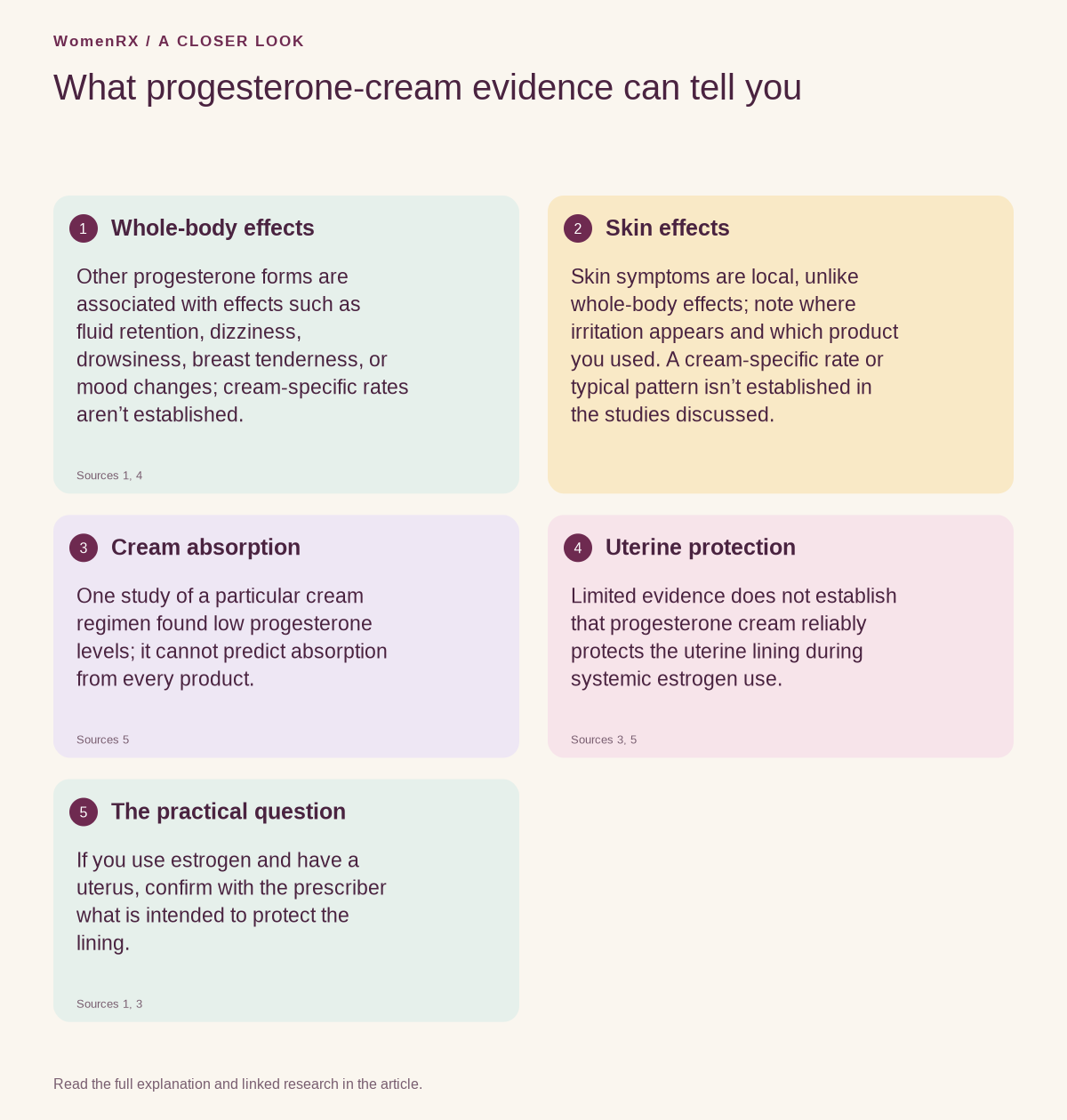
What progesterone-cream evidence can tell you
Whole-body effects: Other progesterone forms are associated with effects such as fluid retention, dizziness, drowsiness, breast tenderness, or mood changes; cream-specific rates aren’t established.14
Skin effects: Skin symptoms are local, unlike whole-body effects; note where irritation appears and which product you used. A cream-specific rate or typical pattern isn’t established in the studies discussed.
Cream absorption: One study of a particular cream regimen found low progesterone levels; it cannot predict absorption from every product.5
Uterine protection: Limited evidence does not establish that progesterone cream reliably protects the uterine lining during systemic estrogen use.35
The practical question: If you use estrogen and have a uterus, confirm with the prescriber what is intended to protect the lining.13
Read the figure as text
Separate effects reported with other progesterone forms from what remains uncertain for creams, especially when estrogen and an intact uterus are involved.- Whole-body effects: Other progesterone forms are associated with effects such as fluid retention, dizziness, drowsiness, breast tenderness, or mood changes; cream-specific rates aren’t established.14
- Skin effects: Skin symptoms are local, unlike whole-body effects; note where irritation appears and which product you used. A cream-specific rate or typical pattern isn’t established in the studies discussed.
- Cream absorption: One study of a particular cream regimen found low progesterone levels; it cannot predict absorption from every product.5
- Uterine protection: Limited evidence does not establish that progesterone cream reliably protects the uterine lining during systemic estrogen use.35
- The practical question: If you use estrogen and have a uterus, confirm with the prescriber what is intended to protect the lining.13
More questions, answered
Does progesterone cream reliably protect the uterine lining when I use estrogen?
The evidence does not establish that progesterone cream reliably protects the lining. One study of a specific cream-and-estrogen regimen found low progesterone levels and called for more research, while a menopause position statement noted limited data for topical cream. If you have a uterus and use systemic estrogen, ask your prescriber to confirm your endometrial-protection plan. 3 5
Sources you can check
- PROMETRIUM (PROGESTERONE) CAPSULE [ACERTIS PHARMACEUTICALS, LLC] | US prescribing information and patient instructionsAccessed 2026-09-25Return to first citation
- Side effects of hormone replacement therapy (HRT) - NHSAccessed 2026-09-25Return to first citation
- Treatment of menopause-associated vasomotor symptoms: position statement of The North American Menopause Society.North American Menopause Society. · Menopause (New York, N.Y.) · 2004Return to first citation
- Benefits of Levonorgestrel Intrauterine Device Use vs. Oral or Transdermal Progesterone for Postmenopausal Women Using Estrogen Containing Hormone Therapy.Clark K, Westberg SM. · Innovations in pharmacy · 2019Return to first citation
- A study to look at hormonal absorption of progesterone cream used in conjunction with transdermal estrogen.Vashisht A, Wadsworth F, Carey A, Carey B, Studd J. · Gynecological endocrinology : the official journal of the International Society of Gynecological Endocrinology · 2005Return to first citation