Does Over-the-Counter Progesterone Cream Provide Reliable Hormone Effects?
A cream may let some progesterone enter the bloodstream, but that alone doesn’t show it will relieve menopause symptoms or protect the uterine lining.
Progesterone cream can be absorbed through skin, but neither the amount absorbed nor the effects of one formulation establish reliable results for every product. 2 3 In a review of three trials, vaginal bleeding and headaches were the most commonly reported side effects; the authors described reported effects as mild and self-limiting. These short studies can’t establish long-term or product-wide safety. 4
A progesterone cream’s listed content, the amount that crosses the skin, and whether it produces a particular health effect are three different questions. Evidence for one doesn’t answer the others. A product can contain progesterone and lead to some absorption without proven relief for hot flashes or proven protection of the uterine lining.
Absorption isn’t the same as a clinical effect
In a randomized trial, 80 postmenopausal women used progesterone cream containing 32 mg daily or a placebo for 12 weeks. The progesterone group had a slight rise in blood progesterone, but the study detected no improvement in vasomotor symptoms, mood, sexual feelings, blood lipids, or bone markers. This trial tested one formulation and timeframe, not every cream on the market. 2
A separate randomized study tested a 2% cream in 40 peri- and postmenopausal women for 16 weeks. It found a small increase in mean blood progesterone and studied skin measures, including elasticity and firmness. That finding shows that absorption can happen; it does not demonstrate relief of menopause symptoms or protection from estrogen’s effects on the uterine lining. 3
A blood level, even when it changes, is therefore not a stand-in for a demonstrated health benefit. Nor do results from one study formulation tell you how much of another product reaches the bloodstream.
What the hot-flash evidence says
A systematic review identified three randomized trials of progesterone cream for menopause-related vasomotor symptoms. One trial using a cream specially compounded for the study reported more benefit than placebo; two trials of manufactured creams did not. The review concluded that the available trial evidence did not support progesterone cream for managing hot flashes. 4
That mixed result doesn’t prove that no cream could ever help. It does mean the evidence doesn’t show consistent, dependable relief across the creams studied. Don’t assume that a label stating a progesterone amount, or the word “bioidentical,” predicts a reliable symptom effect.
What’s known about side effects and safety
Short-term trial reports offer some information, but not a general safety guarantee. A review of three randomized trials reported vaginal bleeding and headaches as the most common side effects, describing the reported adverse effects as mild and self-limiting. In a separate 16-week trial of 2% cream involving 40 peri- and postmenopausal women, no serious side effects were observed. 4 3
Those findings apply to the small groups and particular formulations studied. They don’t establish the safety of every nonprescription cream, or what may happen with longer use. And a finding about side effects is separate from the question of whether a cream protects the uterine lining during estrogen therapy.
Estrogen use is a separate question
If you use systemic estrogen, whether a progesterone cream provides enough protection for your particular situation is not answered by knowing that progesterone is present in the product or detectable in blood. The cream trials discussed above did not establish endometrial protection. The North American Menopause Society says hormone therapy should be individualized; its position statement also identifies whether a progestogen is used as one factor affecting hormone therapy risks. 1
If you’re considering a cream while using estrogen, ask the clinician managing your hormone therapy to confirm what plan is intended for you. Don’t treat an over-the-counter cream as proven protection based only on its label or on evidence that some absorption occurs.
A useful way to evaluate the claim
Ask what specific outcome the claim is about: hot-flash relief, a blood hormone level, a skin effect, side effects, or protection of the uterine lining. Then ask whether a study measured that outcome using the same formulation. For progesterone cream, the available evidence gives different answers to different questions: absorption has been observed, skin effects were studied in one small trial, hot-flash results were inconsistent, reported short-term side effects were limited in the trials, and endometrial protection was not established by these studies. 2 3 4
So the most accurate takeaway is not that progesterone cream can have no effect. It’s that absorption alone doesn’t demonstrate a dependable menopause benefit, and limited short-term side-effect reports don’t establish overall safety. Evidence for one outcome shouldn’t be used to imply another.
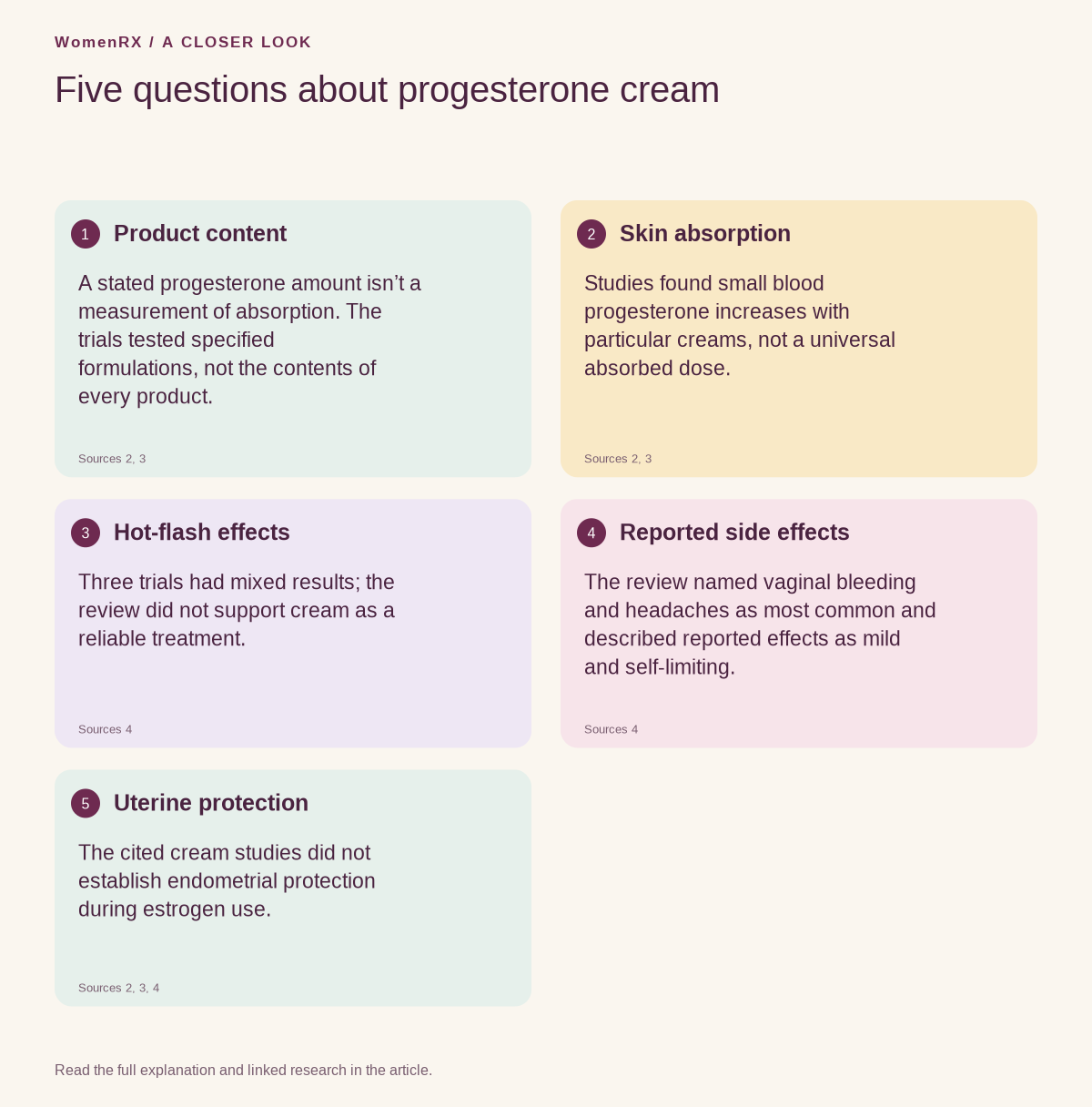
Five questions about progesterone cream
Product content: A stated progesterone amount isn’t a measurement of absorption. The trials tested specified formulations, not the contents of every product.23
Skin absorption: Studies found small blood progesterone increases with particular creams, not a universal absorbed dose.23
Hot-flash effects: Three trials had mixed results; the review did not support cream as a reliable treatment.4
Reported side effects: The review named vaginal bleeding and headaches as most common and described reported effects as mild and self-limiting.4
Uterine protection: The cited cream studies did not establish endometrial protection during estrogen use.234
Read the figure as text
Separate what a product contains from what studies show about absorption, outcomes, and safety.- Product content: A stated progesterone amount isn’t a measurement of absorption. The trials tested specified formulations, not the contents of every product.23
- Skin absorption: Studies found small blood progesterone increases with particular creams, not a universal absorbed dose.23
- Hot-flash effects: Three trials had mixed results; the review did not support cream as a reliable treatment.4
- Reported side effects: The review named vaginal bleeding and headaches as most common and described reported effects as mild and self-limiting.4
- Uterine protection: The cited cream studies did not establish endometrial protection during estrogen use.234
Sources you can check
- The 2022 hormone therapy position statement of The North American Menopause Society.“The 2022 Hormone Therapy Position Statement of The North American Menopause Society” Advisory Panel. · Menopause (New York, N.Y.) · 2022Return to first citation
- Transdermal progesterone and its effect on vasomotor symptoms, blood lipid levels, bone metabolic markers, moods, and quality of life for postmenopausal women.Wren BG, Champion SM, Willetts K, Manga RZ, Eden JA. · Menopause (New York, N.Y.) · 2003Return to first citation
- Effects and side-effects of 2% progesterone cream on the skin of peri- and postmenopausal women: results from a double-blind, vehicle-controlled, randomized study.Holzer G, Riegler E, Hönigsmann H, Farokhnia S, Schmidt JB. · The British journal of dermatology · 2005Return to first citation
- Bioidentical progesterone cream for menopause-related vasomotor symptoms: is it effective?Whelan AM, Jurgens TM, Trinacty M. · The Annals of pharmacotherapy · 2013Return to first citation