Reading a Bioidentical Hormone Cream Label
The label describes the hormones being marketed, but it doesn’t tell you whether a cream is FDA-approved, well-studied, or right for your menopause symptoms.
In menopause marketing, “bioidentical” is used for hormones described as similar to those present before menopause. Some FDA-approved menopause medicines use bioidentical hormones, so the term doesn’t mean a product is compounded. A cream’s label alone doesn’t establish its approval status or prove its safety or effectiveness. Ask what the exact product is and what evidence supports it. 2 3
The label and the product are different questions
“Bioidentical” is used in menopause care to describe hormones similar to those present before menopause. The word by itself doesn’t tell you how a product is made or whether it’s compounded. FDA-approved menopause medicines can use bioidentical hormones, synthetic hormones, or both, so “bioidentical” and “compounded” aren’t interchangeable terms. 2 3
That distinction matters because the word can sound like a promise of something more natural, safer, or more effective. The American College of Obstetricians and Gynecologists (ACOG) says evidence does not support marketing claims that compounded bioidentical menopause therapy is safer or more effective than FDA-approved options. 2
“Cream” doesn’t answer whether it’s been studied
Cream describes a product’s form. It doesn’t tell you whether a specific preparation is FDA-approved or custom-compounded, or what evidence supports that exact product. Compounded medicines are prepared for an individual prescription; that doesn’t make them inherently safer or more effective. 2 4
ACOG advises against routinely prescribing compounded bioidentical menopause therapy when FDA-approved formulations exist. If you’re considering a compounded product, ACOG recommends discussing its lack of FDA approval and its potential risks and benefits. The organization also says high-quality trials comparing custom-compounded products with approved therapy, with long-term follow-up, are needed. 2
This is a product-specific distinction, not a claim that every approved treatment suits every person. FDA-approved products have product labeling, while the evidence behind hormone therapy overall shouldn’t be treated as proof that a particular compounded cream works the same way. 1 3
What hormone therapy evidence can tell you
For menopause hormone therapy overall, the North American Menopause Society identifies it as the most effective treatment for hot flashes and night sweats, and for genitourinary symptoms of menopause. But its benefit-risk balance varies with the type of hormone, dose, duration, route, timing of starting treatment, and whether a progestogen is used. Those general findings don’t establish the benefits or risks of every cream or custom formulation. 1
Whether treatment is a reasonable option for you also depends on your circumstances, including your age, time since menopause, health history, symptoms, and preferences. A label can’t make that decision. 1
Questions that make a product conversation clearer
You might ask:
- What are the active hormones in this product, and what symptoms is it intended to treat?
- Is this exact product FDA-approved, or is it custom-compounded?
- What evidence supports this specific cream, rather than hormone therapy in general?
- If it’s compounded, why wouldn’t an FDA-approved formulation meet my needs?
- How do my health history and the type of hormone therapy affect the benefits and risks for me?
The most useful takeaway is simple: ask separately about the hormone, the product, and its fit for you. “Bioidentical” may describe how the hormones are being characterized, but it can’t stand in for product-specific evidence or an individualized treatment discussion. 1 2 3
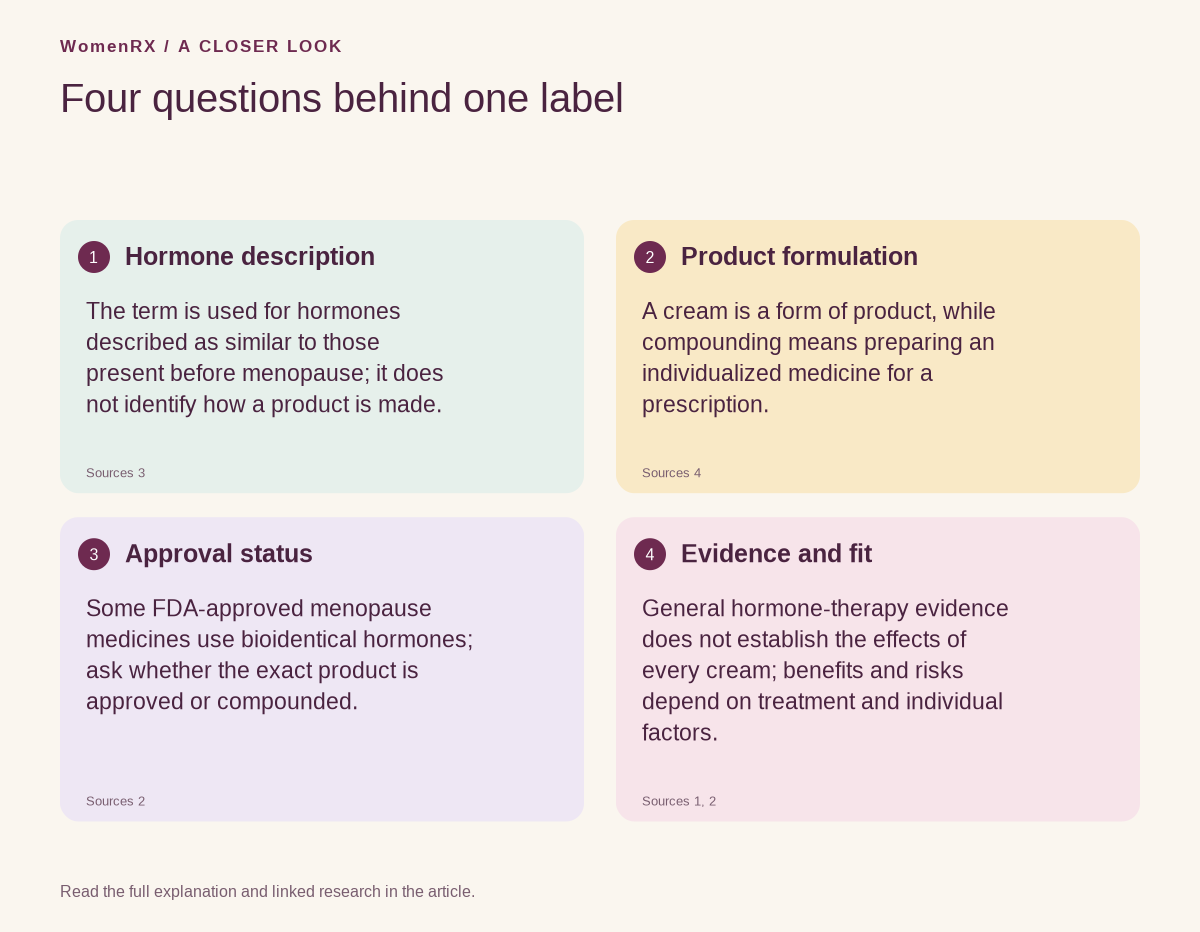
Four questions behind one label
Hormone description: The term is used for hormones described as similar to those present before menopause; it does not identify how a product is made.3
Product formulation: A cream is a form of product, while compounding means preparing an individualized medicine for a prescription.4
Approval status: Some FDA-approved menopause medicines use bioidentical hormones; ask whether the exact product is approved or compounded.2
Evidence and fit: General hormone-therapy evidence does not establish the effects of every cream; benefits and risks depend on treatment and individual factors.12
Read the figure as text
Separate what “bioidentical” describes from a cream’s formulation, approval status, evidence, and personal fit.- Hormone description: The term is used for hormones described as similar to those present before menopause; it does not identify how a product is made.3
- Product formulation: A cream is a form of product, while compounding means preparing an individualized medicine for a prescription.4
- Approval status: Some FDA-approved menopause medicines use bioidentical hormones; ask whether the exact product is approved or compounded.2
- Evidence and fit: General hormone-therapy evidence does not establish the effects of every cream; benefits and risks depend on treatment and individual factors.12
More questions, answered
Can a bioidentical hormone be part of an FDA-approved menopause medicine?
Yes. ACOG notes that FDA-approved menopause medicines can use bioidentical hormones, synthetic hormones, or both. “Bioidentical” alone doesn’t tell you whether a product is approved or compounded. 2
Does “bioidentical” mean a cream is safer or more effective?
No. ACOG says evidence doesn’t support marketing claims that compounded bioidentical menopause therapy is safer or more effective than FDA-approved options. The label alone can’t establish how a specific cream performs. 2
Sources you can check
- The 2022 hormone therapy position statement of The North American Menopause Society.“The 2022 Hormone Therapy Position Statement of The North American Menopause Society” Advisory Panel. · Menopause (New York, N.Y.) · 2022Return to first citation
- Compounded Bioidentical Menopausal Hormone Therapy: ACOG Clinical Consensus No. 6.Obstetrics and gynecology · 2023Return to first citation
- Concerns About Compounded Bioidentical Menopausal Hormone Therapy.Pinkerton JV. · Cancer journal (Sudbury, Mass.) · 2022Return to first citation
- Compounded bioidentical menopausal hormone therapy.American College of Obstetricians and Gynecologists Committee on Gynecologic Practice, American Society for Reproductive Medicine Practice Committee. · Fertility and sterility · 2012Return to first citation