How to Assess Claims About “Bioidentical” Progesterone Cream
“Bioidentical” describes a hormone’s chemical identity, not proof that a cream works, is consistently made, or is safer.
Before buying, identify the exact active ingredient and amount, how the product is used, and whether it’s an FDA-approved finished drug, a compounded prescription, or a nonprescription product. “Bioidentical” may describe chemical identity, but it doesn’t establish that a particular cream is effective or safe. Evidence from mixed topical hormone formulas can’t tell you what progesterone-only cream does. 1 3 4
Start with what’s actually in the product
“Bioidentical” is a description of a hormone, not a quality or effectiveness rating for the product that contains it. For example, the prescribing information for oral micronized progesterone says its progesterone is chemically identical to progesterone of human ovarian origin. That identifies the molecule in that capsule. It doesn’t establish that a cream has the same formulation, effects, or evidence. 1
Before buying, find out the exact active ingredient, amount, route of use, and product category. Is it an FDA-approved finished drug, a prescription prepared by a compounding pharmacy, or a nonprescription product? Those labels aren’t interchangeable. “Natural,” “customized,” or “bioidentical” doesn’t answer what the product is or what evidence supports its use.
The National Academies describes FDA-approved hormone products as having been reviewed for safety and effectiveness, and compounded hormones as custom-formulated alternatives. That distinction doesn’t mean every compounded preparation is harmful. It does mean you shouldn’t assume a compounded cream has the same product-specific review or evidence as an FDA-approved finished drug. 3
Match the evidence to the reason you’d use it
A claim about hot flashes, sleep, or mood needs evidence for that intended use and a product sufficiently like the one being sold. The relevant study in postmenopausal women was a prospective observational cohort, not a controlled trial of progesterone-only cream. It included 200 people: 160 used topical compounded hormones and 40 used sublingual compounded hormones. In the topical group, 99% received progesterone and 43% also received estrogen. 4
The topical group reported no significant symptom reductions at one to three months, and reductions in only some symptoms at three to six months. The study did include a comparison between topical and sublingual groups, but the abstract reports no placebo or untreated group. Because the formulas varied and almost half the topical group also received estrogen, the results can’t isolate an effect of progesterone-only cream. They also don’t establish that such a cream does or doesn’t relieve menopause symptoms. 4
That’s a useful distinction when reading a seller’s claim: evidence about oral progesterone, sublingual hormones, or a mixture of hormones doesn’t automatically apply to a topical progesterone-only product.
Ask a separate question if you use systemic estrogen
Symptom relief and protection of the uterine lining are different intended uses. A review describes progesterone as helping prevent estrogen-related endometrial hyperplasia. But that general statement doesn’t show that a particular cream, used in a particular way, provides enough protection. A separate review raises concern about possible estrogen-progestogen imbalance with compounded therapy. Ask what evidence supports the exact product and route for uterine protection, rather than relying on the word “progesterone.” 5 6
The form matters, too. The oral micronized progesterone capsule described in prescribing information is not a cream, so its product information can’t establish how a topical product performs. Menopause hormone therapy decisions also depend on factors such as the product, route, dose, duration, timing, and whether a progestogen is used. 1 2
A practical check before you buy
- Identify the product category. Get a clear answer about whether it’s an FDA-approved finished drug, a compounded prescription, or a nonprescription product. If the seller’s description doesn’t make that clear, don’t treat “bioidentical” as a substitute for the answer. 3
- Write down the active ingredient and amount. Check the label or ask the seller or pharmacist. A hormone’s chemical identity doesn’t tell you whether the product’s formulation or route has evidence for your intended use. 1 3
- Match the evidence to the claim. Ask whether evidence is for this product and route, and whether it studied progesterone alone or a combination. The observational study of topical compounded hormones included varied regimens, often with progesterone and sometimes estrogen. 4
- Separate symptom treatment from uterine protection. If you’re considering progesterone with systemic estrogen, ask what evidence supports the specific product and route for protecting the uterine lining. General information about progesterone isn’t proof about a particular cream. 5 6
- Treat broad safety promises as claims to verify. Chemical identity doesn’t prove a product is safer, more effective, or consistently formulated. Ask what evidence supports the specific claim, not just the appealing label. 1 3
A focused question for the person recommending the product is: “What is this exact cream intended to do, and what evidence supports this ingredient, formulation, and route for that use?”
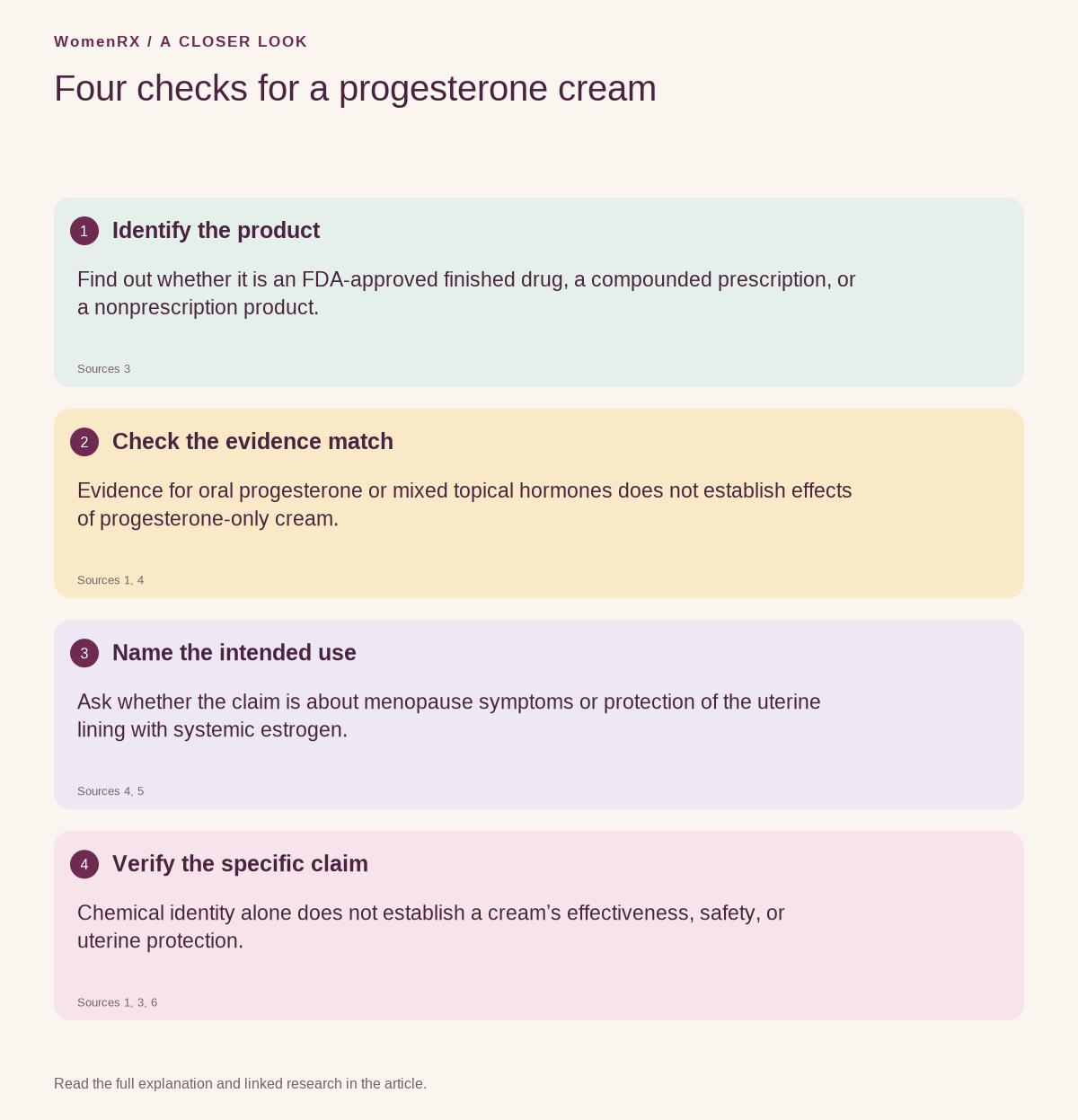
Four checks for a progesterone cream
Identify the product: Find out whether it is an FDA-approved finished drug, a compounded prescription, or a nonprescription product.3
Check the evidence match: Evidence for oral progesterone or mixed topical hormones does not establish effects of progesterone-only cream.14
Name the intended use: Ask whether the claim is about menopause symptoms or protection of the uterine lining with systemic estrogen.45
Verify the specific claim: Chemical identity alone does not establish a cream’s effectiveness, safety, or uterine protection.136
Read the figure as text
Use these questions to separate product identity and category from evidence for the intended use.- Identify the product: Find out whether it is an FDA-approved finished drug, a compounded prescription, or a nonprescription product.3
- Check the evidence match: Evidence for oral progesterone or mixed topical hormones does not establish effects of progesterone-only cream.14
- Name the intended use: Ask whether the claim is about menopause symptoms or protection of the uterine lining with systemic estrogen.45
- Verify the specific claim: Chemical identity alone does not establish a cream’s effectiveness, safety, or uterine protection.136
Sources you can check
- PROMETRIUM (PROGESTERONE) CAPSULE [ACERTIS PHARMACEUTICALS, LLC] | US prescribing information and patient instructionsAccessed 2026-09-25Return to first citation
- The 2022 hormone therapy position statement of The North American Menopause Society.“The 2022 Hormone Therapy Position Statement of The North American Menopause Society” Advisory Panel. · Menopause (New York, N.Y.) · 2022Return to first citation
- The Clinical Utility of Compounded Bioidentical Hormone Therapy: A Review of Safety, Effectiveness, and UseNational Academies of Sciences, Engineering, and Medicine; Health and Medicine Division; Board on Health Sciences Policy; Committee on the Clinical Utility of Treating Patients wit... · 2020Return to first citation
- The effectiveness of sublingual and topical compounded bioidentical hormone replacement therapy in postmenopausal women: an observational cohort study.Ruiz AD, Daniels KR. · International journal of pharmaceutical compounding · 2014Return to first citation
- Evidence on the use of progesterone in menopausal hormone therapy.Mirkin S. · Climacteric : the journal of the International Menopause Society · 2018Return to first citation
- Custom-compounded bioidentical hormone therapy: why so popular despite potential harm? The case against routine use.L'Hermite M. · Climacteric : the journal of the International Menopause Society · 2017Return to first citation