Hormone Therapy: What Bioidentical Does and Doesn’t Mean
“Bioidentical” describes a hormone’s molecular identity, not whether a product is FDA-approved, compounded, or better suited to your menopause symptoms.
Some FDA-approved menopause medicines contain hormones described as bioidentical, including estradiol and micronized progesterone. Compounded products can also contain hormones described that way, but they are not FDA-approved drug products and have less established product-specific evidence and labeling. When discussing treatment, separate what hormone it is from how it’s made, what it’s approved for, and what symptoms you want to treat. 2 4 6
“Bioidentical” describes the molecule, not the medicine
The term means that a hormone is chemically identical to a hormone made in the body. It doesn’t tell you whether a product is FDA-approved, how it’s prepared, or how much evidence supports that particular formulation. A hormone may be made from a plant-derived starting material and still be chemically identical to its human counterpart; that doesn’t make the finished product a plant remedy. 2
Some regulated menopause medicines contain bioidentical hormones. For example, Prometrium is an oral product containing micronized progesterone, and Bijuva combines estradiol with progesterone. The prescribing information for Prometrium describes its progesterone as chemically identical to progesterone of ovarian origin. 1 2 Bijuva was studied as a treatment for moderate-to-severe menopause-related hot flashes in postmenopausal women with a uterus. 1 6
So “bioidentical” and “compounded” aren’t synonyms. A product can be bioidentical and FDA-approved, or it can be compounded and contain hormones described as bioidentical.
What changes when a product is compounded?
Compounded hormones are prepared by a pharmacy rather than sold as an FDA-approved drug product. Compounding may be considered when an approved medicine can’t meet a particular formulation or dosing need, or when a patient has an allergy to an ingredient in an available product. But the word “custom” doesn’t by itself show that a preparation is more accurate, safer, or more effective for you. 4
The practical difference is the evidence attached to the finished product. Approved hormone medicines have product-specific prescribing information, and some have clinical trial data for particular symptoms and populations. Reviews of compounded bioidentical hormone therapy describe gaps in product-specific pharmacokinetic, safety, and efficacy data and in consistent risk labeling. That makes it harder to know whether the dose and effects of a compounded preparation match what you expect. 1 4 5
This isn’t a claim that every compounded preparation causes harm, or that every approved medicine is right for every woman. It means the word “bioidentical” can’t fill in evidence that hasn’t been established for a particular compounded product. Hormone therapy’s risks and benefits vary with factors such as hormone type, route, timing, duration, and whether a progestogen is used. 3
Match the discussion to your symptoms and uterus status
For bothersome hot flashes and night sweats, hormone therapy is the most effective treatment, according to the North American Menopause Society. The balance of benefits and risks depends on your circumstances, including your age and how long it has been since menopause began. 3
If vaginal or urinary symptoms are the main concern, that’s a different treatment question. For bothersome genitourinary symptoms not relieved by over-the-counter options, the Society recommends considering low-dose vaginal estrogen or other therapies for women without a reason to use systemic hormone therapy. 3 A treatment designed for local symptoms isn’t interchangeable with a product intended to treat hot flashes throughout the body.
Uterus status matters when discussing systemic estrogen because the uterine lining may need protection. Prometrium’s prescribing information includes prevention of endometrial hyperplasia in non-hysterectomized postmenopausal women receiving conjugated estrogens as an indication. In a trial lasting up to 36 months in postmenopausal women with an intact uterus, hyperplasia was reported in 6% of women receiving progesterone with conjugated estrogen, compared with 64% receiving conjugated estrogen alone. Those results apply to the studied regimen, not automatically to every hormone product or route. 2
A useful conversation separates four questions: What symptom are you treating? Is the proposed hormone systemic or local? Is the product an approved medicine or a compounded preparation? And, if systemic estrogen is being considered, how does your uterus status affect the plan? These questions are more informative than asking whether a product is simply “natural” or “bioidentical.”
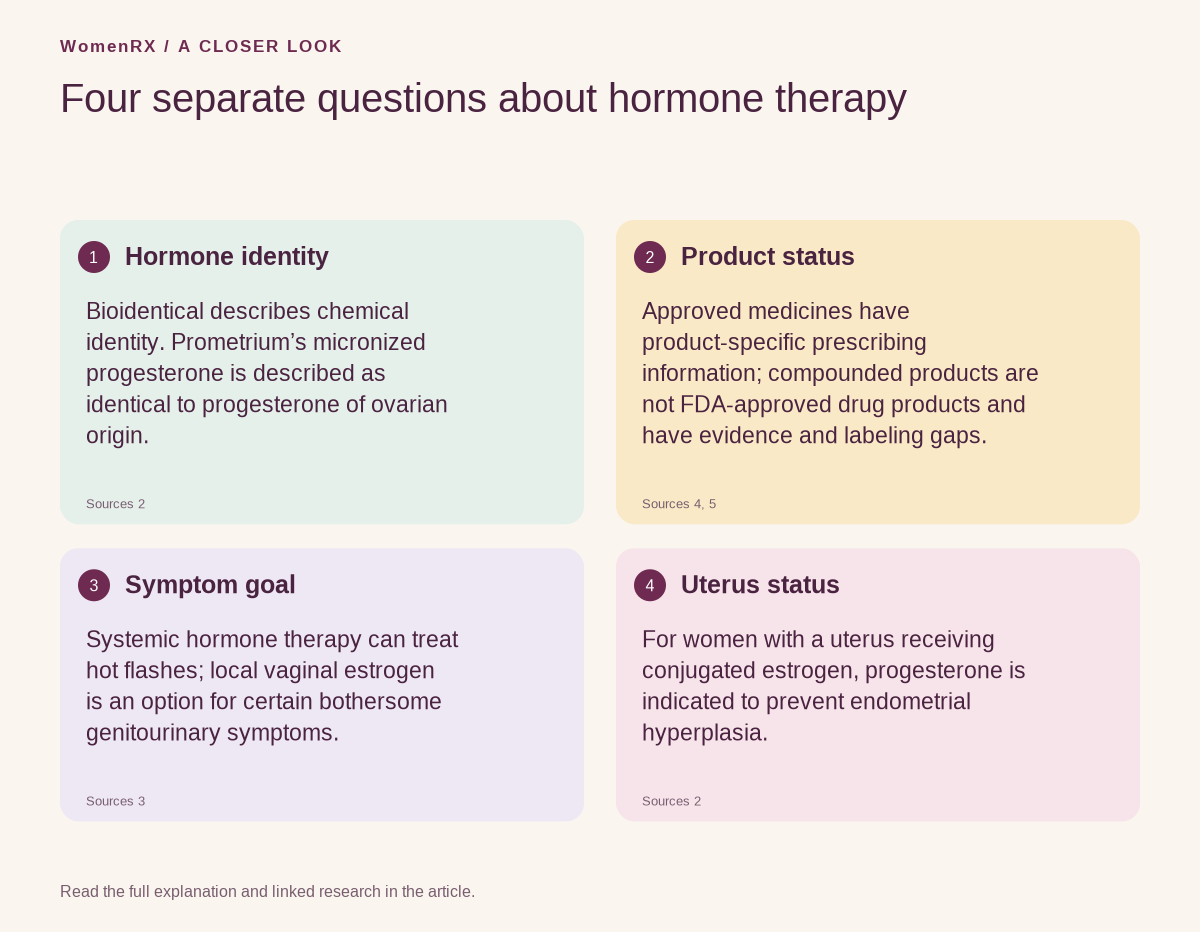
Four separate questions about hormone therapy
Hormone identity: Bioidentical describes chemical identity. Prometrium’s micronized progesterone is described as identical to progesterone of ovarian origin.2
Product status: Approved medicines have product-specific prescribing information; compounded products are not FDA-approved drug products and have evidence and labeling gaps.45
Symptom goal: Systemic hormone therapy can treat hot flashes; local vaginal estrogen is an option for certain bothersome genitourinary symptoms.3
Uterus status: For women with a uterus receiving conjugated estrogen, progesterone is indicated to prevent endometrial hyperplasia.2
Read the figure as text
“Bioidentical” answers only what a hormone is like at the molecular level. These distinctions help put product and treatment choices in context.- Hormone identity: Bioidentical describes chemical identity. Prometrium’s micronized progesterone is described as identical to progesterone of ovarian origin.2
- Product status: Approved medicines have product-specific prescribing information; compounded products are not FDA-approved drug products and have evidence and labeling gaps.45
- Symptom goal: Systemic hormone therapy can treat hot flashes; local vaginal estrogen is an option for certain bothersome genitourinary symptoms.3
- Uterus status: For women with a uterus receiving conjugated estrogen, progesterone is indicated to prevent endometrial hyperplasia.2
More questions, answered
Does “bioidentical” mean a hormone is safer?
No. The word describes molecular identity, not safety. Risks depend on the specific product and factors such as route, timing, duration, and whether a progestogen is used. Compounded products shouldn’t be assumed safer just because they’re called bioidentical. 3 4
Can an FDA-approved product still be bioidentical?
Yes. The term isn’t limited to compounded products. Prometrium contains micronized progesterone described as chemically identical to ovarian progesterone, and Bijuva combines estradiol and progesterone. 1 2
Sources you can check
- BIJUVA (ESTRADIOL AND PROGESTERONE) CAPSULE [MAYNE PHARMA] | US prescribing information and patient instructionsAccessed 2026-09-25Return to first citation
- PROMETRIUM (PROGESTERONE) CAPSULE [ACERTIS PHARMACEUTICALS, LLC] | US prescribing information and patient instructionsAccessed 2026-09-25Return to first citation
- The 2022 hormone therapy position statement of The North American Menopause Society.“The 2022 Hormone Therapy Position Statement of The North American Menopause Society” Advisory Panel. · Menopause (New York, N.Y.) · 2022Return to first citation
- Concerns About Compounded Bioidentical Menopausal Hormone Therapy.Pinkerton JV. · Cancer journal (Sudbury, Mass.) · 2022Return to first citation
- Compounded bioidentical menopausal hormone therapy - a physician perspective.Stuenkel CA. · Climacteric : the journal of the International Menopause Society · 2021Return to first citation
- Bioidentical Oral 17β-Estradiol and Progesterone for the Treatment of Moderate to Severe Vasomotor Symptoms of Menopause.Woodis CB, Ghassemi E, McLendon AN. · The Annals of pharmacotherapy · 2021Return to first citation