Bioidentical and other hormone therapy: what the labels do and do not tell you
A hormone’s molecular structure, ingredient source, and approval status are different facts, and none is a shortcut to its safety.
“Bioidentical” means a hormone has the same molecular structure as one produced in the human body. It doesn’t mean the product is custom-compounded, and it doesn’t establish that the treatment is safer. To compare two menopause hormone products, check their active ingredients, whether they combine estrogen with a progestogen, how they’re taken, and what evidence applies to each. 4 3
First, separate the words on the label
“Bioidentical” describes a hormone’s chemical and molecular structure. FDA-approved hormone formulations can contain bioidentical hormones, and custom-compounded preparations are also marketed as bioidentical. The word alone tells you neither whether a product is approved nor how well its benefits and risks have been studied. 4
“Natural” can describe an ingredient’s source, but it isn’t a safety rating. Premarin, for example, contains conjugated estrogens derived from pregnant mares’ urine. Its prescribing information says there’s no evidence that natural estrogens have a different endometrial risk profile from synthetic estrogens at an equivalent estrogen dose. That statement is about the uterine lining, not a finding that all estrogen products have identical effects. 2 1
Put two actual products side by side
Premarin and Prempro make a useful comparison because they share an estrogen ingredient but aren’t the same treatment:
| What to compare | Premarin | Prempro |
|---|---|---|
| Active ingredients | Conjugated estrogens, a mixture of estrogen compounds | Conjugated estrogens plus medroxyprogesterone acetate (MPA), a progestin |
| Formulation and route | Oral tablet | Oral tablet |
| Product status | Named product with US prescribing information | Named product with US prescribing information |
| Clinical evidence | The Women’s Health Initiative (WHI) studied oral conjugated estrogens alone against placebo | A separate WHI substudy examined oral conjugated estrogens plus MPA against placebo |
The product descriptions and WHI study designs come from the US prescribing information. These were not head-to-head trials of Premarin versus Prempro, and the WHI substudies cited here assessed chronic-disease outcomes, not how well the products relieved menopause symptoms. 1 2
The ingredient added to Prempro matters. Adding a progestin to postmenopausal estrogen therapy reduces the risk of endometrial hyperplasia, a change in the uterine lining that may precede endometrial cancer. It also changes which evidence is relevant: you shouldn’t apply a finding about estrogen alone to an estrogen-plus-progestin product. 1 2
For example, in the WHI estrogen-plus-progestin substudy, invasive breast cancer occurred at a rate of 41 cases per 10,000 women-years with oral conjugated estrogens plus MPA, versus 33 with placebo, after a mean follow-up of 5.6 years. That finding applies to the studied combination and comparison. It doesn’t establish the breast cancer risk of every estrogen-progestogen pairing, or prove that a product described as bioidentical would be safer. 2 3
Where compounding changes the question
A custom-compounded preparation is a separate consideration from whether its hormones are bioidentical. Unlike an FDA-approved hormone formulation, a custom-compounded product is not itself an FDA-approved formulation; calling it bioidentical doesn’t fill that evidence gap. 4
A systematic review included 29 randomized trials involving 1,808 perimenopausal and postmenopausal women, primarily in short-term studies of compounded bioidentical therapies. It found a symptom benefit for compounded vaginal androgens in the trials assessing vaginal atrophy. But clinical cardiovascular events and breast and endometrial cancer risks were not studied, so the review could not establish those risks for compounded therapy. A finding about one type of vaginal preparation shouldn’t be stretched into a claim about compounded hormone therapy as a whole. 5
Make the comparison fit the reason you’re considering treatment
Start with the exact ingredient names, not the words “natural” or “synthetic.” Then check whether the product contains estrogen alone or estrogen plus a progestogen, whether it’s an oral or another formulation, and whether the evidence you’re reading studied that ingredient combination and route. For example, a result from oral conjugated estrogens plus MPA cannot automatically answer a question about a different estrogen, progestogen, or route. 1 2 3
Your reason for using hormone therapy matters too. The North American Menopause Society identifies hormone therapy as an effective treatment for hot flashes and other vasomotor symptoms, while noting that risks vary by hormone type, dose, duration, route, timing of initiation, and progestogen use. Its assessment of the benefit-risk balance also differs for women starting treatment before age 60 or within 10 years of menopause onset and those starting later. Those details tell you more about a choice than a broad label does. 3
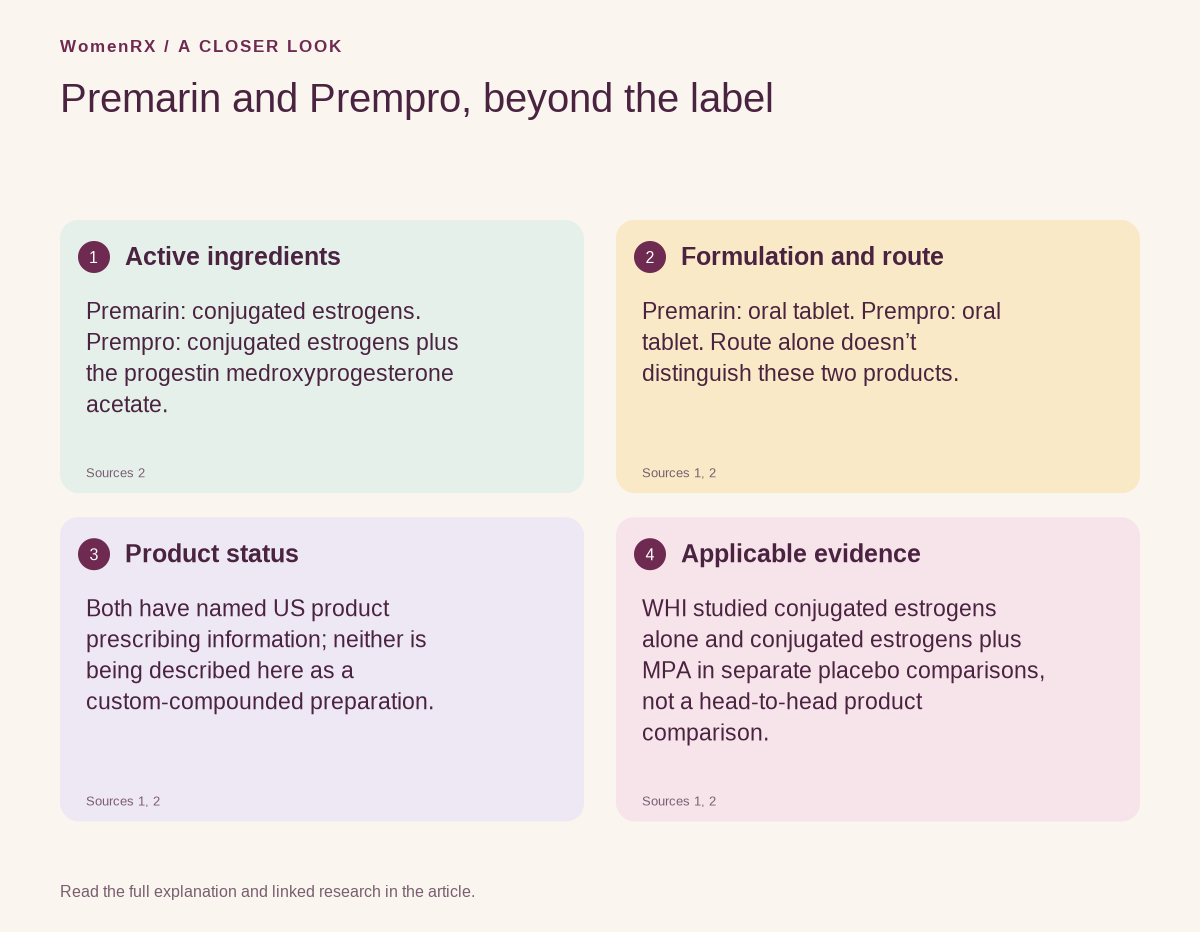
Premarin and Prempro, beyond the label
Active ingredients: Premarin: conjugated estrogens. Prempro: conjugated estrogens plus the progestin medroxyprogesterone acetate.2
Formulation and route: Premarin: oral tablet. Prempro: oral tablet. Route alone doesn’t distinguish these two products.12
Product status: Both have named US product prescribing information; neither is being described here as a custom-compounded preparation.12
Applicable evidence: WHI studied conjugated estrogens alone and conjugated estrogens plus MPA in separate placebo comparisons, not a head-to-head product comparison.12
Read the figure as text
Two named oral hormone products share an estrogen ingredient, but differ in a clinically relevant added ingredient and the evidence that applies.- Active ingredients: Premarin: conjugated estrogens. Prempro: conjugated estrogens plus the progestin medroxyprogesterone acetate.2
- Formulation and route: Premarin: oral tablet. Prempro: oral tablet. Route alone doesn’t distinguish these two products.12
- Product status: Both have named US product prescribing information; neither is being described here as a custom-compounded preparation.12
- Applicable evidence: WHI studied conjugated estrogens alone and conjugated estrogens plus MPA in separate placebo comparisons, not a head-to-head product comparison.12
More questions, answered
Is bioidentical hormone therapy always custom-compounded?
No. “Bioidentical” describes molecular structure. FDA-approved hormone formulations can be bioidentical, while custom-compounded preparations may also be marketed with that word. Check the particular product’s status separately. 4
Can the WHI results for Prempro tell me the risk of every combined hormone therapy?
No. The cited WHI substudy tested oral conjugated estrogens plus MPA against placebo. Hormone-therapy risks can vary with the type, dose, route, duration, and timing of treatment, so its results shouldn’t be assigned to every estrogen-progestogen combination. 2 3
Sources you can check
- PREMARIN (ESTROGENS, CONJUGATED) TABLET, FILM COATED [WYETH PHARMACEUTICALS LLC, A SUBSIDIARY OF PFIZER INC.] | US prescribing information and patient instructionsAccessed 2026-09-25Return to first citation
- PREMPHASE (CONJUGATED ESTROGENS AND MEDROXYPROGESTERONE ACETATE) KIT PREMPRO (CONJUGATED ESTROGENS AND MEDROXYPROGESTERONE ACETATE) TABLET, SUGAR COATED [WYETH PHARMACEUTICALS LLC, A SUBSIDIARY OF PFIZER INC.] | US prescribing information and patient instructionsAccessed 2026-09-25Return to first citation
- The 2022 hormone therapy position statement of The North American Menopause Society.“The 2022 Hormone Therapy Position Statement of The North American Menopause Society” Advisory Panel. · Menopause (New York, N.Y.) · 2022Return to first citation
- Compounded bioidentical hormone therapy: new recommendations from the 2020 National Academies of Sciences, Engineering, and Medicine.Stuenkel CA. · Menopause (New York, N.Y.) · 2021Return to first citation
- Safety and efficacy of compounded bioidentical hormone therapy (cBHT) in perimenopausal and postmenopausal women: a systematic review and meta-analysis of randomized controlled trials.Liu Y, Yuan Y, Day AJ, Zhang W, John P, Ng DJ, Banov D. · Menopause (New York, N.Y.) · 2022Return to first citation