Compounded Bioidentical Hormones: How to Assess Safety and Evidence
“Bioidentical” describes a hormone’s structure, not whether a compounded product has been shown to be safer or more effective.
Compounded bioidentical hormone therapy isn’t automatically unsafe, but “bioidentical” doesn’t mean better tested, safer, or more precisely tailored. FDA-approved bioidentical hormone products also exist. ACOG recommends approved menopause therapies over compounded products when approved formulations are available. Before choosing compounding, ask why it’s needed, what evidence applies to that exact preparation, and what remains unknown about its risks. 45
The label and the product are different questions
“Bioidentical” means a hormone has the same chemical and molecular structure as a hormone produced by the body. That term doesn’t tell you whether a product is FDA-approved or whether a particular preparation has been shown to work safely over time. FDA-approved hormone formulations can be bioidentical, so the choice isn’t simply “natural” hormones versus conventional ones. 5
“Compounded” describes a custom-prepared medicine. Compounded menopausal hormone therapy is a separate category from FDA-approved products. ACOG recommends approved menopause therapies over compounded bioidentical hormone therapy and advises against routinely prescribing compounded products when approved formulations are available. That isn’t a claim that every compounded preparation is harmful. It means a “bioidentical” or “custom” label doesn’t establish greater safety or effectiveness. 34
What the studies can and can’t establish
A systematic review included 29 randomized trials, reported in 40 articles, with 1,808 perimenopausal and postmenopausal women. The trials were primarily short term. The review says clinical cardiovascular events, endometrial biopsy, and breast cancer risk were not studied. It also concludes that the available trials are insufficient to assess the clinical risks of cardiovascular disease, breast cancer, or endometrial cancer. These are related but distinct points: some outcomes weren’t studied, and the broader clinical risks can’t yet be assessed from the trial evidence. 2
The review found that compounded vaginal androgen improved vaginal atrophy symptoms in the trials, but results varied substantially between studies. That finding concerns a particular treatment and symptom; it doesn’t establish the safety or effectiveness of other compounded hormones, routes, or formulas. The review also reported variation in absorption across compounded hormones, routes, and strengths. 2
For hormone therapy overall, risks vary with factors such as hormone type, dose, route, duration, timing, and whether a progestogen is used. Evidence about one preparation shouldn’t automatically be applied to another. 12
Questions to ask about the specific preparation
Bring the discussion back to what you’re treating and the exact product being proposed. These questions can help you compare it with an approved option:
- What symptom or condition are we treating? Hormone therapy can treat bothersome hot flashes and other vasomotor symptoms, but the balance of benefits and risks depends on the treatment and your circumstances. 1
- Is there an FDA-approved product that fits my needs? If not, ask what specific limitation makes a compounded formulation necessary. ACOG advises against routine use of compounded menopause hormones when an approved formulation is available. 4
- What evidence applies to this exact preparation? Ask about its ingredients, route, and strength, and what evidence supports it for your treatment goal. Results for one compounded formulation may not apply to another. 24
- What testing or quality controls apply to this product? Ask the prescriber or pharmacist what they can tell you about how the preparation is assessed. The review’s finding of variable absorption across types, routes, and strengths is a reason not to assume that “custom” means more predictable dosing. It doesn’t establish the practices of any particular pharmacy. 2
- Which risks are known, and which remain uncertain? Ask what is known about the proposed preparation and what long-term outcomes have not been established. ACOG calls for high-quality, long-term comparisons with approved menopause therapies. 24
- How will we tell whether it’s helping? Identify the symptom you’re treating and agree on when to review whether the benefits still justify continuing. Menopause guidance recommends periodic reevaluation of hormone therapy’s benefits and risks. 1
These questions aren’t a test you need to pass. They help distinguish a specific reason for compounding from a broad promise of a safer or more personalized result that hasn’t been demonstrated.
Weighing the tradeoff
When an FDA-approved therapy fits your needs, it has a clearer approval and evidence basis than a compounded alternative: approved hormone products have been reviewed for safety and efficacy, while ACOG says evidence supporting marketing claims for compounded products is lacking. If compounding is proposed because an approved option doesn’t fit, ask what limitation it addresses and what evidence supports the particular preparation. 34
The aim isn’t to label every compounded product unsafe or to assume approved therapy is right for everyone. It’s to make the decision based on your symptoms, the exact product, and the evidence and uncertainties that apply to it, rather than treating “bioidentical” as a promise of safety. Long-term studies comparing compounded products with approved menopause therapies are still needed. 124
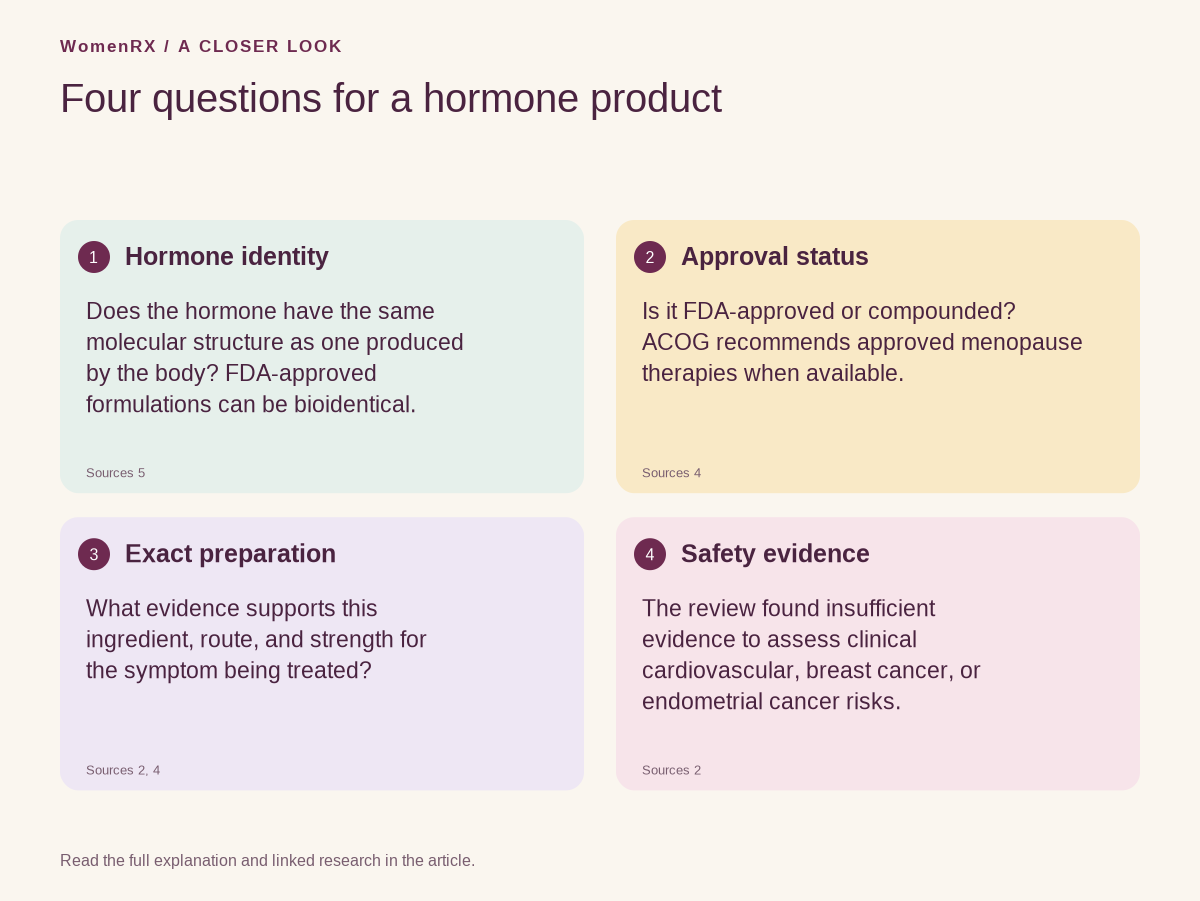
Four questions for a hormone product
Hormone identity: Does the hormone have the same molecular structure as one produced by the body? FDA-approved formulations can be bioidentical.5
Approval status: Is it FDA-approved or compounded? ACOG recommends approved menopause therapies when available.4
Exact preparation: What evidence supports this ingredient, route, and strength for the symptom being treated?24
Safety evidence: The review found insufficient evidence to assess clinical cardiovascular, breast cancer, or endometrial cancer risks.2
Read the figure as text
“Bioidentical” describes hormone structure. Compare that label with separate questions about approval, the exact preparation, evidence, and what remains unknown.- Hormone identity: Does the hormone have the same molecular structure as one produced by the body? FDA-approved formulations can be bioidentical.5
- Approval status: Is it FDA-approved or compounded? ACOG recommends approved menopause therapies when available.4
- Exact preparation: What evidence supports this ingredient, route, and strength for the symptom being treated?24
- Safety evidence: The review found insufficient evidence to assess clinical cardiovascular, breast cancer, or endometrial cancer risks.2
More questions, answered
Does “bioidentical” mean a hormone is compounded?
No. “Bioidentical” describes a hormone’s molecular structure. FDA-approved hormone formulations can be bioidentical; compounding is a separate question about how a medicine is prepared. 5
Does “custom” mean a compounded hormone has been proven to fit my needs better?
No. Ask what makes the specific preparation necessary and what evidence supports it for your treatment goal. ACOG says evidence for marketing claims of greater safety and effectiveness is lacking. 4
Sources you can check
- The 2022 hormone therapy position statement of The North American Menopause Society.“The 2022 Hormone Therapy Position Statement of The North American Menopause Society” Advisory Panel. · Menopause (New York, N.Y.) · 2022Return to first citation
- Safety and efficacy of compounded bioidentical hormone therapy (cBHT) in perimenopausal and postmenopausal women: a systematic review and meta-analysis of randomized controlled trials.Liu Y, Yuan Y, Day AJ, Zhang W, John P, Ng DJ, Banov D. · Menopause (New York, N.Y.) · 2022Return to first citation
- The Clinical Utility of Compounded Bioidentical Hormone Therapy: A Review of Safety, Effectiveness, and UseNational Academies of Sciences, Engineering, and Medicine; Health and Medicine Division; Board on Health Sciences Policy; Committee on the Clinical Utility of Treating Patients wit... · 2020Return to first citation
- Compounded Bioidentical Menopausal Hormone Therapy: ACOG Clinical Consensus No. 6.Obstetrics and gynecology · 2023Return to first citation
- Compounded bioidentical hormone therapy: new recommendations from the 2020 National Academies of Sciences, Engineering, and Medicine.Stuenkel CA. · Menopause (New York, N.Y.) · 2021Return to first citation