Comparing Compounded and FDA-Approved Menopause Hormone Costs
The cheaper-looking hormone quote may cover a different prescription, supply period, or set of fees.
A compounded hormone preparation is not itself an FDA-approved finished drug product. Approved hormone therapies have product-specific evidence and risk information that compounded preparations generally lack. 6 That oversight difference doesn’t establish which option costs less. To compare quotes, check what each prescription contains, how long it lasts, what’s billed separately, and what you’ll pay after insurance.
Start with the treatment, not the price tag
Imagine you’re comparing a quote for a compounded hormone cream with a price for an estradiol patch. Those aren’t automatically two prices for the same treatment. One quote might include more than one hormone; the other might cover estradiol alone. Before comparing dollars, ask the prescriber to spell out each proposed hormone, its strength and form, and what the full treatment plan includes.
The treatment goal matters, too. Menopause hormone therapy guidance says risks vary with factors including the type, dose, route, duration, and timing of treatment, and whether a progestogen is used. Treatment should be individualized and periodically reevaluated. A formulation that fits someone else’s symptoms or circumstances isn’t necessarily the right comparison for yours. 5
What does “compounded” change?
“Bioidentical” doesn’t tell you whether a hormone is compounded. A review notes that approved therapies are available for people seeking hormones similar to those present before menopause. Ask for the specific product name or compounded formula rather than relying on that label. 6
A compounded preparation is not itself an FDA-approved finished drug product. A review of compounded bioidentical menopausal hormones describes a gap in product-specific pharmacokinetic, safety, and efficacy data and risk labeling compared with approved therapies. It identifies an allergy, or a needed dose or formulation unavailable among approved therapies, as circumstances in which compounding might be considered. That’s a reason to ask why this preparation is being proposed for you, not a reason to assume it’s safer or more effective. 6
Named products can also have details that a broad description such as “hormone therapy” misses. For example, BIJUVA’s prescribing information identifies estradiol and progesterone in a capsule and specifies its contents and product instructions. Those details describe BIJUVA, not another product or a compounded prescription. 4
If you’re considering a compounded option, ask which pharmacy will prepare it and how that pharmacy checks the ingredients, prescribed strength, and consistency between fills. These are questions about your particular prescription; a quote alone won’t answer them.
Build a total for the same period
Request an itemized cost for each complete proposed plan over the same supply period. Include the medication, any separate consultation or follow-up fees, and any planned tests. Keep one-time charges separate from recurring ones. Then check coverage, deductible, copay, or coinsurance with your insurer rather than assuming either type of prescription will cost less out of pocket. Insurance charges depend on the plan. 1
Posted prices show how easily a partial price can be mistaken for a total. As observed September 25, 2026, Alloy listed an estradiol pill starting at $39.99 per month, gel and spray at $69.99 per month each, and a patch at $100 per month, plus a separate one-time $49 consultation fee. Those figures don’t include a stated progesterone price, so they aren’t prices for every possible regimen. Alloy also says subscriptions usually bill every three months, with exceptions: a monthly advertised figure may not be the checkout charge. 23
Visits can be a separate expense. Midi’s posted self-pay prices on September 25, 2026, were $250 for a 30-minute first visit and $150 for a 15-minute return visit, with possible additional costs. Those are visit prices, not medication prices. Neither provider’s posted figures amount to a matched compounded-versus-approved comparison. 12
For each quote, ask: What will I pay now, what will I pay at each refill, and what follow-up or testing is planned and charged separately? Also ask whether a change in the prescription would change the price. Put both totals on the same calendar period. You’ll be comparing the care you’re actually considering, rather than two numbers that happen to appear side by side.
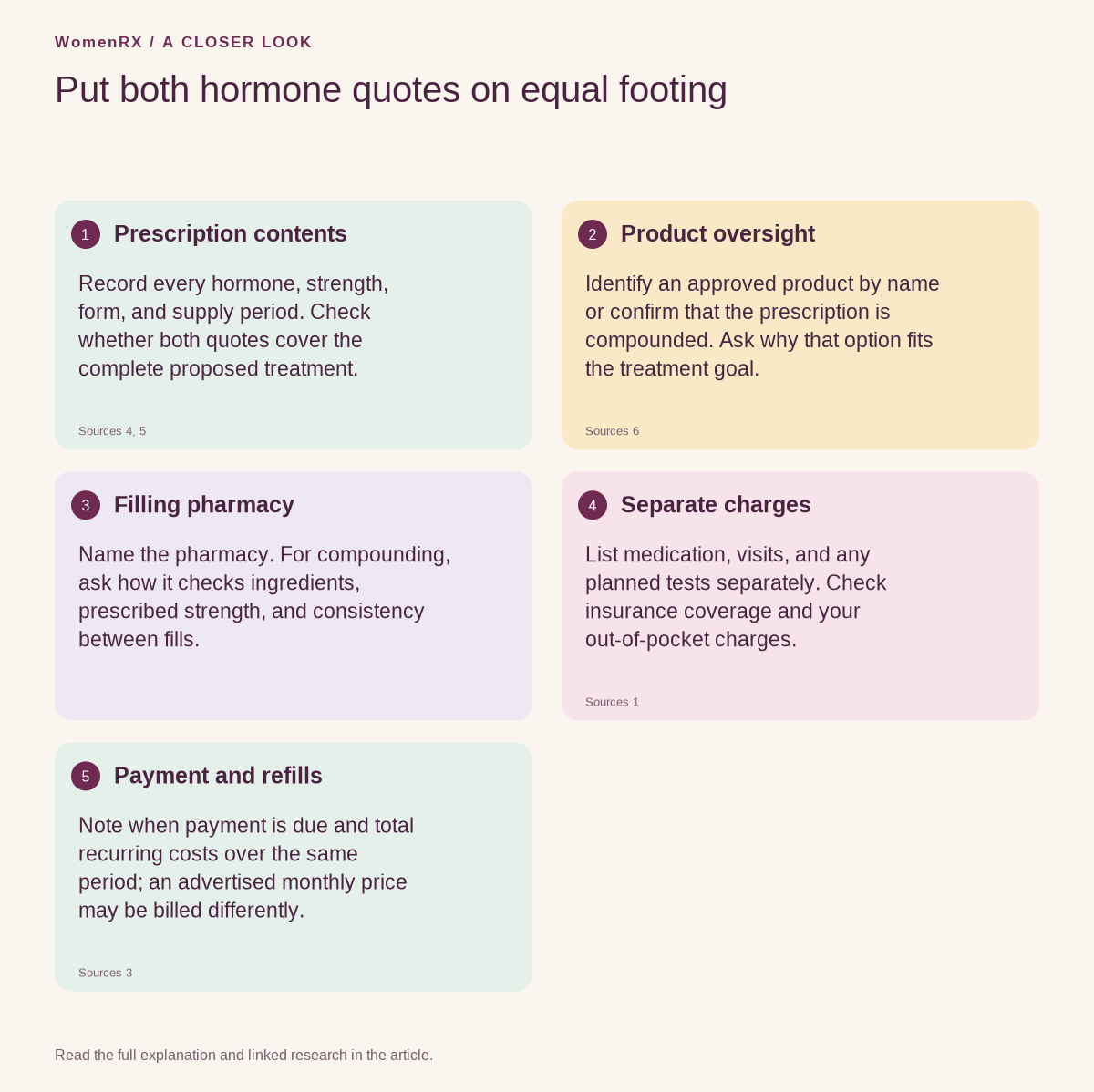
Put both hormone quotes on equal footing
Prescription contents: Record every hormone, strength, form, and supply period. Check whether both quotes cover the complete proposed treatment.45
Product oversight: Identify an approved product by name or confirm that the prescription is compounded. Ask why that option fits the treatment goal.6
Filling pharmacy: Name the pharmacy. For compounding, ask how it checks ingredients, prescribed strength, and consistency between fills.
Separate charges: List medication, visits, and any planned tests separately. Check insurance coverage and your out-of-pocket charges.1
Payment and refills: Note when payment is due and total recurring costs over the same period; an advertised monthly price may be billed differently.3
Read the figure as text
Fill in one column for each proposed prescription. Leave a space blank until the prescriber, pharmacy, or insurer confirms it.- Prescription contents: Record every hormone, strength, form, and supply period. Check whether both quotes cover the complete proposed treatment.45
- Product oversight: Identify an approved product by name or confirm that the prescription is compounded. Ask why that option fits the treatment goal.6
- Filling pharmacy: Name the pharmacy. For compounding, ask how it checks ingredients, prescribed strength, and consistency between fills.
- Separate charges: List medication, visits, and any planned tests separately. Check insurance coverage and your out-of-pocket charges.1
- Payment and refills: Note when payment is due and total recurring costs over the same period; an advertised monthly price may be billed differently.3
More questions, answered
Does “bioidentical” mean a hormone must be compounded?
No. Approved hormone therapies can contain hormones similar to those present before menopause. Ask for the product name, ingredients, and whether the proposed prescription is an approved product or a compounded preparation. 6
Sources you can check
- Midi menopause telehealth visit pricesAccessed 2026-09-25Return to first citation
- Alloy menopause hormone consultation and medication pricesAccessed 2026-09-25Return to first citation
- Alloy menopause hormone subscription billing cadenceAccessed 2026-09-25Return to first citation
- BIJUVA (ESTRADIOL AND PROGESTERONE) CAPSULE [MAYNE PHARMA] | US prescribing information and patient instructionsAccessed 2026-09-25Return to first citation
- The 2022 hormone therapy position statement of The North American Menopause Society.“The 2022 Hormone Therapy Position Statement of The North American Menopause Society” Advisory Panel. · Menopause (New York, N.Y.) · 2022Return to first citation
- Concerns About Compounded Bioidentical Menopausal Hormone Therapy.Pinkerton JV. · Cancer journal (Sudbury, Mass.) · 2022Return to first citation