Compounded Menopause Hormones: What Are You Getting?
A custom hormone prescription may meet a specific need, but “bioidentical” doesn’t establish that it’s safer or better tested.
Compounded hormone therapy may meet a specific need when an approved product cannot, such as an ingredient allergy or an unavailable formulation. It has not been shown to be safer or more effective than approved menopause hormone therapy. 3 Before choosing it, clarify why an approved option won’t work, what evidence supports the proposed treatment, and what the pharmacy can tell you about checks on the finished preparation.
First, separate the hormone from how it’s made
“Bioidentical” describes a hormone similar to one the body makes. It does not tell you whether the medicine is an FDA-approved product or a preparation made by a compounding pharmacy. Approved hormone products include bioidentical options, so wanting estradiol or progesterone does not, by itself, mean you need a compounded prescription. 34
That distinction matters because approved products have been reviewed for safety and effectiveness and come with information about their use and risks. 34 Compounded preparations do not have the same product-specific evidence behind them. A custom formula may sound more precise, but customization is not proof of a better outcome. 3
Start with the symptom, then the proposed solution
If hot flashes or night sweats are disrupting your life, hormone therapy is the most effective treatment for those symptoms. Its benefits and risks depend on factors including the type and route of treatment, when it’s started, and your health history. A treatment plan can be individualized using approved products; it does not have to be compounded to take your circumstances seriously. 1
If the main problem is vaginal dryness or discomfort and you do not need systemic hormone therapy, low-dose vaginal estrogen is among the treatments recommended for persistent symptoms. If you prefer not to use hormone therapy or it isn’t a good fit, evidence-supported nonhormone options for hot flashes include cognitive behavioral therapy and several prescription treatments. These are different choices for different problems, not interchangeable versions of one hormone plan. 12
A compounded preparation becomes a more specific question when there is a reason an approved product cannot meet your needs. An allergy to an ingredient or a needed formulation unavailable as an approved product are examples raised in a clinical review. Ask which exact feature of the approved options is the obstacle and what the proposed compound changes. 3
What “tested” needs to mean
There are two separate questions: Has this treatment been studied in people? And what is known about the preparation this pharmacy will dispense? Compounded menopausal hormones lack the established product-specific pharmacokinetic, safety, and effectiveness data available for approved therapies. That evidence gap does not establish that every compounded preparation is poorly made. It means an assurance that a formula is “customized” cannot stand in for evidence about its effects or its finished quality. 3
For the pharmacy question, ask what checks apply to the finished preparation, not just where its ingredients came from. For example: Is the finished product checked for hormone identity and strength? If it contains more than one hormone, how is its composition checked? What documentation can the pharmacy share about those checks for this formulation? Only the pharmacy making your prescription can tell you which checks it performs and what documentation it can share.
Dose planning deserves the same clarity. Ask which hormones the prescription contains, what each is intended to treat, and how the plan will be reassessed if symptoms persist or side effects appear. If a combination includes an androgen such as testosterone, ask what that ingredient is intended to do. Testosterone is among the hormones used in compounded recipes; its inclusion does not, by itself, establish a benefit for your symptoms. 6 If a pellet is proposed, a clinical review raises additional safety concerns about pellets that can deliver hormone levels above the usual physiological range. That concern is not a claim that every compounded form has the same risk. 3
Don’t let a saliva result make the decision for you
Some compounded regimens are promoted as being tailored to saliva hormone measurements. An older review found little evidence supporting individualized hormone dosing based on saliva concentrations. If testing is presented as the reason for a particular mixture, ask what decision the result changes and what evidence shows that the change improves symptoms or safety. 6
The useful comparison is not “personalized care versus ordinary care.” In interviews with 21 current or former compounded-hormone users in the United States, women described wanting symptom relief and care that took their concerns seriously. Those priorities are reasonable, and they belong in any menopause treatment discussion. The question is whether the proposed product adds something an approved option cannot provide, with an uncertainty you’re comfortable accepting. 513
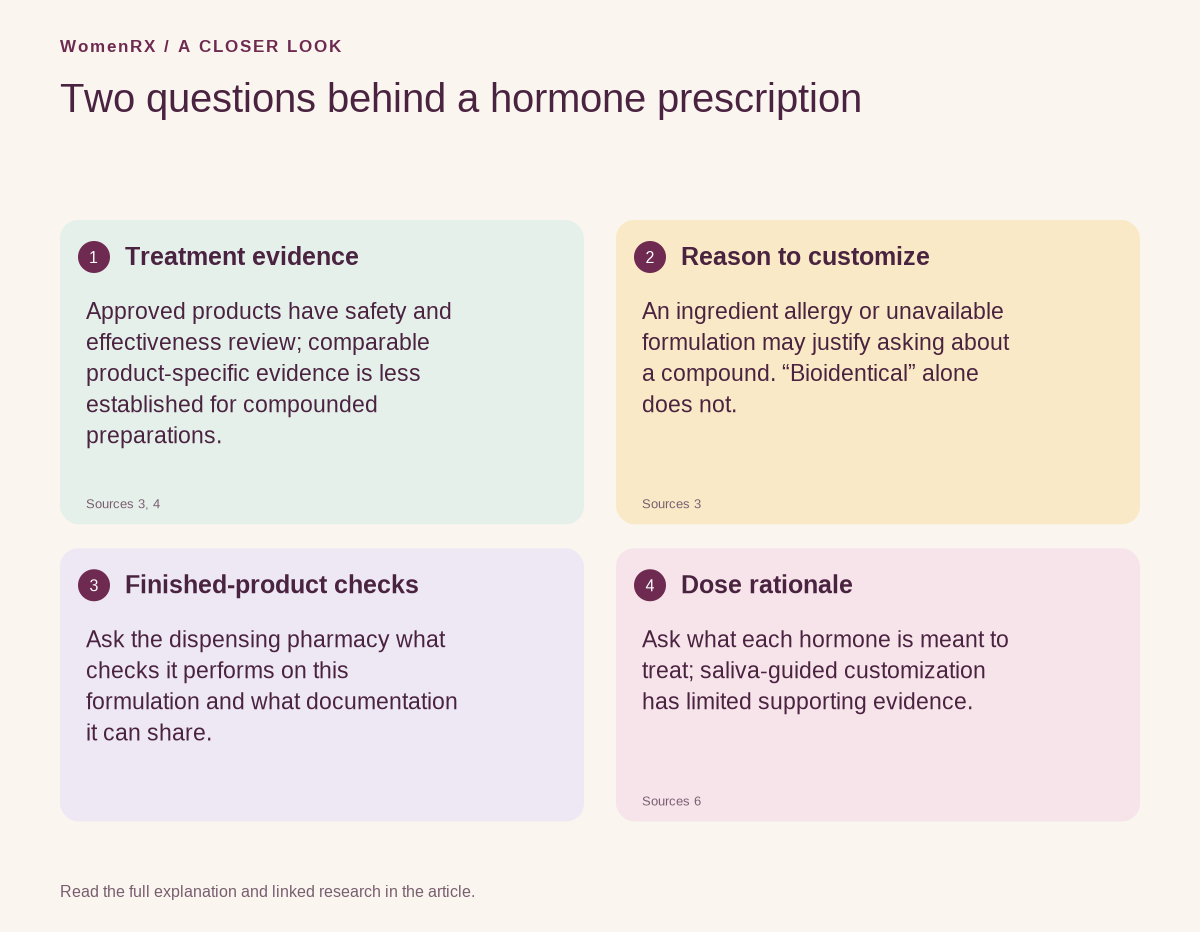
Two questions behind a hormone prescription
Treatment evidence: Approved products have safety and effectiveness review; comparable product-specific evidence is less established for compounded preparations.34
Reason to customize: An ingredient allergy or unavailable formulation may justify asking about a compound. “Bioidentical” alone does not.3
Finished-product checks: Ask the dispensing pharmacy what checks it performs on this formulation and what documentation it can share.
Dose rationale: Ask what each hormone is meant to treat; saliva-guided customization has limited supporting evidence.6
Read the figure as text
Compare what is established for an approved product with what you need to clarify when a custom preparation is proposed.- Treatment evidence: Approved products have safety and effectiveness review; comparable product-specific evidence is less established for compounded preparations.34
- Reason to customize: An ingredient allergy or unavailable formulation may justify asking about a compound. “Bioidentical” alone does not.3
- Finished-product checks: Ask the dispensing pharmacy what checks it performs on this formulation and what documentation it can share.
- Dose rationale: Ask what each hormone is meant to treat; saliva-guided customization has limited supporting evidence.6
Sources you can check
- The 2022 hormone therapy position statement of The North American Menopause Society.“The 2022 Hormone Therapy Position Statement of The North American Menopause Society” Advisory Panel. · Menopause (New York, N.Y.) · 2022Return to first citation
- The 2023 nonhormone therapy position statement of The North American Menopause Society.Menopause (New York, N.Y.) · 2023Return to first citation
- Concerns About Compounded Bioidentical Menopausal Hormone Therapy.Pinkerton JV. · Cancer journal (Sudbury, Mass.) · 2022Return to first citation
- The Clinical Utility of Compounded Bioidentical Hormone Therapy: A Review of Safety, Effectiveness, and UseNational Academies of Sciences, Engineering, and Medicine; Health and Medicine Division; Board on Health Sciences Policy; Committee on the Clinical Utility of Treating Patients wit... · 2020Return to first citation
- Why women choose compounded bioidentical hormone therapy: lessons from a qualitative study of menopausal decision-making.Thompson JJ, Ritenbaugh C, Nichter M. · BMC women's health · 2017Return to first citation
- Bioidentical hormone therapy: a review.Boothby LA, Doering PL, Kipersztok S. · Menopause (New York, N.Y.) · 2004Return to first citation