Are Compounded “Bioidentical” Hormones Safer Than Approved HRT?
“Bioidentical” describes a hormone molecule, not a guarantee that a menopause treatment is safer.
There’s no good basis for assuming compounded “bioidentical” hormones are safer than approved hormone therapy. Approved products can contain bioidentical hormones too. The key difference is that approved products have product-specific evidence and prescribing information, while compounded preparations generally lack comparable safety and effectiveness data. Your own balance of benefits and risks depends on the regimen and your health circumstances, not the label alone. 4 3

“Bioidentical” can sound like a promise that a hormone is gentler or safer. It isn’t. The word describes the hormone molecule, not how a finished product is made or studied. For example, progesterone in an approved capsule is chemically identical to progesterone made by the ovaries. 2
Separate the molecule from the product
Bioidentical describes what the hormone is. Estradiol and progesterone can be used in approved products as well as compounded preparations. An approved estradiol-and-progesterone combination is one example of a bioidentical menopause treatment. So “bioidentical” does not mean “compounded,” and “approved” does not mean “not bioidentical.” 2 4 6
Approved describes a specific finished product. Its formulation and strength are identified, and its prescribing information describes its uses and potential risks. A review of research on one approved estradiol-and-progesterone combination reports that a phase 3 study found fewer and less severe hot flashes than with placebo at 12 weeks in menopausal women with an intact uterus. That result belongs to the studied product and population. It cannot be assigned to every preparation containing estradiol and progesterone. 1 4 6
Compounded describes how a preparation is made. Compounded bioidentical preparations are not FDA-approved finished products. Reviews describe gaps in product-specific information about their absorption, safety, and effectiveness, as well as inconsistent labeling across compounded products. That does not prove every compounded preparation is harmful or that every dose is inconsistent. It does mean you cannot assume it has the same testing or risk information as an approved product with the same hormone names. 4 5
Why the label alone cannot settle safety
Hormone therapy is not one treatment with one risk profile. Its benefits and risks vary with the hormones used, dose, route, duration, when treatment starts, and whether a progestogen is included. Your health history matters to that assessment. The North American Menopause Society recommends an individualized choice and periodic review of whether the benefits still outweigh the risks. 3
If you have a uterus, a particularly useful question is how the proposed regimen addresses protection of the uterine lining. Progesterone has a role in endometrial protection, and the research on the approved estradiol-and-progesterone combination cited above included women with an intact uterus. Neither point establishes that another product or regimen provides equivalent protection. 2 6
A review identifies a more concrete reason to consider compounding: an allergy, or a needed dose or formulation that an approved product cannot provide. That is different from choosing it because “customized” sounds safer. Likewise, a saliva test should not be taken as proof that a customized hormone dose is more precise: a review found little evidence supporting dose selection based on saliva hormone concentrations. 4 7
Make the comparison product by product
If you are weighing two options, ask what each one contains, whether it is an approved product or a compounded preparation, and what evidence applies to that specific formulation. If one is compounded, ask what need it meets that an approved option cannot. Then discuss how the proposed hormones, route, timing, and any progestogen fit your treatment goal and health history. Those questions reveal more than either the word “bioidentical” or the word “regular.” 3 4
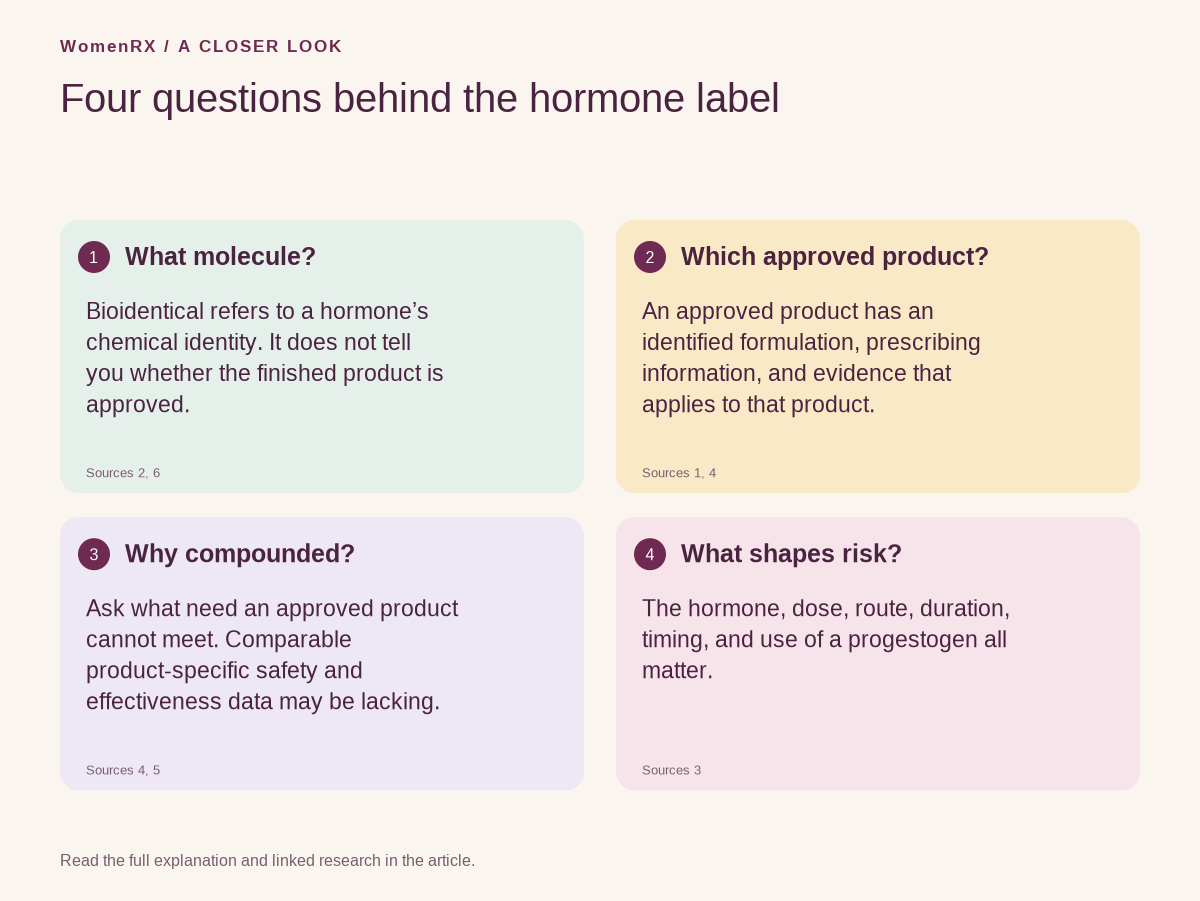
Four questions behind the hormone label
What molecule?: Bioidentical refers to a hormone’s chemical identity. It does not tell you whether the finished product is approved.26
Which approved product?: An approved product has an identified formulation, prescribing information, and evidence that applies to that product.14
Why compounded?: Ask what need an approved product cannot meet. Comparable product-specific safety and effectiveness data may be lacking.45
What shapes risk?: The hormone, dose, route, duration, timing, and use of a progestogen all matter.3
Read the figure as text
These distinctions help you compare finished treatments rather than assuming the same hormone name means the same evidence or risk.- What molecule?: Bioidentical refers to a hormone’s chemical identity. It does not tell you whether the finished product is approved.26
- Which approved product?: An approved product has an identified formulation, prescribing information, and evidence that applies to that product.14
- Why compounded?: Ask what need an approved product cannot meet. Comparable product-specific safety and effectiveness data may be lacking.45
- What shapes risk?: The hormone, dose, route, duration, timing, and use of a progestogen all matter.3
More questions, answered
Does saliva testing establish the right dose for compounded hormones?
A review found little evidence supporting individualized hormone dosing based on saliva hormone concentrations. A dose selected using that test should not be treated as proof of better safety or effectiveness. 7
Were the major Women’s Health Initiative risks measured with compounded bioidentical hormones?
No. The estrogen-plus-progestin trial described in product prescribing information compared oral conjugated estrogens plus medroxyprogesterone acetate with placebo. Its findings matter to discussions about hormone therapy risks, but they are not a direct safety comparison between compounded and approved bioidentical products. 1 2
Sources you can check
- BIJUVA (ESTRADIOL AND PROGESTERONE) CAPSULE [MAYNE PHARMA] | US prescribing information and patient instructionsAccessed 2026-09-25Return to first citation
- PROMETRIUM (PROGESTERONE) CAPSULE [ACERTIS PHARMACEUTICALS, LLC] | US prescribing information and patient instructionsAccessed 2026-09-25Return to first citation
- The 2022 hormone therapy position statement of The North American Menopause Society.“The 2022 Hormone Therapy Position Statement of The North American Menopause Society” Advisory Panel. · Menopause (New York, N.Y.) · 2022Return to first citation
- Concerns About Compounded Bioidentical Menopausal Hormone Therapy.Pinkerton JV. · Cancer journal (Sudbury, Mass.) · 2022Return to first citation
- Compounded bioidentical menopausal hormone therapy - a physician perspective.Stuenkel CA. · Climacteric : the journal of the International Menopause Society · 2021Return to first citation
- Bioidentical Oral 17β-Estradiol and Progesterone for the Treatment of Moderate to Severe Vasomotor Symptoms of Menopause.Woodis CB, Ghassemi E, McLendon AN. · The Annals of pharmacotherapy · 2021Return to first citation
- Bioidentical hormone therapy: a review.Boothby LA, Doering PL, Kipersztok S. · Menopause (New York, N.Y.) · 2004Return to first citation