Changing Menopause Hormone Therapy: Questions Before You Switch
A clear switch plan names both products, explains the timing, and accounts for your symptoms and uterine health.
Before changing menopause hormone therapy, bring the exact name, strength, route, and schedule of your current product to your prescriber or pharmacist. Confirm those details for the new product, why you’re switching, when to use each one, and when to follow up. If you have a uterus, ask how the new plan protects the uterine lining and mention any unusual bleeding. 1 3
Changing hormone therapy can mean more than replacing one brand with another. The estrogen, dose, route, schedule, or progestogen may change, sometimes all at once. Those differences matter because the benefits and risks of menopause hormone therapy vary by product and how it’s used. Treatment should be individualized and reviewed periodically. 3
Make the change visible
Put the current package and the proposed prescription side by side, or use an up-to-date medication list. For each treatment, identify the exact name and strength, whether you take it by mouth or use it on your skin, how often you use it, and whether it contains estrogen, a progestogen, or both.
Names alone can be misleading. For example, Premarin contains conjugated estrogens, while Prempro contains conjugated estrogens and medroxyprogesterone acetate, a progestin. That’s a meaningful difference to check, not a reason to assume either product is right for your switch. 1 2
Tell your prescriber what you want the change to solve. Are hot flashes continuing? Is a side effect bothering you? Has cost or a supply problem made the current product difficult to use? Then ask which part of the treatment is changing and what the new plan is intended to improve. Hormone type, dose, route, and progestogen use are all factors in an individualized treatment decision. 3
Get timing for the exact products
Ask for a plan that names both products and says when you’ll finish using the current one and begin the new one. Confirm whether any overlap or gap is intended. If the new product isn’t available when expected, or the pharmacy supplies something different from the plan, ask what to do before changing your routine.
Don’t guess at stop-and-start timing from a different product or route. If the instructions from your prescriber and the product you receive don’t line up, ask your prescriber or pharmacist to resolve the difference.
If you have a uterus, ask about progestogen and bleeding
Tell the person coordinating the switch whether you still have your uterus and whether you’ve had bleeding, including when it happened and whether it was expected with your current regimen. Ask how the new plan addresses the uterine lining and what bleeding should prompt you to get in touch.
Estrogen-alone product information warns about uterine cancer risk and advises reporting unusual vaginal bleeding. It also describes studies in which adding a progestin to estrogen was associated with less overgrowth of the uterine lining than estrogen alone. 1 That makes progestogen coverage a question to settle as part of the switch, not something to add or remove on your own.
Decide how you’ll judge the change
Before switching, agree on when to review the symptom or side effect that prompted the change and whether the new regimen is causing problems. Periodic reassessment is part of individualized hormone therapy care. 3
A quick repeat-back can catch confusion: “I use this product until , start the new one on , and contact __ if I can’t fill it or these symptoms occur.” If you can’t fill in those blanks, ask for a clearer plan before you switch.
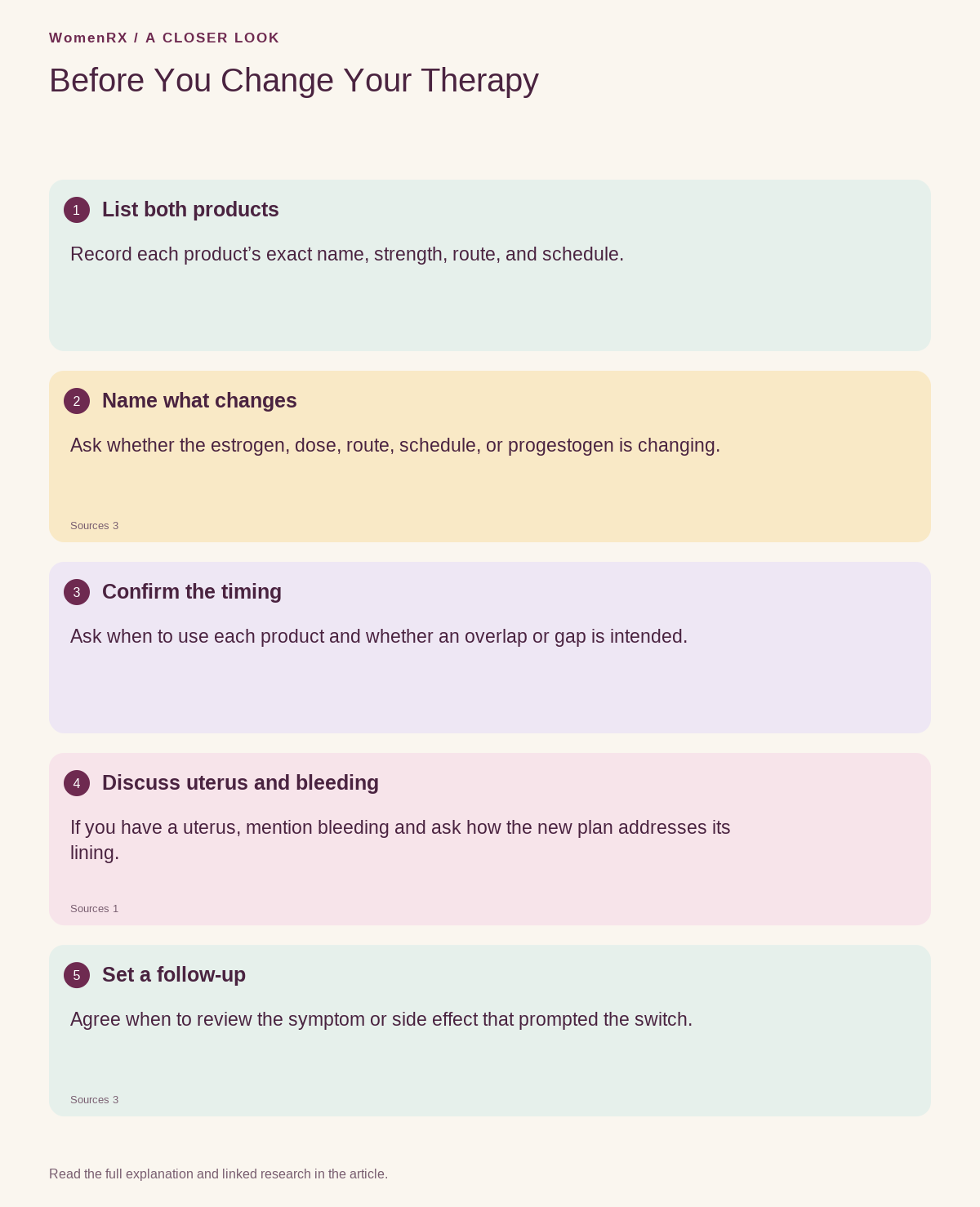
Before You Change Your Therapy
List both products: Record each product’s exact name, strength, route, and schedule.
Name what changes: Ask whether the estrogen, dose, route, schedule, or progestogen is changing.3
Confirm the timing: Ask when to use each product and whether an overlap or gap is intended.
Discuss uterus and bleeding: If you have a uterus, mention bleeding and ask how the new plan addresses its lining.1
Set a follow-up: Agree when to review the symptom or side effect that prompted the switch.3
Read the figure as text
Use these questions to make sure the old and new treatments, transition timing, and follow-up plan are clear.- List both products: Record each product’s exact name, strength, route, and schedule.
- Name what changes: Ask whether the estrogen, dose, route, schedule, or progestogen is changing.3
- Confirm the timing: Ask when to use each product and whether an overlap or gap is intended.
- Discuss uterus and bleeding: If you have a uterus, mention bleeding and ask how the new plan addresses its lining.1
- Set a follow-up: Agree when to review the symptom or side effect that prompted the switch.3
Sources you can check
- PREMARIN (ESTROGENS, CONJUGATED) TABLET, FILM COATED [WYETH PHARMACEUTICALS LLC, A SUBSIDIARY OF PFIZER INC.] | US prescribing information and patient instructionsAccessed 2026-09-25Return to first citation
- PREMPHASE (CONJUGATED ESTROGENS AND MEDROXYPROGESTERONE ACETATE) KIT PREMPRO (CONJUGATED ESTROGENS AND MEDROXYPROGESTERONE ACETATE) TABLET, SUGAR COATED [WYETH PHARMACEUTICALS LLC, A SUBSIDIARY OF PFIZER INC.] | US prescribing information and patient instructionsAccessed 2026-09-25Return to first citation
- The 2022 hormone therapy position statement of The North American Menopause Society.“The 2022 Hormone Therapy Position Statement of The North American Menopause Society” Advisory Panel. · Menopause (New York, N.Y.) · 2022Return to first citation