How Soon Can Menopause Hormone Therapy Help?
There’s no single timeline that fits every hormone therapy and symptom, so track the concern you’re treating and use follow-up to review both benefit and tolerability.
Menopause hormone therapy doesn’t have one reliable time-to-relief deadline for every symptom or treatment. Track the specific concern you’re treating, notice whether it improves and whether side effects are manageable, and review the plan with your prescriber. MedlinePlus says many clinicians check in every three to six months at first, then yearly once treatment is working well. 1

Start by naming the symptom you want to change
The most useful way to judge treatment is to focus on its intended target. If hot flashes are disrupting sleep, for example, notice whether they’re less bothersome or interrupt your nights less often. If vaginal dryness or discomfort is the concern, pay attention to that symptom rather than expecting a change in hot flashes.
Hormone therapy comes in different forms, and its risks and benefits depend on factors such as the type, route, timing, and whether a progestogen is used. Treatment is individualized, so there isn’t one response timeline that applies to everyone. 3
A brief note can help you describe what’s changing: the symptom, how it affects daily life, and whether it feels better, unchanged, or worse. You don’t need a detailed diary unless that’s useful to you.
Keep tolerability separate from treatment benefit
Notice how you feel while using the treatment as well as whether the target symptom changes. If a side effect is difficult to tolerate or you feel worse, contact the person who prescribed it rather than waiting for routine follow-up. That’s a practical way to raise a concern early, not a prediction that every side effect means treatment must change.
For routine follow-up, MedlinePlus says many clinicians recommend checking in every three to six months at first, then yearly once treatment is working well. These are review intervals, not a promised deadline for relief. 1
At a review, describe what has improved, what hasn’t, and what feels difficult to tolerate. You can ask whether the treatment still matches your main goal and whether its form or route remains appropriate. A change in the plan doesn’t automatically mean simply increasing the dose; the treatment’s risks and benefits vary with its details and your circumstances. 3
Match the treatment goal to the treatment type
Systemic hormone therapy is used for symptoms such as hot flashes. Low-dose vaginal estrogen is a different option for bothersome genitourinary symptoms that haven’t improved with over-the-counter therapies when there isn’t another reason to use systemic therapy. Because these treatments have different goals, judge vaginal treatment by the genitourinary symptom it’s intended to address, not by whether it changes hot flashes. 3
The broader discussion can also depend on whether you’re approaching menopause or are already past your final menstrual period. Perimenopause is the transition before menopause, when periods may become irregular; menopause is defined as 12 months without a period. 2 The Menopause Society says the benefit-risk balance is favorable for certain women younger than 60 or within 10 years of menopause onset, without contraindications, when treating bothersome hot flashes or preventing bone loss. It appears less favorable for women starting more than 10 years after menopause onset or after age 60. These factors inform the overall treatment discussion; they don’t tell you how quickly a particular symptom will improve. 3
If you still have your uterus, ask how your treatment plan accounts for that. MedlinePlus describes estrogen paired with progesterone or a similar hormone as a common option for women with a uterus, while estrogen alone may be recommended after hysterectomy. 1
The practical measure isn’t simply how much time has passed. It’s whether the symptom you chose is changing, whether the treatment is tolerable, and whether the plan still fits your goals.
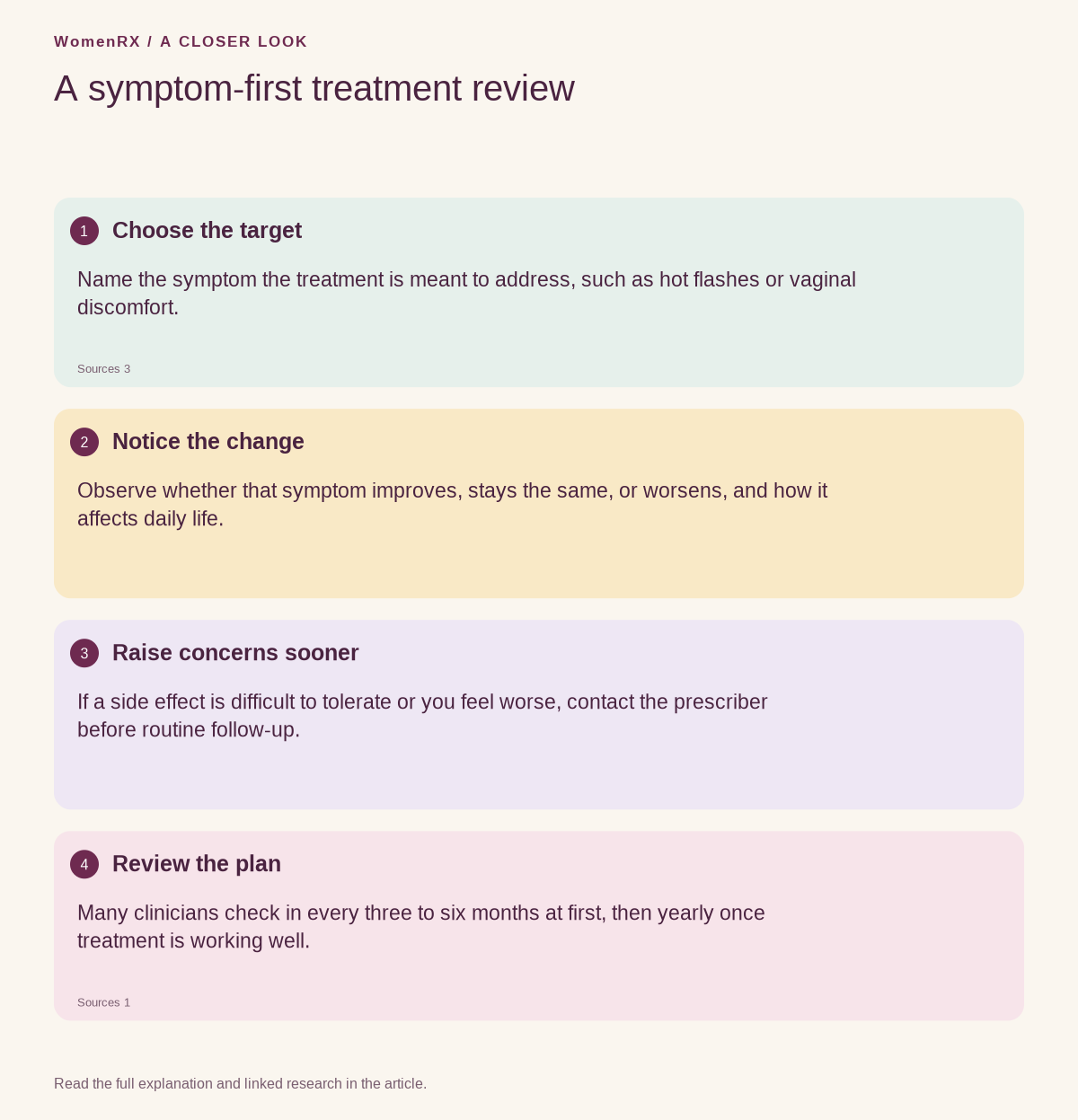
A symptom-first treatment review
Choose the target: Name the symptom the treatment is meant to address, such as hot flashes or vaginal discomfort.3
Notice the change: Observe whether that symptom improves, stays the same, or worsens, and how it affects daily life.
Raise concerns sooner: If a side effect is difficult to tolerate or you feel worse, contact the prescriber before routine follow-up.
Review the plan: Many clinicians check in every three to six months at first, then yearly once treatment is working well.1
Read the figure as text
Follow the target symptom and treatment tolerability separately. Routine follow-up is a time to review the plan, not a universal deadline for relief.- Choose the target: Name the symptom the treatment is meant to address, such as hot flashes or vaginal discomfort.3
- Notice the change: Observe whether that symptom improves, stays the same, or worsens, and how it affects daily life.
- Raise concerns sooner: If a side effect is difficult to tolerate or you feel worse, contact the prescriber before routine follow-up.
- Review the plan: Many clinicians check in every three to six months at first, then yearly once treatment is working well.1
More questions, answered
Does a three-to-six-month follow-up mean I should wait that long about a side effect?
No. MedlinePlus describes three-to-six-month check-ins as a routine follow-up suggestion, not an instruction to wait through a difficult side effect. 1 If a side effect is hard to tolerate or you feel worse, contact the prescriber sooner.
Is vaginal estrogen intended to relieve hot flashes?
Low-dose vaginal estrogen is described for genitourinary symptoms, while systemic hormone therapy is used for symptoms such as hot flashes. They have different treatment targets. 3
Sources you can check
- Hormone Therapy for Menopause | MedlinePlusAccessed 2026-09-25Return to first citation
- Menopause | Menopause Symptoms | MedlinePlusAccessed 2026-09-25Return to first citation
- The 2022 hormone therapy position statement of The North American Menopause Society.“The 2022 Hormone Therapy Position Statement of The North American Menopause Society” Advisory Panel. · Menopause (New York, N.Y.) · 2022Return to first citation