How Soon Can Combined Menopause Hormone Therapy Help?
Hot flashes may improve over the first several weeks, while sleep and vaginal symptoms need their own check-in.
There’s no single day when combined menopause hormone therapy should start working. In trials of one estrogen-plus-progestin pill, hot-flash frequency had fallen from the starting level by week four; that finding doesn’t set a deadline for other formulations or symptoms. Track hot flashes, night sweats, sleep, and any symptoms that remain troublesome separately so a follow-up can focus on what has and hasn’t changed. 58
What the first few weeks can tell you
Combined therapy pairs an estrogen with a progestogen, which may be progesterone or a progestin. The progestogen is generally used to protect the uterus when someone with a uterus takes systemic estrogen. Your particular combination matters when you’re trying to judge a response: evidence for one estrogen-plus-progestin product cannot give every formulation the same timetable. 35
The clearest early measurement here comes from an analysis of two randomized, placebo-controlled trials of a specific pill containing ethinyl estradiol and the progestin norethindrone acetate. In one trial, average weekly hot-flash frequency in the treatment group was lower than at the start by week four. In the other, moderate-to-severe hot-flash frequency was lower than at the start by week four, while average hot-flash intensity was lower than with placebo at weeks eight and twelve. Those are measurements at scheduled study visits, not proof that relief first appears in week four or that everyone will feel better by then. They also aren’t a timetable for a different estrogen, progestogen, patch, or gel. 5
If you’ve just started treatment, look for a pattern rather than testing it against a single good or bad day. For example, are hot flashes waking you less often, even if they haven’t disappeared? Are daytime episodes less disruptive? The trials assessed frequency and intensity separately, and those are useful distinctions for your own follow-up too. 5
Sleep, vaginal symptoms, and mood may tell different stories
Night sweats can interrupt sleep, so fewer episodes may make nights easier. But an unchanged sleep problem does not, by itself, show that treatment has failed to help hot flashes. It’s worth recording whether you’re waking because you’re hot and sweating or waking for another reason. Night sweats also have causes other than menopause. 16
Vaginal dryness or irritation deserves its own line on that record. Local vaginal estrogen acts mainly in the vagina and does not treat hot flashes or other whole-body menopause symptoms. NHS guidance says it can take up to three months for local vaginal estrogen to work fully. That three-month estimate is not an onset estimate for combined systemic therapy. If dryness is the symptom that still bothers you, vaginal moisturizers or lubricants are among the options to discuss rather than assuming the hot-flash response answers the vaginal-symptom question. 234
Mood, energy, and other body symptoms are harder to use as a clock for combined therapy. In a randomized trial involving 106 women with systemic lupus erythematosus, estrogen-plus-progestin treatment improved vasomotor symptom scores more than placebo, but several other symptom groups improved similarly in both groups. That finding comes from women with lupus, so it cannot predict every individual’s response. It does show why a change in hot flashes shouldn’t be treated as a promise that every symptom will change alongside them. 7
What to bring to a treatment review
You don’t need a complicated diary. A brief note about the symptom you most wanted to treat can make a review more useful: how often hot flashes or night sweats occur, how disruptive they feel, whether sleep is improving, and which symptoms haven’t changed. Note bothersome new symptoms or bleeding as well. Hot-flash trials used reports of frequency and intensity, and recorded bleeding and spotting, because those details reveal more than a simple “working” or “not working.” 5
If symptoms remain disruptive, the next question is whether the treatment is helping the symptom it was chosen to treat, not whether you should increase it yourself. The formulation, your circumstances, and the balance of benefit and risk belong in a treatment review; a clinical review recommends regularly reviewing the need for continued hormone therapy. 8
Don’t wait for a routine review if you have bleeding after menopause, or night sweats that regularly soak your clothes or sheets, especially alongside fever, cough, or unexplained weight loss. Those symptoms deserve assessment rather than being written off as a slow response to therapy. 12
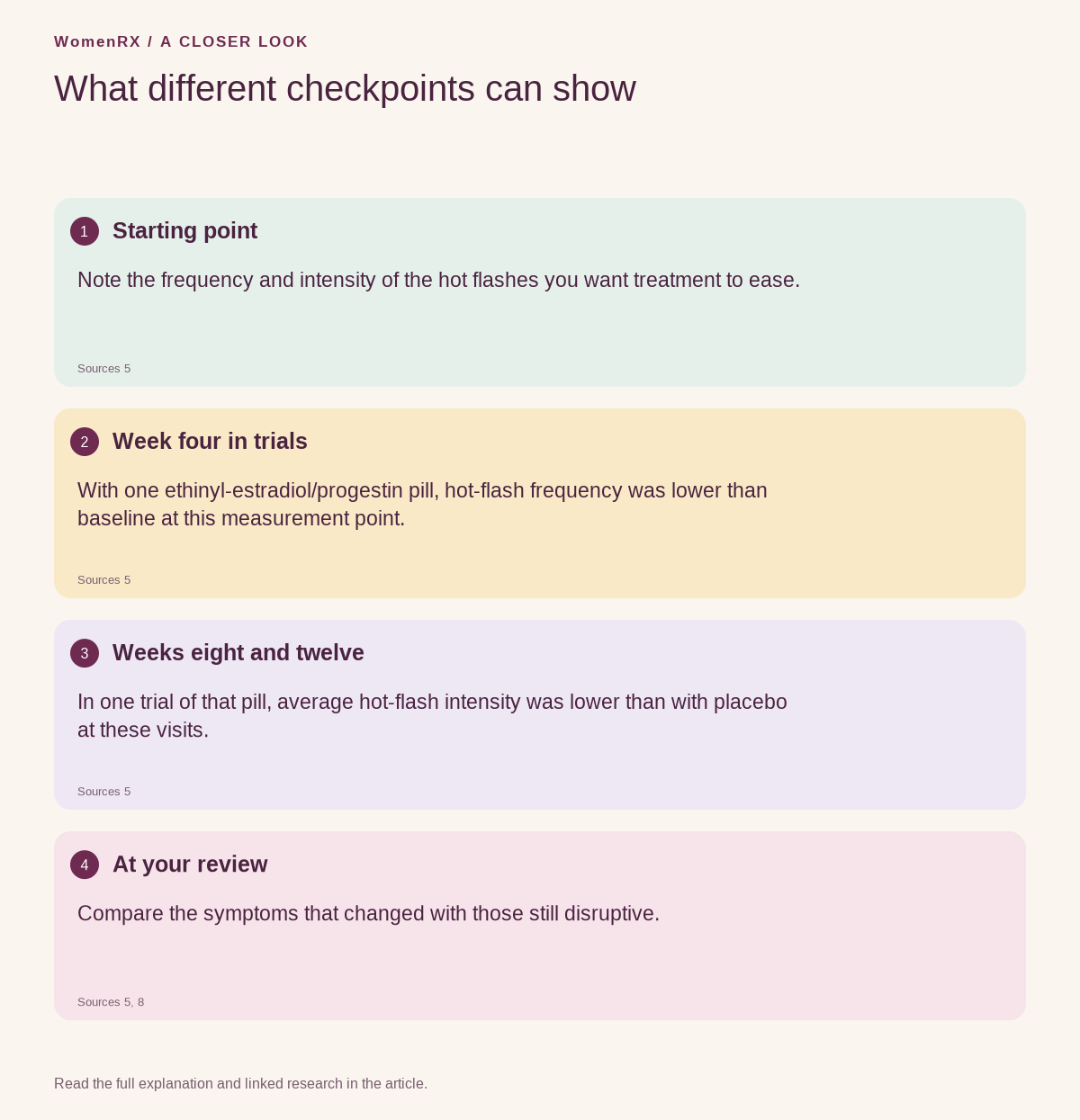
What different checkpoints can show
Starting point: Note the frequency and intensity of the hot flashes you want treatment to ease.5
Week four in trials: With one ethinyl-estradiol/progestin pill, hot-flash frequency was lower than baseline at this measurement point.5
Weeks eight and twelve: In one trial of that pill, average hot-flash intensity was lower than with placebo at these visits.5
At your review: Compare the symptoms that changed with those still disruptive.58
Read the figure as text
These checkpoints distinguish findings for one studied combined pill from questions to revisit about your own symptoms. They are not deadlines for improvement.- Starting point: Note the frequency and intensity of the hot flashes you want treatment to ease.5
- Week four in trials: With one ethinyl-estradiol/progestin pill, hot-flash frequency was lower than baseline at this measurement point.5
- Weeks eight and twelve: In one trial of that pill, average hot-flash intensity was lower than with placebo at these visits.5
- At your review: Compare the symptoms that changed with those still disruptive.58
More questions, answered
Does a better hot-flash week mean the treatment has reached its full effect?
Not necessarily. Trials of one combined pill measured hot-flash frequency and intensity at different follow-up points, with a frequency change from baseline reported by week four and a difference from placebo in intensity reported at weeks eight and twelve in one trial. One improved week is useful information, but it isn’t a measure of the treatment’s full effect. 5
Sources you can check
- Night sweats - NHSAccessed 2026-09-25Return to first citation
- Vaginal dryness - NHSAccessed 2026-09-25Return to first citation
- About vaginal oestrogen - NHSAccessed 2026-09-25Return to first citation
- Common questions about vaginal oestrogen - NHSAccessed 2026-09-25Return to first citation
- Effects of low-dose norethindrone acetate plus ethinyl estradiol (0.5 mg/2.5 microg) in women with postmenopausal symptoms: updated analysis of three randomized, controlled trials.Rowan JP, Simon JA, Speroff L, Ellman H. · Clinical therapeutics · 2006Return to first citation
- PERCEIVE: A retrospective, qualitative interview-based study of the impact of vasomotor symptoms associated with menopause on the lives of individuals who are not suitable candidates for hormone therapy.Hirschberg AL, Morga A, Bruon F, Martins K, Schild A, Hawryluk E, Roberts K, Williams B, Nappi RE. · Maturitas · 2025Return to first citation
- Efficacy of estrogen plus progestin on menopausal symptoms in women with systemic lupus erythematosus: a randomized, double-blind, controlled trial.Cravioto MD, Durand-Carbajal M, Jiménez-Santana L, Lara-Reyes P, Seuc AH, Sánchez-Guerrero J. · Arthritis care & research · 2011Return to first citation
- Current recommendations: what is the clinician to do?Manson JE. · Fertility and sterility · 2014Return to first citation