Who needs extra assessment before combined menopause hormone therapy?
Some histories are listed as contraindications for a specific progesterone product; others call for a closer look at your overall health and the treatment being considered.
A history of breast cancer, certain blood clots, stroke, or heart attack appears on the contraindication list for a U.S. progesterone capsule, but that label does not define every combined hormone product. Cardiovascular and breast cancer risk, other cancers, complex health conditions, and when you’re starting therapy all deserve individual review. Your uterus status and the exact medicines also help shape the discussion. 2 6 7
First, separate a product contraindication from a risk factor
There isn’t one avoid list that applies in the same way to every form of systemic menopause hormone therapy. A product’s prescribing information identifies situations in which that particular product should not be used. A clinician also considers your symptoms, medical history, treatment goals, and preferences when weighing benefits and risks. 3 6
For example, U.S. prescribing information for oral progesterone capsules lists breast cancer, a history of breast cancer, estrogen-dependent neoplasia, and active or previous deep vein thrombosis (DVT), pulmonary embolism (PE), or arterial thromboembolic disease as contraindications. Stroke and heart attack are examples of arterial events in that labeling. This is a product-specific list, not proof that all combined regimens have identical labeling. The exact estrogen and progestogen product matters. 2
That distinction is useful if you’ve had a serious medical condition but aren’t sure whether it rules out therapy. Don’t assume that a different route or formulation makes a listed contraindication irrelevant. Instead, ask how the product being considered applies to your history. 2 3
Histories that call for a closer review
Before starting systemic therapy, the Endocrine Society guideline recommends screening cardiovascular and breast cancer risk. A history of cardiovascular disease or substantial risk factors deserves discussion, but risk assessment is not the same as a blanket rule that every person with a risk factor must avoid every regimen. Hormone therapy is not recommended to prevent heart disease, heart attacks, strokes, or dementia. 1 4 6
A past cancer other than breast cancer, a blood-clotting history, liver or kidney problems, several ongoing conditions, or a long medication list can make the decision more complex. A review of clinical guidance notes that people with multimorbidity, organ impairment, prior malignancy, thromboembolic disorders, or polypharmacy are often underrepresented in trials. These histories aren’t all interchangeable or automatic exclusions; they may call for a more tailored review, sometimes with input from a clinician familiar with the condition. 7
The route can be part of that review. A clinical review describes a possible lower risk of venous clots and stroke with transdermal rather than oral estrogen, while noting that more research is needed. That possible difference can inform product selection, but it doesn’t erase a contraindication or replace assessment of your own history. 3
Timing matters, but it isn’t a yes-or-no test
Age and time since menopause help put potential benefits and risks in context. The Endocrine Society guideline says benefits may outweigh risks for many symptomatic postmenopausal women younger than 60 or within 10 years of menopause, while still recommending individualized decisions. Those ranges aren’t a personal guarantee of safety or a substitute for reviewing your health history. 6
Starting therapy later and continuing therapy you already use are also different questions. A review of guidelines says starting systemic therapy after age 65 is typically not advised, while describing continuation for selected people with persistent symptoms as a separate individualized decision. If you’re over 65, be clear whether you’re considering a new start or discussing ongoing treatment. 7
Your uterus and medicines belong in the conversation
Tell the prescriber whether you have a uterus and what surgeries you’ve had. Combined therapy pairs estrogen with a progestogen, such as progesterone; guidance discusses progestogen when endometrial protection is needed. That makes uterus status relevant to how the regimen is selected. It doesn’t mean every combined product or plan is interchangeable. 1 5
Bring a current list of medicines and supplements. For BIJUVA, a product combining estradiol and progesterone, prescribing information says some CYP3A4 inducers, including St. John’s wort, phenobarbital, carbamazepine, and rifampin, may lower hormone concentrations. Some inhibitors, including erythromycin, clarithromycin, ketoconazole, itraconazole, ritonavir, and grapefruit juice, may raise them. These examples come from BIJUVA’s labeling, so have the specific product’s interactions checked rather than assuming the same list applies to every regimen. 1
A useful way to frame the discussion
You can make the conversation more specific by bringing four details together: the symptoms you want treated, relevant cancer and cardiovascular history, whether you’re starting or continuing therapy, and whether you have a uterus. Add your medication and supplement list. Then ask which concerns are contraindications for the exact product, which call for additional assessment, and whether the route or formulation changes the balance for you. Guidelines emphasize symptoms, preferences, contraindications, timing, and baseline risks as parts of that decision. 3 6
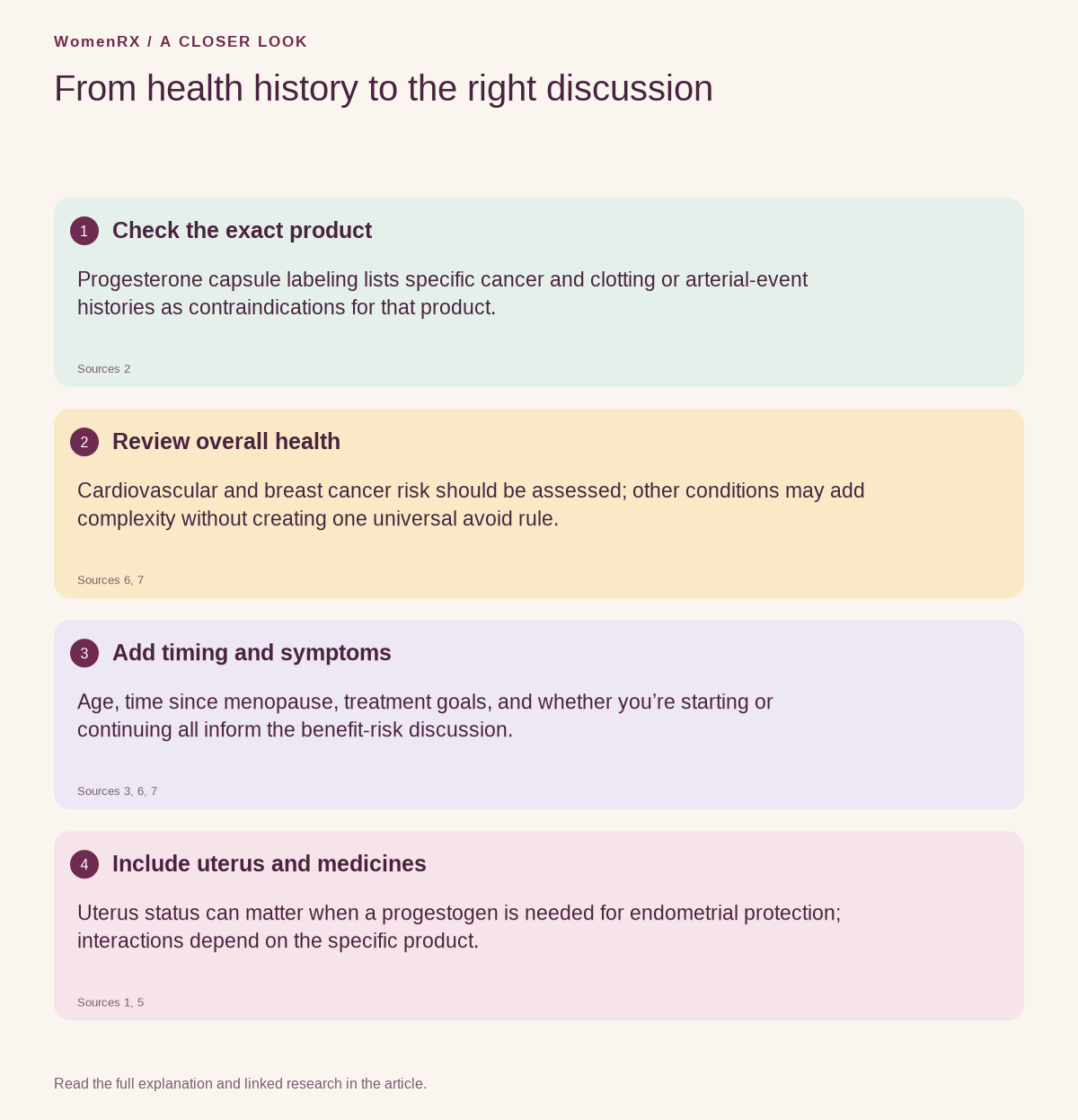
From health history to the right discussion
Check the exact product: Progesterone capsule labeling lists specific cancer and clotting or arterial-event histories as contraindications for that product.2
Review overall health: Cardiovascular and breast cancer risk should be assessed; other conditions may add complexity without creating one universal avoid rule.67
Add timing and symptoms: Age, time since menopause, treatment goals, and whether you’re starting or continuing all inform the benefit-risk discussion.367
Include uterus and medicines: Uterus status can matter when a progestogen is needed for endometrial protection; interactions depend on the specific product.15
Read the figure as text
A discussion map for sorting product-specific contraindications from histories that need individualized assessment. It cannot determine whether a regimen is suitable for you.- Check the exact product: Progesterone capsule labeling lists specific cancer and clotting or arterial-event histories as contraindications for that product.2
- Review overall health: Cardiovascular and breast cancer risk should be assessed; other conditions may add complexity without creating one universal avoid rule.67
- Add timing and symptoms: Age, time since menopause, treatment goals, and whether you’re starting or continuing all inform the benefit-risk discussion.367
- Include uterus and medicines: Uterus status can matter when a progestogen is needed for endometrial protection; interactions depend on the specific product.15
More questions, answered
Does being over 60 automatically rule out starting hormone therapy?
No. Age and time since menopause are part of the benefit-risk discussion, not a standalone answer. The Endocrine Society guideline says benefits may outweigh risks for many symptomatic postmenopausal women under 60 or within 10 years of menopause. A review says starting after 65 is typically not advised, but continuation is a separate question. 6 7
Does any past cancer rule out combined therapy?
The progesterone capsule labeling cited here specifically lists breast cancer, a history of breast cancer, and estrogen-dependent neoplasia as contraindications for that product. Other cancer histories aren’t all classified alike in the guidance summarized here; they may make the assessment more complex. 2 7
Sources you can check
- BIJUVA (ESTRADIOL AND PROGESTERONE) CAPSULE [MAYNE PHARMA] | US prescribing information and patient instructionsAccessed 2026-09-25Return to first citation
- PROMETRIUM (PROGESTERONE) CAPSULE [ACERTIS PHARMACEUTICALS, LLC] | US prescribing information and patient instructionsAccessed 2026-09-25Return to first citation
- Current recommendations: what is the clinician to do?Manson JE. · Fertility and sterility · 2014Return to first citation
- Menopausal Hormone Therapy and Cardiovascular Risk: Current Evidence and Clinical Implications.Buzduga CM, Bobu AM, Covali R, Costea CF, Cucu AI, Graur M, Patrascanu E, Solomon-Condriuc I, Carauleanu A. · Medical sciences (Basel, Switzerland) · 2026Return to first citation
- Menopausal Hormone Therapy: A Narrative Review of Contemporary Evidence.Finks SW, Cieri-Hutcherson NE, Vernon V, McBane SE. · Pharmacotherapy · 2026Return to first citation
- Treatment of Symptoms of the Menopause: An Endocrine Society Clinical Practice Guideline.Stuenkel CA, Davis SR, Gompel A, Lumsden MA, Murad MH, Pinkerton JV, Santen RJ. · The Journal of clinical endocrinology and metabolism · 2015Return to first citation
- Menopausal Hormone Therapy in Clinically Vulnerable Women: A Narrative Review of Guidelines and Real-World Evidence.Yanachkova V, Lebanova H, Stoev S. · Medicina (Kaunas, Lithuania) · 2026Return to first citation