Combined menopause hormone therapy: uses, benefits, risks, and choices
The right discussion starts with your symptoms and whether you have a uterus, then weighs route, regimen, bleeding preferences, and personal health history.
Combined menopausal hormone therapy pairs estrogen with progesterone or a similar progestogen. It’s commonly considered for bothersome menopause symptoms when you have a uterus, because estrogen can stimulate the uterine lining; people without a uterus may often use estrogen alone. Route and regimen can affect bleeding and some risks, so there isn’t one best option for everyone. 1 3 4
What combined therapy is meant to do
Combined therapy contains estrogen, such as estradiol or conjugated estrogens, plus progesterone or a progestin. Systemic hormone therapy can ease menopause symptoms; it may also help protect against osteoporosis. The specific symptom you most want to address matters: treatment intended for disruptive symptoms is a different decision from using hormones solely in hope of preventing future disease. 1
If you have a uterus, estrogen can stimulate the uterine lining. MedlinePlus describes estrogen plus progesterone or progestin as the usual hormone-therapy approach for people with a uterus, while estrogen alone may be recommended after the uterus has been removed. A systematic review also found that endometrial-cancer findings differed by estrogen-only, continuous-combined, and sequential-combined regimens. The studies were heterogeneous, so “combined” should not be taken to mean every formulation and schedule has the same effect. 1 4
A hysterectomy removes the uterus, but not necessarily the ovaries. If you’ve had surgery, the distinction that matters for this choice is whether your uterus is still present. 2
Regimen and route can change the experience
Combined therapy may be continuous, with estrogen and progestogen used together, or sequential, with the progestogen used on a different schedule. The evidence review found that endometrial-cancer outcomes varied with regimen and with factors such as progestogen type, amount, and duration. Those findings do not establish one schedule as best for every person. 4
Bleeding is another practical difference. A systematic review of continuous-combined therapy in postmenopausal women with a uterus found that bleeding profiles varied by formulation and route. In comparisons across separate studies, oral therapy generally had a more favorable bleeding profile than transdermal therapy; bleeding and spotting tended to improve over time. Because those were not direct head-to-head comparisons, this is a factor to weigh, not a guarantee of what you’ll experience. 3
Estrogen can be taken by mouth or delivered through the skin, including by patch, gel, or spray. Route may also matter to vascular-risk discussions. A meta-analysis of 15 observational studies in postmenopausal women found oral estrogen therapy was associated with more venous blood clots and deep-vein thrombosis than transdermal estrogen therapy; the evidence was low confidence and did not show a difference in heart-attack risk. That review compared estrogen therapy routes, not every combined product. A separate review of guideline and observational evidence also described lower venous-clot risk with transdermal regimens, but route does not remove the need to consider your overall health and history. 5 6
Build the decision around your situation
A useful discussion is not simply “hormones: yes or no.” Consider these factors together:
- Your main goal: Which symptoms are disrupting daily life, and what benefit would make treatment worthwhile? Hormone therapy may help menopause symptoms and may protect against osteoporosis, but that does not make it the right choice for every goal. 1
- Whether you have a uterus: This affects whether estrogen is paired with a progestogen. If you’ve had a hysterectomy, clarify whether it was the uterus that was removed. 1 2
- Route and bleeding preferences: Oral and skin-delivered options differ in convenience, and bleeding patterns can vary by formulation and route. Ask what pattern is possible with the specific regimen being considered. 1 3
- Your health history and timing: MedlinePlus notes that risks depend on the type of therapy, how long it’s used, and medical history and lifestyle. A review of guidelines and evidence describes a generally more favorable benefit-risk balance when therapy is started before age 60 or within 10 years of menopause, while emphasizing individual risk. These are context for a decision, not a personal prediction or a rule that overrides your circumstances. 1 5
For example, if hot flashes are the main problem and you have a uterus, the conversation may focus on a systemic estrogen-progestogen regimen, which route fits your health history, and what bleeding to expect. If you don’t have a uterus, whether estrogen alone is appropriate may be part of the discussion instead. Those are different starting points, not universal prescriptions.
One practical question to ask is: “What is this option intended to improve, and how would my uterus status, route, and medical history change the choice?” That keeps the discussion tied to your priorities and the tradeoffs that actually distinguish the options.
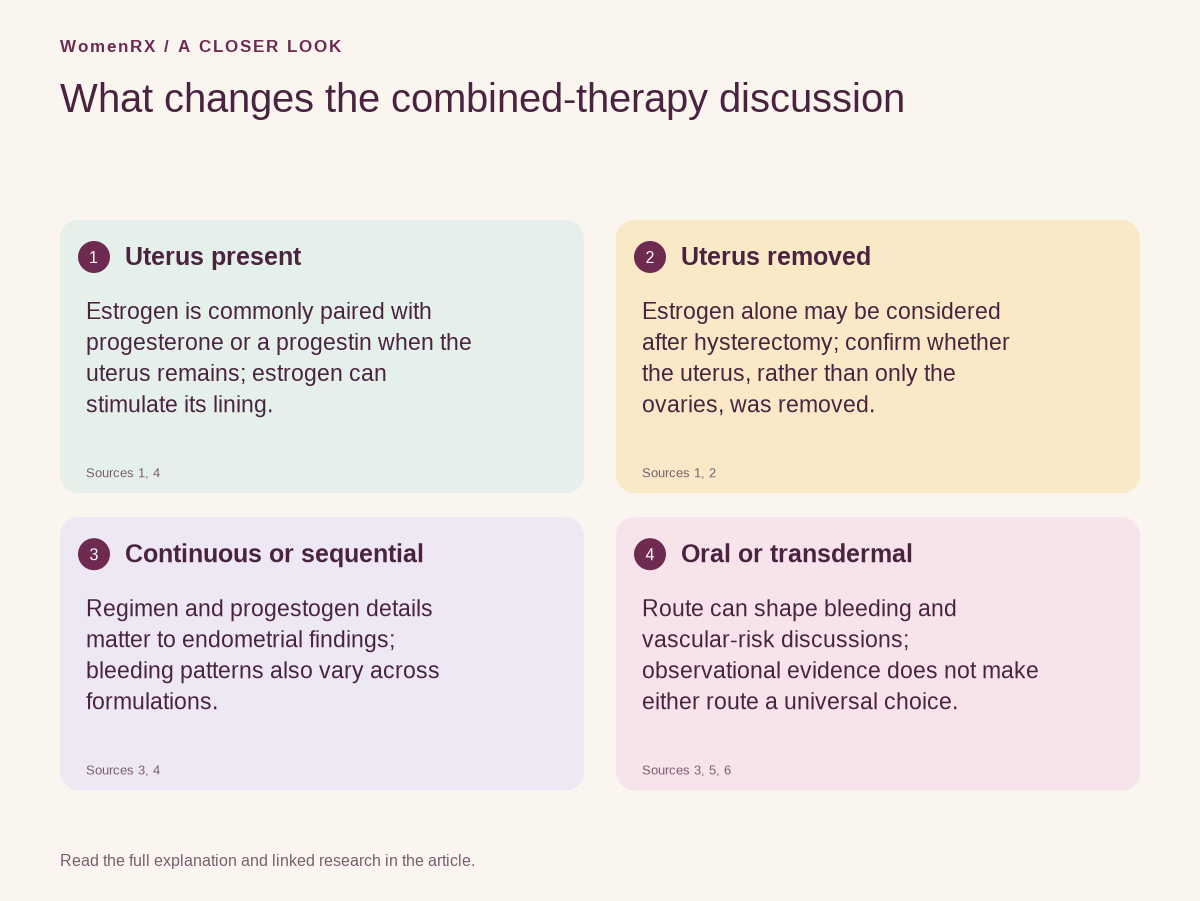
What changes the combined-therapy discussion
Uterus present: Estrogen is commonly paired with progesterone or a progestin when the uterus remains; estrogen can stimulate its lining.14
Uterus removed: Estrogen alone may be considered after hysterectomy; confirm whether the uterus, rather than only the ovaries, was removed.12
Continuous or sequential: Regimen and progestogen details matter to endometrial findings; bleeding patterns also vary across formulations.34
Oral or transdermal: Route can shape bleeding and vascular-risk discussions; observational evidence does not make either route a universal choice.356
Read the figure as text
These are connected decision factors, not competing treatments. The same person may weigh several at once.- Uterus present: Estrogen is commonly paired with progesterone or a progestin when the uterus remains; estrogen can stimulate its lining.14
- Uterus removed: Estrogen alone may be considered after hysterectomy; confirm whether the uterus, rather than only the ovaries, was removed.12
- Continuous or sequential: Regimen and progestogen details matter to endometrial findings; bleeding patterns also vary across formulations.34
- Oral or transdermal: Route can shape bleeding and vascular-risk discussions; observational evidence does not make either route a universal choice.356
Sources you can check
- Hormone Therapy for Menopause | MedlinePlusAccessed 2026-09-25Return to first citation
- Menopause | Menopause Symptoms | MedlinePlusAccessed 2026-09-25Return to first citation
- Uterine bleeding with hormone therapies in menopausal women: a systematic review.Pickar JH, Archer DF, Goldstein SR, Kagan R, Bernick B, Mirkin S. · Climacteric : the journal of the International Menopause Society · 2020Return to first citation
- Menopausal Hormone Therapy and Risk of Endometrial Cancer: A Systematic Review.Tempfer CB, Hilal Z, Kern P, Juhasz-Boess I, Rezniczek GA. · Cancers · 2020Return to first citation
- Menopausal Hormone Therapy in Clinically Vulnerable Women: A Narrative Review of Guidelines and Real-World Evidence.Yanachkova V, Lebanova H, Stoev S. · Medicina (Kaunas, Lithuania) · 2026Return to first citation
- Oral vs Transdermal Estrogen Therapy and Vascular Events: A Systematic Review and Meta-Analysis.Mohammed K, Abu Dabrh AM, Benkhadra K, Al Nofal A, Carranza Leon BG, Prokop LJ, Montori VM, Faubion SS, Murad MH. · The Journal of clinical endocrinology and metabolism · 2015Return to first citation