What symptoms can combined menopause hormone therapy improve?
Combined therapy can ease hot flashes and night sweats, while the progestogen’s key role is protecting the uterine lining when you use systemic estrogen.
Combined therapy pairs systemic estrogen with progesterone or a progestin. Hormone therapy is the most effective treatment for hot flashes and night sweats. If you have a uterus, the progestogen’s key role is protecting its lining. Hormone therapy also helps prevent bone loss, but vaginal or urinary symptoms may call for a different treatment approach, and it should not be taken to prevent heart disease or dementia. 3 6
The clearest benefit: fewer hot flashes and night sweats
Combined menopause hormone therapy (MHT) uses estrogen with progesterone or a progestin. Its best-established symptom goal is relief from vasomotor symptoms, especially hot flashes and night sweats. The Menopause Society describes hormone therapy as the most effective treatment for these symptoms. 6 7
That can matter beyond the hot flashes themselves. If night sweats are waking you, sleep may improve when the vasomotor symptoms improve. A network meta-analysis of sleep-treatment trials found a benefit for oral combined hormone therapy in a subgroup of trials involving vasomotor symptoms. That finding is about sleep disturbance in this context, not a general treatment for insomnia from any cause. 5
Vaginal symptoms are a separate treatment question
Vaginal dryness and pain or discomfort with sex can occur during menopause, whether or not hot flashes are a concern. But those symptoms do not automatically mean systemic combined therapy is the right fit. For bothersome genitourinary symptoms when there is no other reason to use systemic hormone therapy, the Menopause Society identifies low-dose vaginal estrogen and other treatments as options. 2 6
Don’t assume systemic combined MHT will improve urinary leakage or prevent urinary tract infections. The available guidance distinguishes genitourinary symptoms from the reasons to use systemic therapy; it does not establish those broader urinary outcomes as expected benefits of combined treatment. 2 6
Why a progestogen is included
When someone with a uterus uses systemic estrogen, a progestogen is needed to protect the uterine lining. Estrogen can stimulate that lining, and unopposed estrogen can lead to endometrial overgrowth. A systematic review covering 84 randomized trials found that most studies demonstrated endometrial protection for the specific progestogen formulation and treatment period examined, though study quality varied. 3 4
So, in combined therapy, the progestogen’s established job is uterine protection. Its presence should not be read as a promise of extra symptom relief. If you’ve had a hysterectomy, estrogen-only therapy may be an option because there is no uterine lining to protect; the appropriate regimen still depends on your circumstances. 1 3
Bone protection is a supported health outcome
Hormone therapy has been shown to prevent bone loss and fractures. The Menopause Society says the benefit-risk balance is generally more favorable for people younger than 60 or within 10 years of menopause onset who have no contraindications, when treatment is for bothersome symptoms or bone-loss prevention. This is a benefit of hormone therapy overall, not evidence that combined therapy has a unique bone effect beyond estrogen-containing therapy. 6
Age and timing matter to the conversation. When therapy starts more than 10 years after menopause begins or after age 60, the benefit-risk balance appears less favorable, in part because the absolute risks of coronary heart disease, stroke, venous thromboembolism, and dementia are higher in those groups. MHT should not be treated as a way to prevent heart disease or dementia. 6
Mood effects are less certain
Some people experience mood changes during perimenopause, but mood improvement is a less certain goal for MHT than relief from hot flashes. A 2026 meta-analysis of 12 randomized trials in perimenopausal women found a small average reduction in depressive symptom severity with MHT compared with placebo. The authors judged the evidence limited, and the finding does not establish combined therapy as a treatment for depression generally. 8
Match the treatment goal to the treatment
A helpful starting point is to name the symptom you want to change, then consider why a particular regimen is being discussed. For example, if hot flashes are disrupting sleep and you have a uterus, systemic combined therapy may address the vasomotor symptoms while the progestogen protects the uterine lining. If vaginal dryness is your main concern, local treatment may be a more relevant discussion than systemic combined therapy. 3 5 6
The expected benefit also depends on when treatment starts and on individual health factors. Combined therapy is not a general-purpose plan for aging, cardiovascular prevention, or dementia prevention. Its clearest symptom benefit is for hot flashes and night sweats; bone protection is a separate supported outcome, and vaginal or urinary symptoms should be considered on their own terms. 6
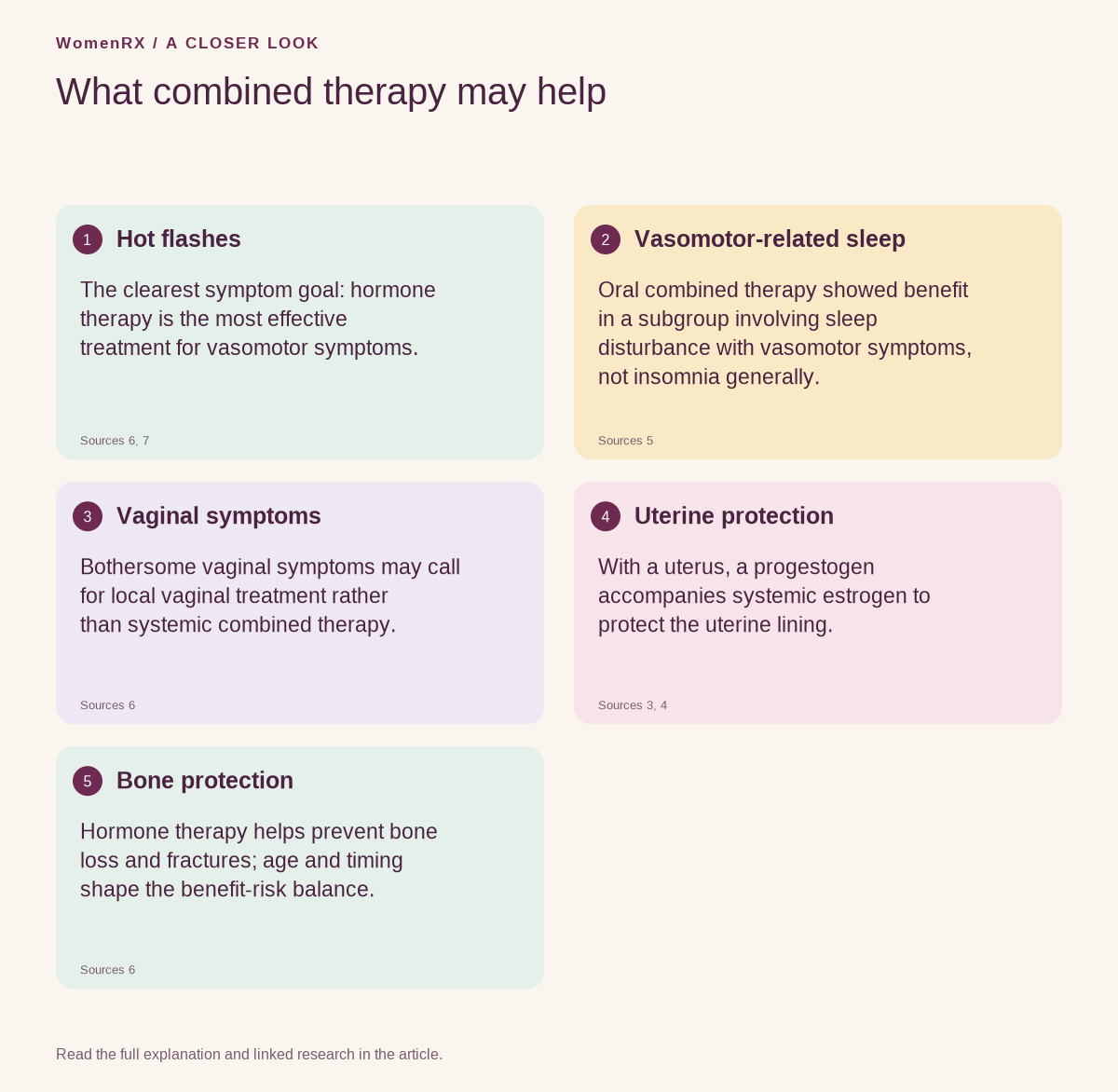
What combined therapy may help
Hot flashes: The clearest symptom goal: hormone therapy is the most effective treatment for vasomotor symptoms.67
Vasomotor-related sleep: Oral combined therapy showed benefit in a subgroup involving sleep disturbance with vasomotor symptoms, not insomnia generally.5
Vaginal symptoms: Bothersome vaginal symptoms may call for local vaginal treatment rather than systemic combined therapy.6
Uterine protection: With a uterus, a progestogen accompanies systemic estrogen to protect the uterine lining.34
Bone protection: Hormone therapy helps prevent bone loss and fractures; age and timing shape the benefit-risk balance.6
Read the figure as text
The expected symptom benefit and the reason for adding a progestogen are different parts of the treatment decision.- Hot flashes: The clearest symptom goal: hormone therapy is the most effective treatment for vasomotor symptoms.67
- Vasomotor-related sleep: Oral combined therapy showed benefit in a subgroup involving sleep disturbance with vasomotor symptoms, not insomnia generally.5
- Vaginal symptoms: Bothersome vaginal symptoms may call for local vaginal treatment rather than systemic combined therapy.6
- Uterine protection: With a uterus, a progestogen accompanies systemic estrogen to protect the uterine lining.34
- Bone protection: Hormone therapy helps prevent bone loss and fractures; age and timing shape the benefit-risk balance.6
Sources you can check
- Hormone Therapy for Menopause | MedlinePlusAccessed 2026-09-25Return to first citation
- Menopause | Menopause Symptoms | MedlinePlusAccessed 2026-09-25Return to first citation
- Progestogens for endometrial protection in combined menopausal hormone therapy: A systematic review.Stute P, Walker LJ, Eicher A, Pavicic E, Kolokythas A, Theis S, von Gernler M, von Wolff M, Vollrath S. · Best practice & research. Clinical endocrinology & metabolism · 2024Return to first citation
- Progestogens in menopausal hormone therapy.Bińkowska M, Woroń J. · Przeglad menopauzalny = Menopause review · 2015Return to first citation
- Pharmacologic and hormonal treatments for menopausal sleep disturbances: A network meta-analysis of 43 randomized controlled trials and 32,271 menopausal women.Cheng YS, Tseng PT, Wu MK, Tu YK, Wu YC, Li DJ, Chen TY, Su KP, Stubbs B, Carvalho AF, Lin PY, Matsuoka YJ, Chen YW, Sun CK, Shiue YL. · Sleep medicine reviews · 2021Return to first citation
- The 2022 hormone therapy position statement of The North American Menopause Society.“The 2022 Hormone Therapy Position Statement of The North American Menopause Society” Advisory Panel. · Menopause (New York, N.Y.) · 2022Return to first citation
- The 2023 nonhormone therapy position statement of The North American Menopause Society.Menopause (New York, N.Y.) · 2023Return to first citation
- Efficacy and safety of menopausal hormone therapy for depressive symptoms in perimenopausal women: A systematic review and meta-analysis.Li Y, Sun Y, Bi Y, Yang L, Xu Y, Wu H, Ma X. · Journal of affective disorders · 2026Return to first citation