Local or Systemic Estrogen: Which Menopause Symptoms Are You Treating?
The right route depends on whether your main concern is vaginal or urinary discomfort, hot flashes, or both.
Low-dose vaginal estrogen is aimed at genitourinary symptoms such as vaginal dryness and irritation; it won’t treat hot flashes. Systemic hormone therapy is the route to discuss for bothersome hot flashes, and it may also help genitourinary symptoms. If you have both, ask about each target separately. Uterine status, medical history, and the specific vaginal product matter when discussing progestogen and risks. 1 3
Start with the symptoms you want to treat
Vaginal dryness, irritation, and pain with sex are genitourinary symptoms of menopause. Urinary urgency, discomfort with urination, and recurrent urinary tract infections can also occur as part of genitourinary syndrome of menopause (GSM). These symptoms have a different treatment target from hot flashes and night sweats. 3 6
Low-dose vaginal estrogen acts mainly in vaginal tissues and is used for genitourinary symptoms. It can help vaginal dryness and irritation, but it does not treat hot flashes or other menopause symptoms such as sleep problems. 1 2
Systemic hormone therapy is the route to discuss when hot flashes or night sweats are the main concern. The North American Menopause Society identifies hormone therapy as the most effective treatment for vasomotor symptoms. Systemic therapy may also help GSM, but if your symptoms are only vaginal or urinary and aren’t relieved by over-the-counter options, guidance supports considering low-dose vaginal estrogen or another GSM treatment rather than assuming you need systemic therapy. 3
If both symptom groups are bothering you, make both part of the conversation. Ask whether systemic therapy is suitable for the hot flashes and whether the vaginal or urinary symptoms need their own treatment plan. The symptoms can have different targets, so improvement in one group doesn’t guarantee relief in the other. 1 3
“Local” means lower exposure, not one identical product
Vaginal estrogen comes in different forms, including creams, tablets, and rings. Local treatment generally results in little estrogen reaching the rest of the body, which is why low-dose vaginal estrogen is treated differently from systemic therapy. But that doesn’t mean every vaginal product has identical absorption or risk. A 2026 review noted that direct comparisons between formulations in breast cancer survivors are lacking, so ask about the specific product and dose being considered rather than treating all vaginal estrogen as interchangeable. 1 7
That distinction matters especially if you have a personal history of breast cancer or are taking an aromatase inhibitor. Evidence in this setting is still developing: a small randomized trial reported improvement in vaginal dryness and pain with sex over 24 weeks, but it enrolled only 23 participants. A later review described the recurrence question for people on aromatase inhibitors as unsettled. These findings support a specific, individualized discussion, not a blanket promise of safety or a blanket rule against treatment. 5 7
Ask how your uterus changes the plan
With systemic estrogen, whether you have a uterus matters because estrogen is generally paired with a progestogen to protect the uterine lining. Low-dose vaginal estrogen is different: because little medicine reaches the rest of the body, progestogen is generally not needed for standard low-dose local treatment. Don’t assume that rule applies identically to every product or dose; ask what applies to the exact treatment being discussed. 1
It’s useful to mention whether you’ve had a hysterectomy, any unexplained vaginal bleeding, and your relevant medical history. The benefits and risks of hormone therapy vary with its type, dose, duration, route, timing, and whether a progestogen is used. A history of breast cancer or cardiovascular disease can also change whether systemic therapy is appropriate. 3 4
Questions that make the comparison useful
You might ask:
- “Which of my symptoms is this treatment meant to improve: hot flashes, vaginal discomfort, urinary symptoms, or more than one?”
- “Is this a low-dose local product or systemic therapy, and what does that mean for exposure outside the vagina?”
- “Given my uterine status, do I need a progestogen with this specific treatment?”
- “Does my medical history change the options, especially if I’ve had breast cancer or take an aromatase inhibitor?”
- “If one symptom group improves but another doesn’t, what would we reconsider?”
The practical distinction is simple: local vaginal estrogen is usually chosen for genitourinary symptoms; systemic therapy is the option to discuss for hot flashes. Your symptom mix and personal history determine whether one route, another, or a more individualized plan makes sense. 1 3
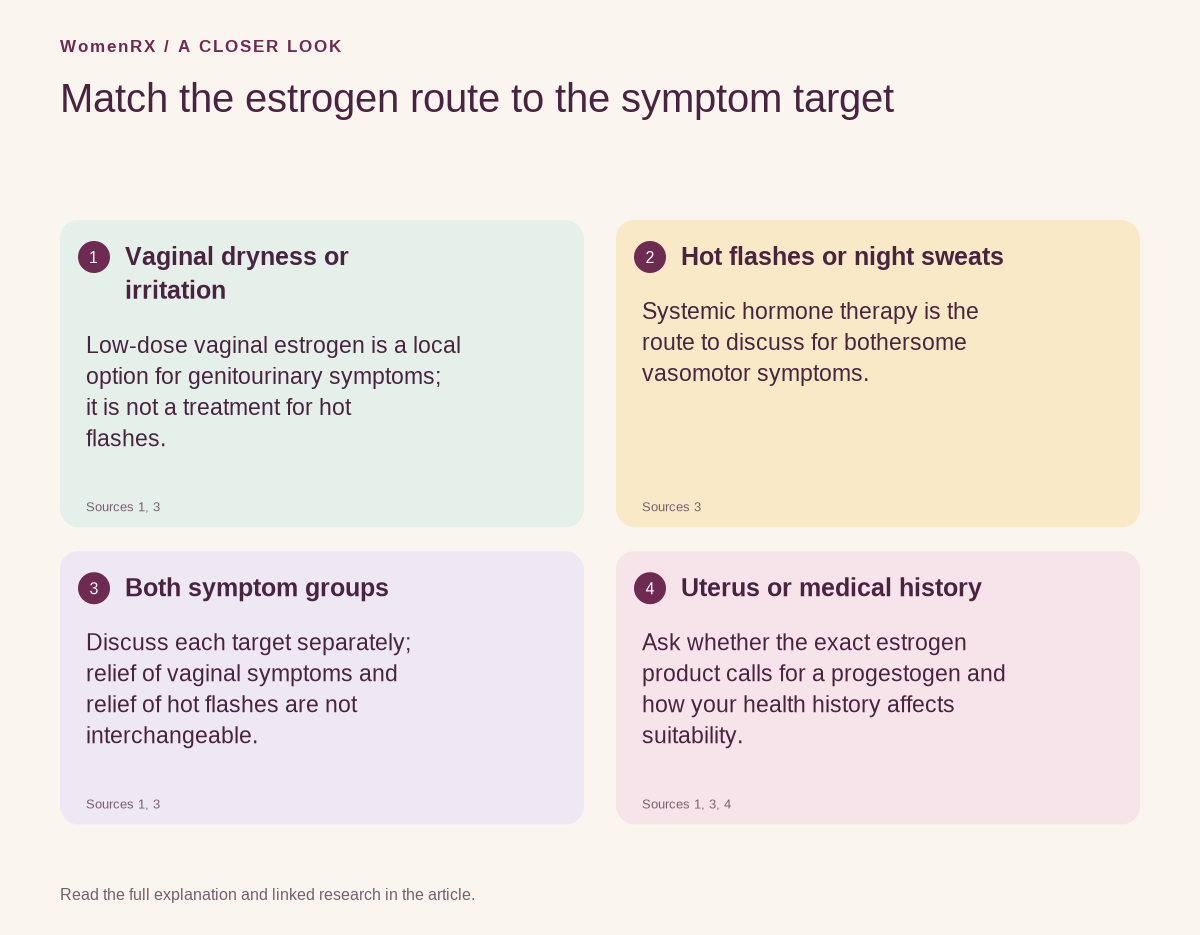
Match the estrogen route to the symptom target
Vaginal dryness or irritation: Low-dose vaginal estrogen is a local option for genitourinary symptoms; it is not a treatment for hot flashes.13
Hot flashes or night sweats: Systemic hormone therapy is the route to discuss for bothersome vasomotor symptoms.3
Both symptom groups: Discuss each target separately; relief of vaginal symptoms and relief of hot flashes are not interchangeable.13
Uterus or medical history: Ask whether the exact estrogen product calls for a progestogen and how your health history affects suitability.134
Read the figure as text
This comparison separates the main treatment targets and highlights questions that depend on the specific product and your history.- Vaginal dryness or irritation: Low-dose vaginal estrogen is a local option for genitourinary symptoms; it is not a treatment for hot flashes.13
- Hot flashes or night sweats: Systemic hormone therapy is the route to discuss for bothersome vasomotor symptoms.3
- Both symptom groups: Discuss each target separately; relief of vaginal symptoms and relief of hot flashes are not interchangeable.13
- Uterus or medical history: Ask whether the exact estrogen product calls for a progestogen and how your health history affects suitability.134
More questions, answered
Can vaginal estrogen help urinary symptoms?
Urinary urgency, discomfort with urination, and recurrent urinary tract infections can occur as part of GSM, but they can have other causes too. Ask whether your symptoms fit GSM and whether local treatment is appropriate for your situation. 6
Does a history of breast cancer rule out vaginal estrogen?
The evidence does not support a simple yes-or-no answer for everyone. In particular, recurrence evidence for people taking aromatase inhibitors remains uncertain, so discuss the specific product, your cancer history, and current treatment with your care team. 5 7
Sources you can check
- About vaginal oestrogen - NHSAccessed 2026-09-25Return to first citation
- Common questions about vaginal oestrogen - NHSAccessed 2026-09-25Return to first citation
- The 2022 hormone therapy position statement of The North American Menopause Society.“The 2022 Hormone Therapy Position Statement of The North American Menopause Society” Advisory Panel. · Menopause (New York, N.Y.) · 2022Return to first citation
- The 2023 nonhormone therapy position statement of The North American Menopause Society.Menopause (New York, N.Y.) · 2023Return to first citation
- VEMORA: Vaginal Estrogen versus non-hormonal MOisturizer in women Receiving Aromatase inhibitors: a randomized, controlled trial.Niravath P, Rimawi M, Sun K, Mai H, Puri A, Vyas A, Nangia J, Brock A, Foreman C, Adnan H, Shafer M, Anand A, Moges A, Al Najjar E, Mathur S, Antosh D, High R, Zaid T, Chang J, Osb... · Breast cancer research and treatment · 2026Return to first citation
- Vaginal Estrogen: Pearls for the Practitioner A Practical Review of Evidence, Guidelines, and Prescribing Strategies for Genitourinary Syndrome of Menopause.Perelmuter S, Srivastava M, Freedman KP, Hanfling S, Rubin RS. · Journal of women's health (2002) · 2026Return to first citation
- Safety of vaginal estrogen in breast cancer survivors: Current evidence on systemic absorption and oncologic outcomes.Mainar LB, Nieto-Pascual L, Bravo EI, García-Ramos BO, Llaneza IP, Vilanova CT, Lloret AM, Alsina JC. · Maturitas · 2026Return to first citation