Vaginal Estrogen: Which Changes Are Realistic to Track?
Track dryness, discomfort, urinary changes, and treatment tolerability separately; improvement can take time, and not every symptom has the same cause.
Vaginal estrogen is used for menopause-related vaginal dryness and irritation, but it doesn’t treat every menopause symptom, and improvement isn’t guaranteed. Record vaginal comfort, urinary symptoms, and side effects separately. It can take up to three months to work fully; if symptoms haven’t improved by then, review the plan. Urinary symptoms with signs of infection, or heavy or unexpected bleeding, also merit medical review. 1 2 3
Start with what you want to feel different
Vaginal estrogen is a local treatment for menopause-related vaginal dryness and irritation. It doesn’t treat hot flashes, mood changes, or sleep problems. 1 Genitourinary syndrome of menopause can involve vaginal, sexual, and lower urinary tract symptoms, but a urinary change can also have another cause, such as an infection. 4 5 3
Before you start, jot down the symptoms you want to change and how they affect everyday life. For example, note dryness or irritation, discomfort during sex, or discomfort during other activities. If you have urinary symptoms, record those separately, such as urgency or burning. These examples are a practical way to organize your notes, not a diagnostic checklist.
Keep the format simple: what you noticed, how much it bothered you, and whether it affected an activity you care about. You might use “mild,” “moderate,” or “severe,” or just a few words. The goal is to notice your own pattern, not to create a perfect score.
Compare changes over time, without expecting a promise
Vaginal estrogen may take up to three months to work fully. As you use it, note whether each symptom changes and whether the treatment is comfortable. Early side effects can include headache, abdominal or vaginal pain, and bleeding; these may improve over the first few months. If an effect bothers you or doesn’t settle, raise it with the prescriber. 1 3
Around three months, compare each symptom with your starting notes. Is dryness less bothersome? Is sex or another activity more comfortable? Are urinary symptoms better, unchanged, or worse? If you don’t feel better after three months, guidance recommends discussing it with your doctor; a different type of vaginal estrogen may be considered. 2
There’s no guaranteed personal response or exact improvement to expect. In a small 12-week randomized pilot trial, symptoms improved over time in both the vaginal-estrogen and vaginal-hyaluronic-acid groups, with no clinically meaningful difference between the treatments. The study doesn’t predict how much an individual will improve. 5
Keep urinary symptoms in their own column
Record urinary changes, but don’t assume they will improve just because vaginal dryness does. Vaginal estrogen is used for local vaginal symptoms, while genitourinary syndrome can include lower urinary tract symptoms too. If you have urinary symptoms alongside signs such as a raised temperature, local pain, or itching, contact a clinician to check whether an infection or another issue could be involved. 1 3 4
This separation can make your notes more useful. For example: “Dryness is less bothersome, but I have new burning when I urinate.” That’s clearer than labeling everything simply “better” or “not better.”
Include treatment comfort and bleeding
Note vaginal pain, itching, headache, or any other effect that makes treatment harder to use. If pain or itching doesn’t improve, or a side effect continues to bother you, ask about it; adjusting the treatment or switching types may be an option. 2 3
Record bleeding too, including when it occurs and whether it seems heavy or unexpected. The guidance advises seeking medical review for heavy bleeding, or unexpected bleeding after six months of use. Don’t use a tracker as a reason to wait out bleeding that concerns you. 3
A useful review can be specific: “Dryness has improved, but burning with urination is new,” or “I haven’t noticed a change after about three months, and the treatment causes itching.” Your notes can show which symptom changed, which did not, and what you want addressed next.
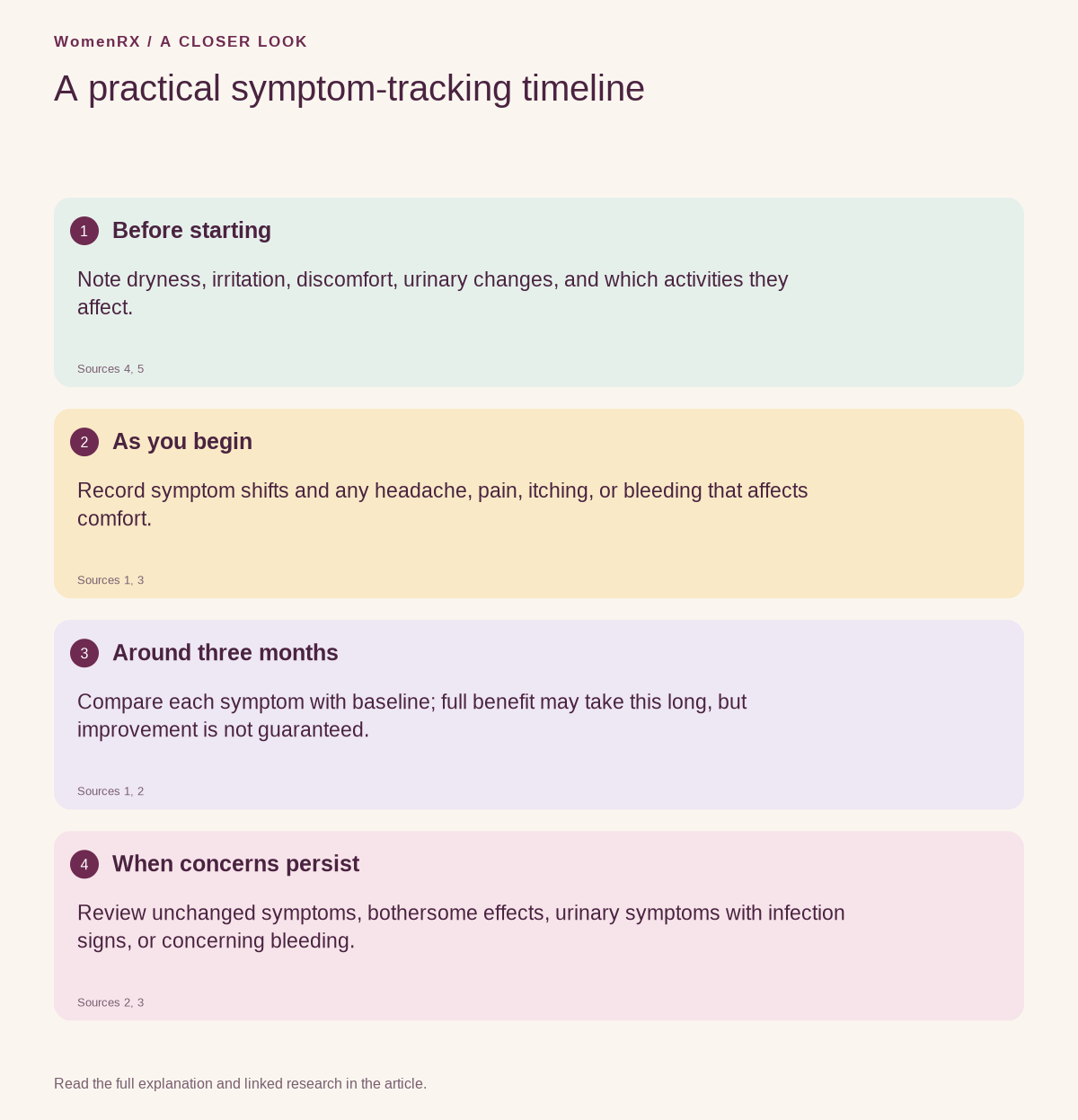
A practical symptom-tracking timeline
Before starting: Note dryness, irritation, discomfort, urinary changes, and which activities they affect.45
As you begin: Record symptom shifts and any headache, pain, itching, or bleeding that affects comfort.13
Around three months: Compare each symptom with baseline; full benefit may take this long, but improvement is not guaranteed.12
When concerns persist: Review unchanged symptoms, bothersome effects, urinary symptoms with infection signs, or concerning bleeding.23
Read the figure as text
Compare your own symptoms and treatment comfort at a few useful checkpoints without assuming a particular result.- Before starting: Note dryness, irritation, discomfort, urinary changes, and which activities they affect.45
- As you begin: Record symptom shifts and any headache, pain, itching, or bleeding that affects comfort.13
- Around three months: Compare each symptom with baseline; full benefit may take this long, but improvement is not guaranteed.12
- When concerns persist: Review unchanged symptoms, bothersome effects, urinary symptoms with infection signs, or concerning bleeding.23
More questions, answered
Will vaginal estrogen help hot flashes or sleep problems?
No. Vaginal estrogen is used for local symptoms such as vaginal dryness and irritation, not hot flashes, mood changes, or sleep problems. 1
What if one symptom improves but another doesn’t?
Keep them separate in your notes. Vaginal and urinary symptoms can have different causes, and urinary symptoms with signs such as fever, local pain, or itching may need evaluation for infection. 3 4
Sources you can check
- About vaginal oestrogen - NHSAccessed 2026-09-25Return to first citation
- Common questions about vaginal oestrogen - NHSAccessed 2026-09-25Return to first citation
- Side effects of vaginal oestrogen - NHSAccessed 2026-09-25Return to first citation
- The 2022 hormone therapy position statement of The North American Menopause Society.“The 2022 Hormone Therapy Position Statement of The North American Menopause Society” Advisory Panel. · Menopause (New York, N.Y.) · 2022Return to first citation
- A randomized, pilot trial comparing vaginal hyaluronic acid to vaginal estrogen for the treatment of genitourinary syndrome of menopause.Agrawal S, Agrawal S, LaPier Z, Nagpal S, Oot A, Friedman S, Hade EM, Nachtigall L, Brucker BM, Escobar C. · Menopause (New York, N.Y.) · 2024Return to first citation