Vaginal Estrogen for Menopause Symptoms: Benefits, Limits, and Safety
Local vaginal estrogen can ease menopause-related vaginal symptoms and may help some urinary symptoms, but it won’t treat hot flashes.
Vaginal estrogen is used for menopause-related dryness and irritation. A review focused on women with cancer also describes possible relief of pain during sex. It may also help some urinary symptoms, including recurrent urinary tract infections, but the evidence differs by outcome. It won’t treat hot flashes. Full improvement can take up to three months. The product and dose matter, as do unexplained bleeding and a history of hormone-sensitive cancer. 1 2 6 7
What local estrogen is meant to treat
As estrogen falls around menopause, some women develop vaginal and urinary symptoms together, a pattern called genitourinary syndrome of menopause. Vaginal dryness and irritation are the clearest treatment goals for local estrogen. Pain during sex can also be part of this pattern; a review focused on women with cancer describes possible relief with local estrogen. Local products include creams, gels, tablets, pessaries, and rings. They deliver estrogen in the vagina, with much less reaching the rest of the body than with systemic hormone therapy. 1 2 7
Urinary symptoms such as urgency or discomfort when urinating can occur alongside vaginal symptoms. A small randomized pilot study of 30 postmenopausal women found urinary-symptom scores improved over three months in the group using vaginal estriol. A review focused on women with cancer also describes a role for low-dose vaginal estrogen in reducing recurrent urinary tract infections, but the pilot study measured urinary complaints, not whether infections were prevented. Neither finding guarantees that estrogen will resolve an individual urinary problem. 6 7 If an urgent need to pee comes with a raised temperature, local pain, or itching, check with a doctor about a possible infection. 4
Local treatment is not whole-body hormone therapy
Vaginal estrogen is not expected to treat hot flashes, night sweats, or other symptoms that require treatment throughout the body. For those symptoms, systemic hormone therapy is a separate discussion; the type, dose, route, timing, and use of a progestogen all affect its benefit-risk profile. If your main concern is hot flashes, vaginal estrogen alone is unlikely to meet that goal. 1 5
This distinction can make the choice more focused: local treatment may fit when vaginal or related urinary symptoms are the main problem, while a broader symptom pattern calls for a different conversation. NAMS recommends considering low-dose vaginal estrogen for bothersome genitourinary symptoms not relieved by over-the-counter treatments when systemic hormone therapy is not otherwise indicated. 5
The product and dose are part of the decision
“Vaginal estrogen” is not one identical product. Creams, gels, tablets, pessaries, and rings differ in how they’re used, and product instructions vary. For example, NHS guidance describes vaginal tablets as starting with daily use before changing to twice-weekly use, while a vaginal ring can stay in place for up to three months. These illustrate different use patterns, not instructions for a US product. Ask which exact formulation and dose are being discussed, what symptoms it is meant to address, and how you’ll know whether it is helping. Full symptom improvement can take up to three months. Don’t assume instructions for one product apply to another. 1 2 3
Low-dose vaginal estrogen generally has limited absorption beyond the vagina, so it does not have the same exposure profile as systemic estrogen. For low-dose vaginal estrogen, a progestogen usually is not needed, unlike many systemic estrogen plans for someone with a uterus. That does not make every formulation or dose interchangeable, or mean that every personal risk question is settled. 1 5
Safety questions worth raising
Bleeding can occur during the first few months of treatment and usually settles. But heavy bleeding or unexpected bleeding after six months of use should be discussed with a doctor; changes in vaginal bleeding after several months also warrant attention. Don’t automatically assume new or unexplained bleeding is just a side effect. 1 4
If you have had breast or another hormone-sensitive cancer, or take medicine for one, the decision needs to account for your cancer history and current treatment. A review focused on cancer survivors describes nonhormonal options as a first step and low-dose vaginal estrogen as a possible option when those measures have not helped, with individualized decision-making and oncology collaboration. This is not a one-size-fits-all answer, especially during endocrine treatment. 7
A useful conversation is specific: “Which symptom are we treating? Which product and dose do you mean? Does my bleeding history or cancer treatment change the choice? What should I do if symptoms or bleeding continue?” If dryness or irritation is your main concern, vaginal moisturizers or lubricants are nonhormonal options to discuss; they may help symptoms without supplying estrogen. 2 8
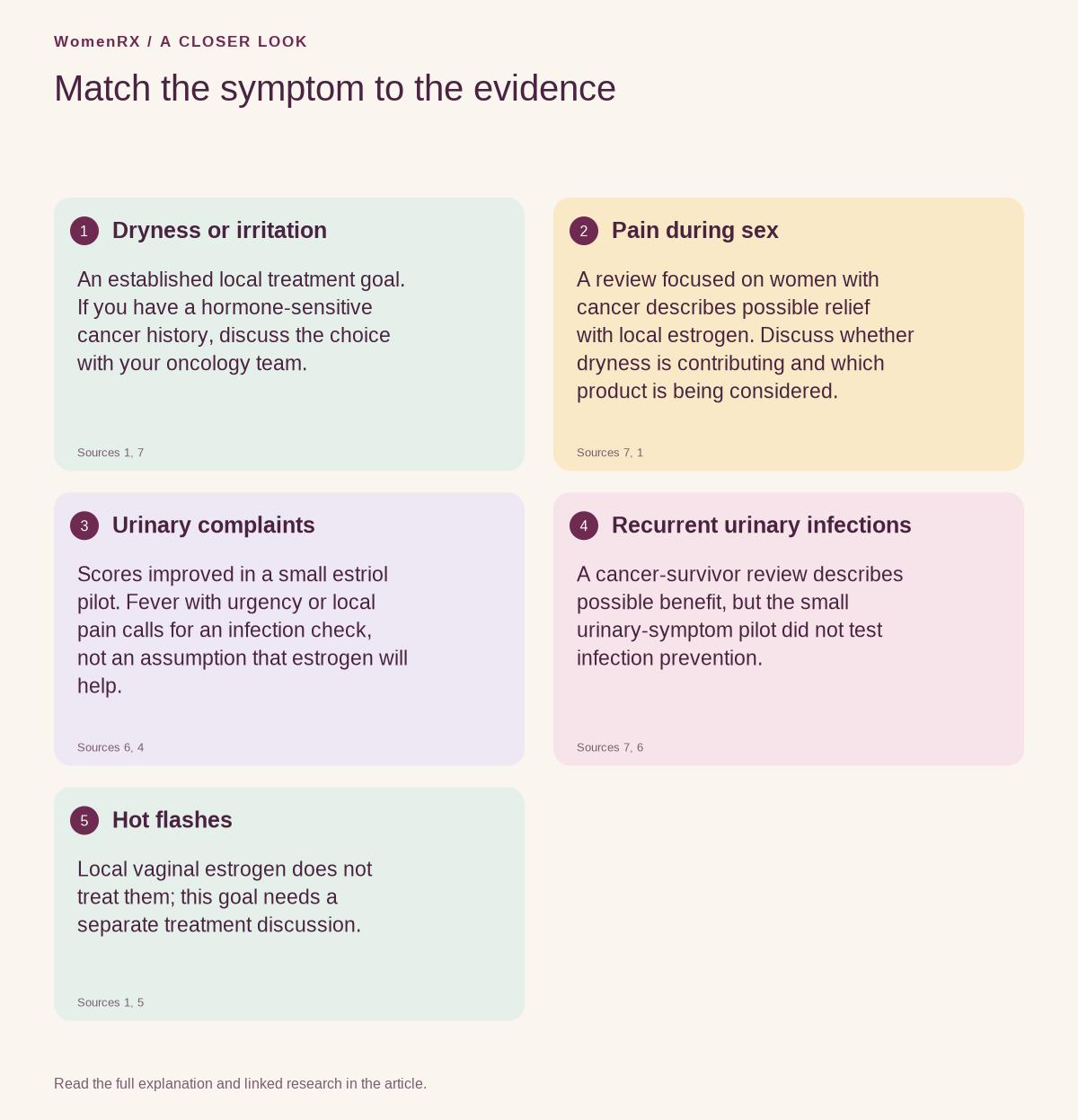
Match the symptom to the evidence
Dryness or irritation: An established local treatment goal. If you have a hormone-sensitive cancer history, discuss the choice with your oncology team.17
Pain during sex: A review focused on women with cancer describes possible relief with local estrogen. Discuss whether dryness is contributing and which product is being considered.71
Urinary complaints: Scores improved in a small estriol pilot. Fever with urgency or local pain calls for an infection check, not an assumption that estrogen will help.64
Recurrent urinary infections: A cancer-survivor review describes possible benefit, but the small urinary-symptom pilot did not test infection prevention.76
Hot flashes: Local vaginal estrogen does not treat them; this goal needs a separate treatment discussion.15
Read the figure as text
Each treatment goal has a different expectation or question to consider.- Dryness or irritation: An established local treatment goal. If you have a hormone-sensitive cancer history, discuss the choice with your oncology team.17
- Pain during sex: A review focused on women with cancer describes possible relief with local estrogen. Discuss whether dryness is contributing and which product is being considered.71
- Urinary complaints: Scores improved in a small estriol pilot. Fever with urgency or local pain calls for an infection check, not an assumption that estrogen will help.64
- Recurrent urinary infections: A cancer-survivor review describes possible benefit, but the small urinary-symptom pilot did not test infection prevention.76
- Hot flashes: Local vaginal estrogen does not treat them; this goal needs a separate treatment discussion.15
More questions, answered
Will vaginal estrogen help hot flashes?
No. It is a local treatment for vaginal symptoms and does not treat hot flashes. Whole-body symptoms require a separate treatment discussion. 1 5
Does using a vaginal product mean I need a progestogen too?
With low-dose vaginal estrogen, a progestogen usually is not needed. That differs from many systemic estrogen plans for people with a uterus; confirm the exact product and dose rather than assuming all estrogen treatments are the same. 1 5
Sources you can check
- About vaginal oestrogen - NHSAccessed 2026-09-25Return to first citation
- Common questions about vaginal oestrogen - NHSAccessed 2026-09-25Return to first citation
- How and when to use vaginal oestrogen - NHSAccessed 2026-09-25Return to first citation
- Side effects of vaginal oestrogen - NHSAccessed 2026-09-25Return to first citation
- The 2022 hormone therapy position statement of The North American Menopause Society.“The 2022 Hormone Therapy Position Statement of The North American Menopause Society” Advisory Panel. · Menopause (New York, N.Y.) · 2022Return to first citation
- Efficacy and safety of fractional microablative radiofrequency versus topical estriol in treating genitourinary syndrome of menopause: A pilot study.Torre PA, Fialho SCAV, do Val Guimarães ICC, Zunino AX, Castro T, Martins CAO, Gonçalves AK. · International journal of gynaecology and obstetrics: the official organ of the International Federation of Gynaecology and Obstetrics · 2026Return to first citation
- Genitourinary syndrome of menopause in women with cancer - a narrative review.Ryan HM, Brennan DJ. · Maturitas · 2026Return to first citation
- Managing Vulvovaginal Atrophy, in Postmenopausal Women, Without Hormones: Efficacy of a Hyaluronic Acid Vaginal Moisturizer.Falcão MAP, Pereira CPM, de Castro TL, Brunetti JDV, Cunha AS, Taira AM, Kummer AM. · Healthcare (Basel, Switzerland) · 2026Return to first citation