Choosing a Vaginal Estrogen Ring for Menopause Symptoms
A ring can mean fewer applications for vaginal dryness, but its instructions and purpose depend on the exact product.
A low-dose vaginal estrogen ring may suit you if menopause-related dryness or irritation is your main concern and you’d prefer a treatment that stays in place between replacements. Estring is one example: NHS guidance describes leaving it in for up to three months. Other rings shouldn’t be assumed to work or be used the same way. Your health history and the exact formulation matter. 1 3 5
What the ring is meant to relieve
As estrogen levels fall around menopause, vaginal tissue can become dry and irritated. Low-dose vaginal estrogen treats symptoms in that area; it isn’t meant to relieve hot flashes or sleep problems. The North American Menopause Society recommends it as an option for bothersome genitourinary symptoms that haven’t improved with over-the-counter therapies when systemic hormone therapy isn’t otherwise needed. 1 5
The appeal of a ring is practical: instead of applying a treatment on scheduled days, you keep it in place between replacements. But “vaginal estrogen ring” isn’t a complete set of instructions. The formulation determines what the ring is intended to treat and how it’s used. Get the exact product name before comparing it with a cream, tablet, or insert. 3 5
What using Estring involves
NHS guidance describes Estring as a ring inserted into the vagina and used for up to three months before it’s removed and replaced. It suggests finding a comfortable position for insertion, such as standing or lying down. If Estring falls out, the guidance says to rinse it in lukewarm water and reinsert it. It can stay in place during sex, or be removed if it feels uncomfortable. These are Estring-specific examples from UK guidance, not directions for every ring or a substitute for your US product’s instructions. 3
That routine may sound simpler than remembering applications, but consider the hands-on parts too: Are you comfortable inserting and removing a ring? Would you rather use something only on the days it’s scheduled? If a ring shifts or feels uncomfortable, you’ll want to know what your particular product’s instructions say to do. 3
How creams, tablets, and inserts compare
The formats differ both in how you handle them and how often you use them. NHS guidance lists vaginal tablets that are inserted with an applicator and begin with daily use for two weeks, followed by twice-weekly use. Its cream instructions also describe an applicator, but the schedules differ by cream: the listed Ovesse example begins with two weeks of daily use before twice-weekly use, while its estriol cream example begins with daily use for up to four weeks before the amount is gradually reduced according to symptoms. 3
An insert or pessary is another option. For its named Imvaggis pessary, NHS guidance describes inserting one daily for three weeks, then one twice a week. That schedule, like the tablet and cream examples, is product-specific and shouldn’t be transferred to another product. Check the instructions for the exact product you’re offered. 3
You don’t have to assume the more frequent format works less well. In a 12-month randomized study of postmenopausal women, researchers found no statistically significant difference in relief of urogenital symptoms and signs between the Estring ring and the Vagifem tablet studied. The study did not compare either product with a cream or pessary, and it doesn’t show that other rings or tablets are interchangeable. 7
Relief may also take time. NHS guidance says vaginal estrogen can take up to three months to work fully. If it isn’t helping, that’s a reason to revisit the treatment choice rather than assume every format will feel the same. 2
Where your health history changes the choice
Hormone therapy’s benefits and risks vary by factors including the type, dose, duration, and route. That’s why a discussion about a specific ring matters more than a general claim that all vaginal estrogen is alike. The North American Menopause Society recommends choosing hormone therapy individually and periodically reassessing its benefits and risks. 5
If you’ve had breast cancer, especially if you take an aromatase inhibitor, bring that up before choosing a vaginal estrogen product. In a small, 24-week randomized trial of 23 breast cancer survivors taking aromatase inhibitors, vaginal estrogen improved dryness and pain with sex more than a nonhormonal moisturizer. The estrogen group included women using either a tablet or Estring, so the result doesn’t establish a separate benefit for the ring. The trial was also too small and short to settle long-term safety. 6
Headache, vaginal or abdominal pain, and bleeding can occur with vaginal estrogen. Don’t automatically attribute unexpected vaginal bleeding to the ring: tell your care team about it, particularly if bleeding is heavy or starts after you’ve been using treatment for several months. 1 4
When comparing products, the most useful questions are concrete: Which exact product is this? How is it inserted, and when is it replaced or applied? What should I do if it comes out or feels uncomfortable? Then weigh that routine alongside your symptoms and health history. 3 5
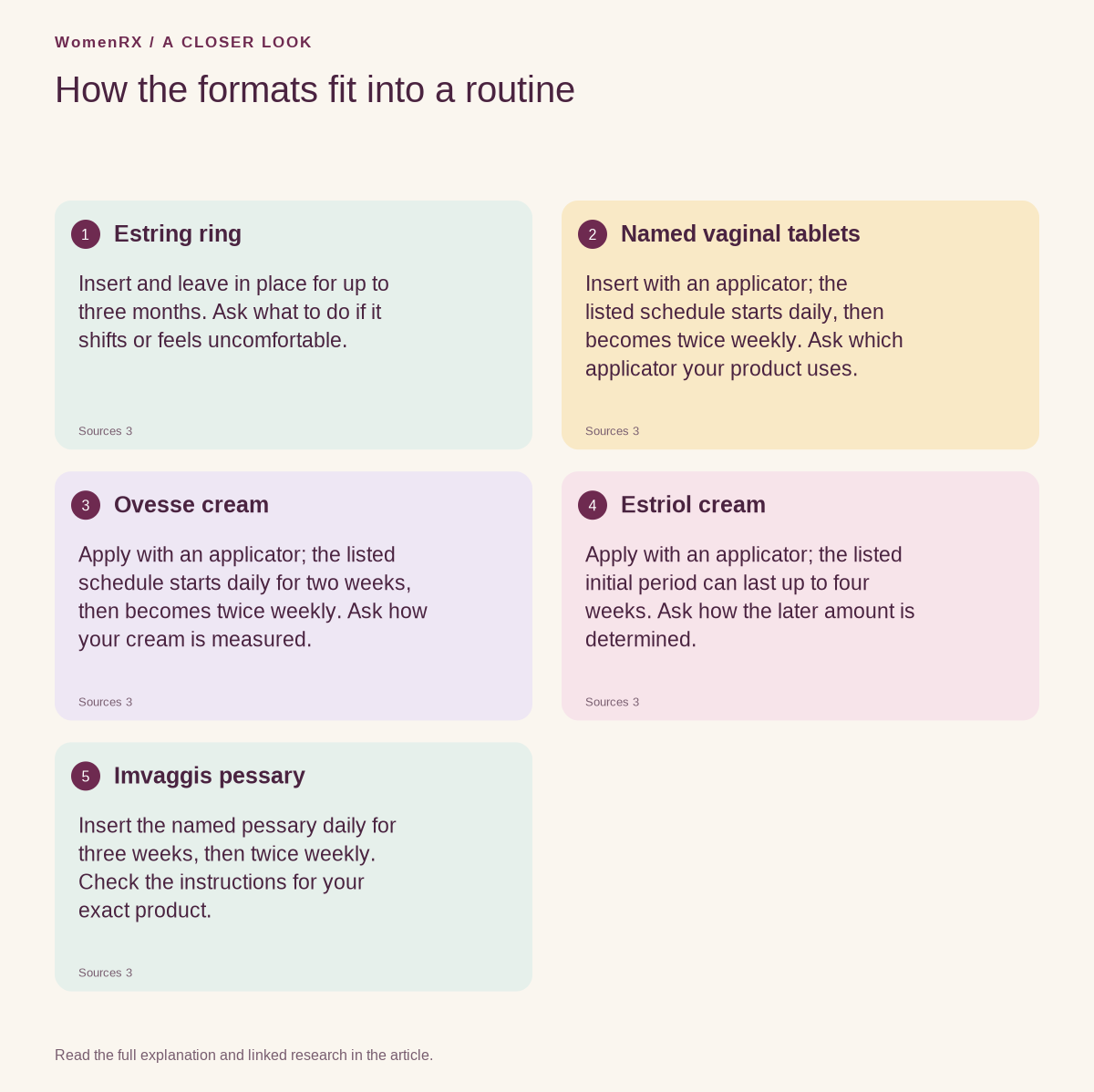
How the formats fit into a routine
Estring ring: Insert and leave in place for up to three months. Ask what to do if it shifts or feels uncomfortable.3
Named vaginal tablets: Insert with an applicator; the listed schedule starts daily, then becomes twice weekly. Ask which applicator your product uses.3
Ovesse cream: Apply with an applicator; the listed schedule starts daily for two weeks, then becomes twice weekly. Ask how your cream is measured.3
Estriol cream: Apply with an applicator; the listed initial period can last up to four weeks. Ask how the later amount is determined.3
Imvaggis pessary: Insert the named pessary daily for three weeks, then twice weekly. Check the instructions for your exact product.3
Read the figure as text
These are named examples from UK NHS guidance, not US prescribing directions. Check the instructions for the exact product you’re offered. 3- Estring ring: Insert and leave in place for up to three months. Ask what to do if it shifts or feels uncomfortable.3
- Named vaginal tablets: Insert with an applicator; the listed schedule starts daily, then becomes twice weekly. Ask which applicator your product uses.3
- Ovesse cream: Apply with an applicator; the listed schedule starts daily for two weeks, then becomes twice weekly. Ask how your cream is measured.3
- Estriol cream: Apply with an applicator; the listed initial period can last up to four weeks. Ask how the later amount is determined.3
- Imvaggis pessary: Insert the named pessary daily for three weeks, then twice weekly. Check the instructions for your exact product.3
More questions, answered
Will a low-dose vaginal estrogen ring help with hot flashes?
A low-dose local treatment such as Estring is used for vaginal symptoms, not hot flashes. If hot flashes are also bothering you, that calls for a separate treatment discussion. 1 5
Sources you can check
- About vaginal oestrogen - NHSAccessed 2026-09-25Return to first citation
- Common questions about vaginal oestrogen - NHSAccessed 2026-09-25Return to first citation
- How and when to use vaginal oestrogen - NHSAccessed 2026-09-25Return to first citation
- Side effects of vaginal oestrogen - NHSAccessed 2026-09-25Return to first citation
- The 2022 hormone therapy position statement of The North American Menopause Society.“The 2022 Hormone Therapy Position Statement of The North American Menopause Society” Advisory Panel. · Menopause (New York, N.Y.) · 2022Return to first citation
- VEMORA: Vaginal Estrogen versus non-hormonal MOisturizer in women Receiving Aromatase inhibitors: a randomized, controlled trial.Niravath P, Rimawi M, Sun K, Mai H, Puri A, Vyas A, Nangia J, Brock A, Foreman C, Adnan H, Shafer M, Anand A, Moges A, Al Najjar E, Mathur S, Antosh D, High R, Zaid T, Chang J, Osb... · Breast cancer research and treatment · 2026Return to first citation
- Endometrial and vaginal effects of low-dose estradiol delivered by vaginal ring or vaginal tablet.Weisberg E, Ayton R, Darling G, Farrell E, Murkies A, O'Neill S, Kirkegard Y, Fraser IS. · Climacteric : the journal of the International Menopause Society · 2005Return to first citation