What to know before choosing estrogen tablets for menopause
Oral estrogen can help with menopause symptoms, but the right route depends on what you want treated and your health history.
Estrogen tablets are one form of systemic menopause hormone therapy, often considered for bothersome hot flashes and night sweats. Before choosing them, discuss your treatment goal, age and time since menopause, health history, and whether another route or a nonhormonal option may fit better. If symptoms are limited to vaginal or urinary changes, local vaginal treatment may be a more targeted option. 1 2
Start with what you want treated
Oral estrogen is a systemic treatment: it acts throughout the body rather than only where it is applied. Menopause hormone therapy is the most effective treatment for hot flashes and night sweats, and it can help prevent bone loss. It isn’t a treatment to take for preventing heart disease. 1 4
That distinction matters if your main concern is vaginal dryness, pain with sex, or urinary symptoms linked to menopause. For bothersome vaginal and urinary symptoms that haven’t improved with over-the-counter options, low-dose vaginal estrogen is one treatment to discuss when you don’t otherwise need systemic hormone therapy. It’s a different approach from taking an estrogen tablet for symptoms throughout the body. 1
What to compare about the route
Oral tablets and estrogen delivered through the skin are both systemic routes. Research comparing their cardiovascular effects isn’t definitive: studies have differed in quality and findings, and much of the evidence is observational. Some evidence suggests that transdermal estrogen may carry less risk of blood clots and stroke than oral therapy, particularly for people with higher baseline clot risk. That isn’t proof that a skin-delivered option is risk-free or best for everyone. 3
A useful discussion is not simply “Which route is safest?” It’s “How do my health history and treatment goal affect the tradeoffs between routes?” Mention any history of blood clots or cardiovascular disease, and discuss conditions such as high blood pressure, diabetes, or obesity that may affect the risk-benefit assessment. These details can make the choice more individualized. 5 7
Your timing and health history matter
The balance of benefits and risks depends on factors including age, time since menopause, route, dose, duration, and whether a progestogen is used. For women younger than 60 or within 10 years of menopause, with no contraindications, the North American Menopause Society describes the balance as generally favorable when treating bothersome hot flashes or preventing bone loss. Starting later, or after age 60, is associated with a less favorable balance because absolute risks of coronary heart disease, stroke, blood clots, and dementia are higher. These are general guidelines, not a personal risk calculation. 1
Ask how your medical history changes the discussion, and whether the proposed plan includes a progestogen. The hormone regimen, not just the word “estrogen,” is part of the risk-benefit picture. Agree on what benefit you’re looking for and how you’ll revisit the decision over time. 1
If tablets aren’t the right fit
If you prefer not to use hormone therapy, or it isn’t a good option for you, there are evidence-supported nonhormonal treatments for hot flashes. The North American Menopause Society lists cognitive behavioral therapy, clinical hypnosis, certain prescription medicines, and weight loss among options with evidence of benefit. Which alternatives make sense depends on your symptoms and health circumstances. 2
You don’t need to arrive with a particular brand or route already chosen. Bring the question you want answered: “Would systemic treatment help my symptoms, and how do oral, transdermal, local vaginal, and nonhormonal options compare for me?” That keeps the decision focused on the outcome you want and the tradeoffs that matter to you.
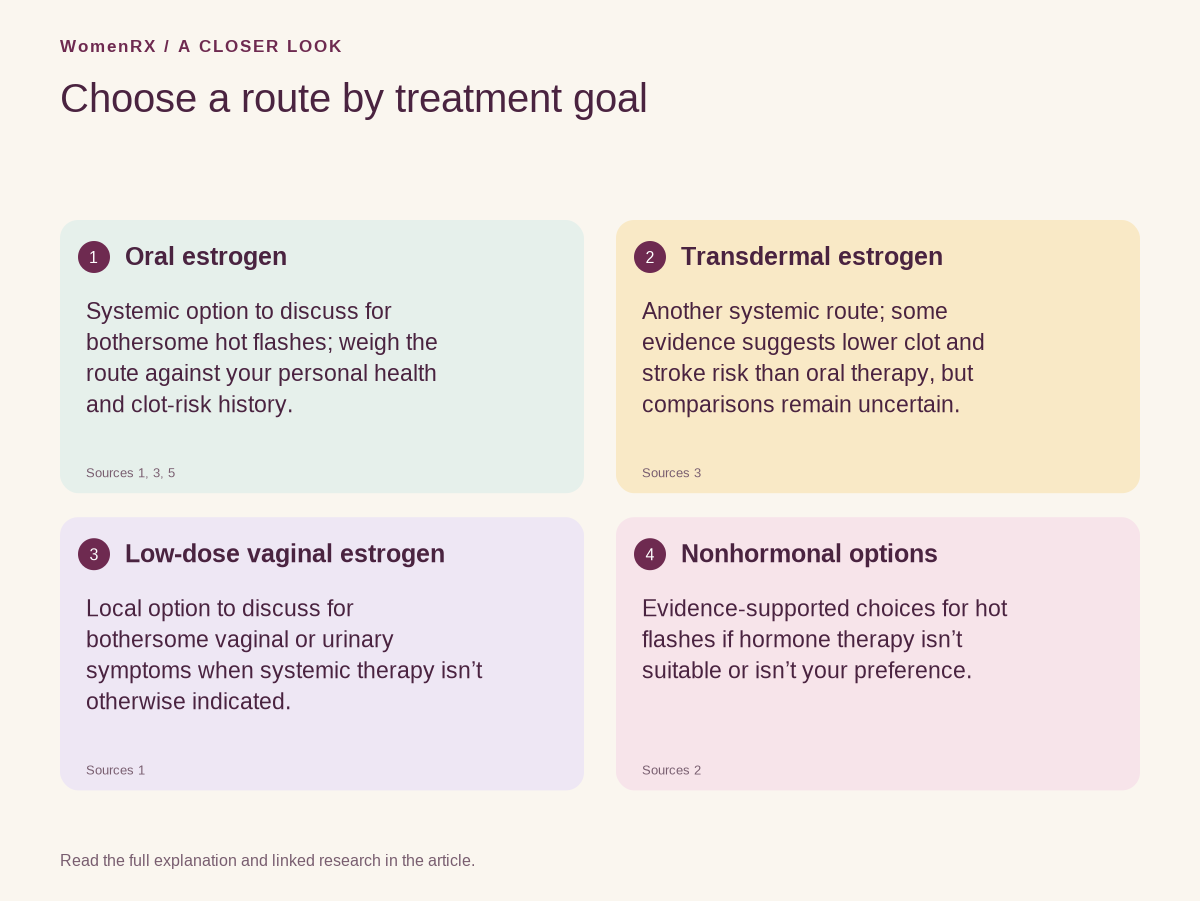
Choose a route by treatment goal
Oral estrogen: Systemic option to discuss for bothersome hot flashes; weigh the route against your personal health and clot-risk history.135
Transdermal estrogen: Another systemic route; some evidence suggests lower clot and stroke risk than oral therapy, but comparisons remain uncertain.3
Low-dose vaginal estrogen: Local option to discuss for bothersome vaginal or urinary symptoms when systemic therapy isn’t otherwise indicated.1
Nonhormonal options: Evidence-supported choices for hot flashes if hormone therapy isn’t suitable or isn’t your preference.2
Read the figure as text
The main distinction is whether you need treatment throughout the body or focused on vaginal and urinary symptoms. Personal risk can affect which systemic route is worth discussing.- Oral estrogen: Systemic option to discuss for bothersome hot flashes; weigh the route against your personal health and clot-risk history.135
- Transdermal estrogen: Another systemic route; some evidence suggests lower clot and stroke risk than oral therapy, but comparisons remain uncertain.3
- Low-dose vaginal estrogen: Local option to discuss for bothersome vaginal or urinary symptoms when systemic therapy isn’t otherwise indicated.1
- Nonhormonal options: Evidence-supported choices for hot flashes if hormone therapy isn’t suitable or isn’t your preference.2
More questions, answered
Are estrogen tablets and vaginal estrogen interchangeable?
No. Oral estrogen is systemic, while low-dose vaginal estrogen is a local option for bothersome vaginal or urinary menopause symptoms when systemic therapy isn’t otherwise indicated. The treatment choice depends on which symptoms you’re trying to address. 1
Can menopause hormone therapy prevent heart disease?
It shouldn’t be started for that purpose. Hormone therapy can treat menopause symptoms, but it is not recommended as a way to prevent cardiovascular disease. 4 6
Sources you can check
- The 2022 hormone therapy position statement of The North American Menopause Society.“The 2022 Hormone Therapy Position Statement of The North American Menopause Society” Advisory Panel. · Menopause (New York, N.Y.) · 2022Return to first citation
- The 2023 nonhormone therapy position statement of The North American Menopause Society.Menopause (New York, N.Y.) · 2023Return to first citation
- The route of administration, timing, duration and dose of postmenopausal hormone therapy and cardiovascular outcomes in women: a systematic review.Oliver-Williams C, Glisic M, Shahzad S, Brown E, Pellegrino Baena C, Chadni M, Chowdhury R, Franco OH, Muka T. · Human reproduction update · 2019Return to first citation
- Menopausal Hormone Therapy and Cardiovascular Risk: Current Evidence and Clinical Implications.Buzduga CM, Bobu AM, Covali R, Costea CF, Cucu AI, Graur M, Patrascanu E, Solomon-Condriuc I, Carauleanu A. · Medical sciences (Basel, Switzerland) · 2026Return to first citation
- Menopausal hormone therapy in women with medical conditions.Kapoor E, Kling JM, Lobo AS, Faubion SS. · Best practice & research. Clinical endocrinology & metabolism · 2021Return to first citation
- Hormone therapy in menopause: An update on cardiovascular disease considerations.Hale GE, Shufelt CL. · Trends in cardiovascular medicine · 2015Return to first citation
- Menopausal hormone therapy and cardiovascular disease risk: utility of biomarkers and clinical factors for risk stratification.Bassuk SS, Manson JE. · Clinical chemistry · 2014Return to first citation