Estradiol Pills for Menopause: Benefits, Risks, and Questions to Ask
Oral estradiol can ease whole-body menopause symptoms, but the right route depends on what you want treated, your health history, and whether you have a uterus.
Oral estradiol is a systemic treatment, often considered for bothersome hot flashes and night sweats. Patches, gels, or sprays also deliver systemic estrogen but avoid the first pass through the liver; low-dose vaginal estrogen is aimed mainly at vaginal or urinary symptoms, not whole-body symptoms. Route, timing, personal health history, and whether you have a uterus all belong in the decision. 1 4
Start with the symptoms you want to treat
Estradiol pills are one way to take systemic estrogen. Systemic hormone therapy is the most effective treatment for hot flashes and other vasomotor symptoms, and it can help prevent bone loss. Whether those benefits make sense for you depends on your symptoms and health history, not simply on whether a pill is convenient. 1
If your main concern is vaginal dryness, discomfort with sex, or other genitourinary symptoms, ask whether you need systemic treatment at all. For bothersome genitourinary symptoms that haven’t improved with over-the-counter options, guidance supports considering low-dose vaginal estrogen or other local treatment options when systemic hormone therapy isn’t otherwise indicated. Local vaginal treatment and systemic estradiol aren’t interchangeable: they’re used with different symptom goals in mind. 1
What changes when estradiol is swallowed?
Oral estradiol passes through the digestive system and liver before reaching the rest of the body. Transdermal estradiol, delivered through the skin as a patch, gel, or spray, bypasses that first pass. A review describes transdermal estrogen as an option that may be advantageous for some people with cardiometabolic risk factors, but that doesn’t mean a patch is automatically safer or better for every person. Hormone therapy risks vary with route, formulation, timing, duration, and whether a progestogen is used. 1 4
There is some direct comparison evidence. In a randomized trial of 257 recently menopausal women, oral and transdermal estradiol both improved symptom scores over 24 weeks, and the study found no difference between groups in its primary symptom measure or in reported adverse effects. Some secondary symptom scores differed at later assessments. Both groups also received micronized progesterone. The trial is useful for comparing short-term symptom relief, but it doesn’t settle which route is safer for you or establish the risks of uncommon, long-term outcomes. 2
So the practical question isn’t simply “Which route is safest?” It’s “What are we treating, and which route best fits my health history and preferences?” Your clinician may consider factors such as your cardiovascular and clotting history alongside how you feel about taking a pill versus using a skin treatment. Don’t assume the evidence supports a precise risk comparison for every individual route: the available head-to-head trial was short and focused on symptoms and reported adverse effects. 1 2
Your uterus changes the conversation
If you have a uterus, ask what will protect its lining while you take systemic estrogen. Treatment planning may include a progestogen alongside estrogen; the oral-versus-transdermal trial included micronized progesterone in both treatment groups, and a review of estradiol treatment discusses endometrial protection as a safety consideration for people with a uterus. The specific plan is part of your prescription discussion, not something to infer from the estradiol route alone. 2 3
If you don’t have a uterus, ask whether you need a progestogen in your particular situation. Don’t add or stop one based on a general rule or someone else’s prescription. Your surgical history and the reason for treatment matter, so make those details part of the conversation.
Put timing and personal history on the table
Age and time since menopause affect the overall benefit-risk discussion. The North American Menopause Society says the balance is generally favorable for people younger than 60 or within 10 years of menopause onset who have no contraindications and are treating bothersome vasomotor symptoms or aiming to prevent bone loss. Starting later, more than 10 years after menopause or after age 60, is associated with a less favorable balance because absolute risks of conditions including coronary heart disease, stroke, and venous thromboembolism are greater. These are broad recommendations, not a prediction of your individual risk. 1
Bring your medical history and priorities into the decision. It may help to name your most disruptive symptoms, any cardiovascular or clotting history, your age and approximate time since your last period, whether you have a uterus, and whether a daily pill or a skin product feels more workable. Then ask how you and your clinician will tell whether the treatment is helping and when you’ll revisit the plan. Hormone therapy should be individualized and periodically reevaluated. 1
Questions to take to your appointment
- Are my symptoms a reason to consider systemic estradiol, or would a local vaginal treatment fit better?
- What are the tradeoffs between a pill and a patch, gel, or spray for my health history?
- If I have a uterus, what protects its lining? If I don’t, is a progestogen appropriate for me?
- How do my age, time since menopause, and personal history affect the expected benefits and risks?
- What changes should I track, and when should we review whether this plan still suits me?
The aim is a plan that matches the symptoms you want to address and the risks and routines that matter to you. Oral estradiol is one option, not a default that everyone needs to accept or avoid.
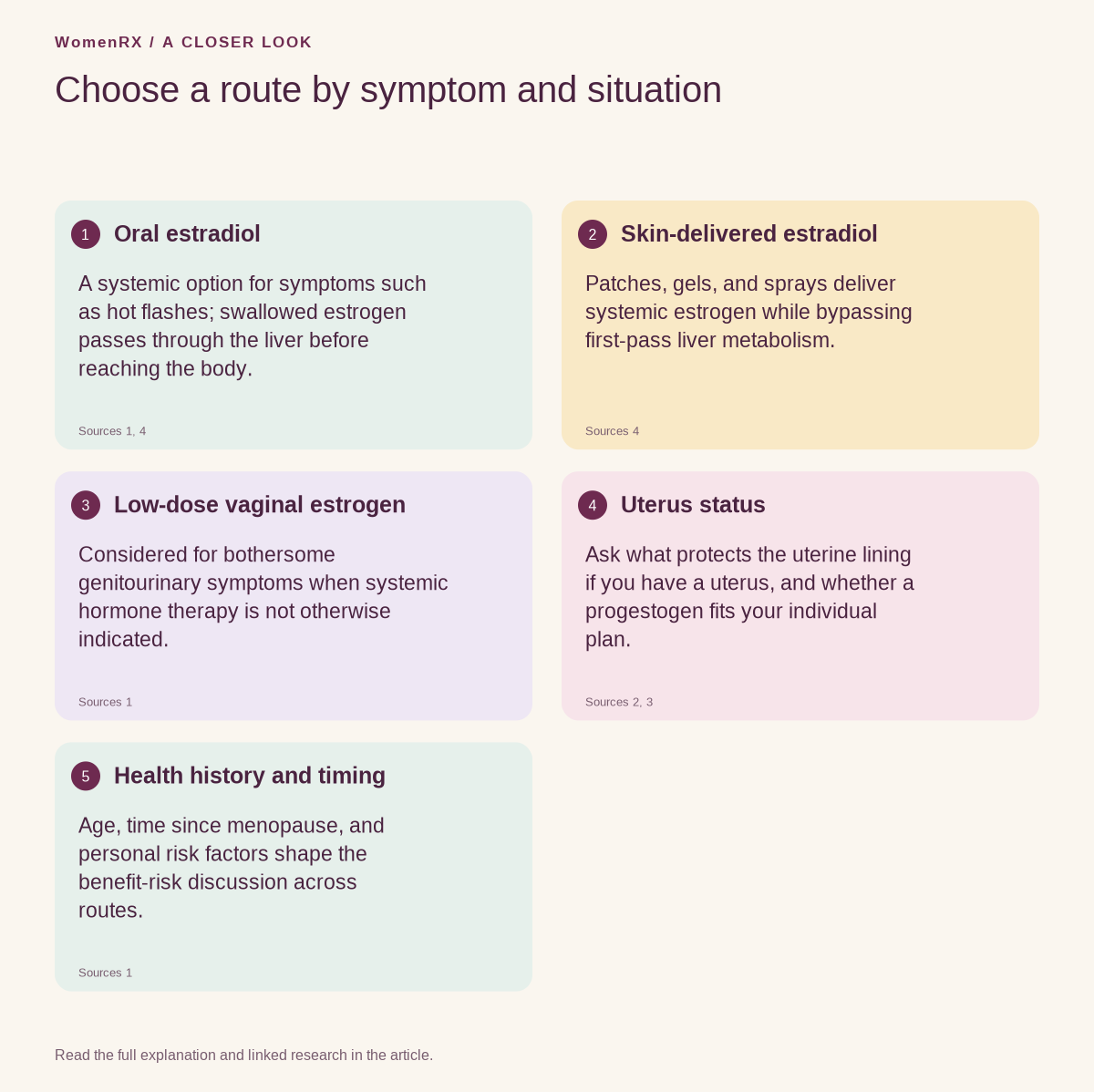
Choose a route by symptom and situation
Oral estradiol: A systemic option for symptoms such as hot flashes; swallowed estrogen passes through the liver before reaching the body.14
Skin-delivered estradiol: Patches, gels, and sprays deliver systemic estrogen while bypassing first-pass liver metabolism.4
Low-dose vaginal estrogen: Considered for bothersome genitourinary symptoms when systemic hormone therapy is not otherwise indicated.1
Uterus status: Ask what protects the uterine lining if you have a uterus, and whether a progestogen fits your individual plan.23
Health history and timing: Age, time since menopause, and personal risk factors shape the benefit-risk discussion across routes.1
Read the figure as text
The route can change how estradiol is delivered and which symptoms it is meant to address. It doesn’t replace a discussion of medical history or uterus status.- Oral estradiol: A systemic option for symptoms such as hot flashes; swallowed estrogen passes through the liver before reaching the body.14
- Skin-delivered estradiol: Patches, gels, and sprays deliver systemic estrogen while bypassing first-pass liver metabolism.4
- Low-dose vaginal estrogen: Considered for bothersome genitourinary symptoms when systemic hormone therapy is not otherwise indicated.1
- Uterus status: Ask what protects the uterine lining if you have a uterus, and whether a progestogen fits your individual plan.23
- Health history and timing: Age, time since menopause, and personal risk factors shape the benefit-risk discussion across routes.1
More questions, answered
Is a patch proven safer than an estradiol pill?
The route can affect hormone therapy risks, and transdermal estrogen bypasses the liver’s first pass. But a 24-week randomized comparison found similar reported adverse effects, not a definitive answer about uncommon or long-term risks. Ask how your own medical history affects the route choice. 1 2 4
Can vaginal estrogen treat hot flashes?
Low-dose vaginal estrogen is discussed as an option for genitourinary symptoms, such as vaginal or urinary concerns, when systemic therapy isn’t otherwise indicated. For hot flashes, systemic hormone therapy is the more relevant treatment category. 1
Sources you can check
- The 2022 hormone therapy position statement of The North American Menopause Society.“The 2022 Hormone Therapy Position Statement of The North American Menopause Society” Advisory Panel. · Menopause (New York, N.Y.) · 2022Return to first citation
- Changes in menopausal symptoms comparing oral estradiol versus transdermal estradiol.Tang R, Xie Z, Ruan X, Zhang Z, Ren M, Wu J, Shu K, Shi H, Xie M, Lv S, Yang X, Chen R, Yu Q. · Climacteric : the journal of the International Menopause Society · 2024Return to first citation
- Subcutaneous Estradiol Pellets as Hormone Therapy in Menopause: Clinical Pharmacology, Patient Selection and Safety Considerations.Jacobsen L, Fernandes DM, Nagel ML, Souza EL, Viana DPDC. · Journal of clinical medicine · 2025Return to first citation
- Estradiol transdermal spray for menopausal symptom management: From RCT to real-world evidence.Hirschberg AL, Stute P, Águas F, Fait T, Polo-Kantola P, Amorim FG, Rézette I, Hadji P. · Maturitas · 2026Return to first citation