Progesterone in Menopause Care: Uses, Risks, and Questions to Ask
Whether a progestogen belongs in your menopause treatment depends on your uterus, any estrogen you use, and the goal of treatment.
Progesterone is one kind of progestogen; synthetic progestins are related medicines, not identical products. A progestogen is often paired with systemic estrogen when someone has a uterus because estrogen can stimulate the uterine lining. Without a uterus, that particular protective purpose no longer applies. Whether a treatment is suitable also depends on the exact medicine and your health history, particularly if you have a history of certain cancers or cardiovascular disease. 5 4 8

First, what is the medicine meant to do?
A progestogen may be prescribed with menopausal hormone therapy (MHT) to protect the uterine lining from estrogen. Estrogen can stimulate the endometrium, and unopposed estrogen in postmenopausal hormone therapy is associated with increased risk of endometrial hyperplasia and cancer. 5
That reason for adding a progestogen depends on whether you have a uterus. If your uterus has been removed, the uterine-lining protection purpose no longer applies. Ask whether your prescription has another specific purpose rather than assuming everyone using estrogen needs the same combination. 5
Progestogens may also be considered on their own for menopause symptoms, but that is a different treatment goal. A systematic review of seven randomized trials involving 601 participants found that three trials reported improvement in hot flashes, while none reported improvement in mood symptoms. The trials varied in formulation and duration, so the findings don’t establish one reliable effect for every product. A later narrative review describes possible benefits of oral micronized progesterone for sleep, but that is a separate evidence base from the hot-flash and mood trials. 2 1
Progesterone and progestins aren’t interchangeable
“Progestogen” is the broad term for medicines with progesterone-like effects. Micronized progesterone is progesterone formulated as a medicine; progestins, such as norethisterone acetate, are synthetic medicines in the same broad family. Their related roles don’t mean they have identical effects or evidence. 1 6
It can be tempting to assume that a medicine described as more similar to the body’s own hormone must be safer in every way. The evidence doesn’t establish that. A review raises the possibility that micronized progesterone may provide less effective endometrial protection than some synthetic progestins. A trial protocol describes differing observational and randomized findings and a planned comparison of micronized progesterone with norethisterone acetate; a protocol is not a report of results. The practical point is to ask how the exact treatment is expected to protect the uterine lining when protection is needed, rather than choosing based on “natural” or “synthetic” alone. 5 6
What side effects and risks should you discuss?
In the systematic review of progestin-only treatment for menopausal symptoms, headache and vaginal bleeding were reported as significant side effects in five of seven trials. Across those trials, 6% to 21% of participants stopped treatment because of side effects. The studies used different formulations and lasted from 21 days to 12 months, so those figures describe the varied trials, not what you should expect from a particular prescription. 2
If estrogen and a progestogen are prescribed together, the discussion needs to include the risks of the combination, not just side effects seen in progestogen-only trials. Patient information for an estradiol-plus-progesterone product names heart attack, stroke, blood clots, and breast cancer as serious concerns with estrogen-plus-progestogen therapy. Those warnings do not mean each risk is the same for every combination or that progesterone alone has the same risk profile. 7 3
Common effects also depend on the product and what it is paired with. In a trial described in the Prometrium prescribing information, postmenopausal women taking cyclic oral micronized progesterone with conjugated estrogens reported effects including headache, breast tenderness, dizziness, abdominal bloating, and depressed mood. That trial compared a combination regimen with placebo, so it cannot tell you which effects came from progesterone alone. 8
For MHT overall, risks vary with the type of hormone, dose, route, duration, timing of initiation, and whether a progestogen is used. The North American Menopause Society’s 2022 position statement recommends individualizing treatment and periodically reassessing its benefits and risks. It does not make every progesterone or progestin product interchangeable or establish that one is safest for every person. 3
Who might need a different plan?
A history of certain cancers or cardiovascular disease can change whether hormone therapy is an appropriate choice. A menopause treatment position statement identifies estrogen-dependent cancers and cardiovascular disease as examples of reasons someone may not be a good candidate for hormone therapy. The prescribing information for an estradiol-plus-progesterone product also calls for a discussion before use if you currently have or have had certain cancers. Those cautions concern hormone therapy or a specific combination product; they aren’t a universal list of who must avoid every progesterone-only or synthetic progestin treatment. 4 7
If you’re taking Bijuva, an estradiol-plus-progesterone product, and notice unusual vaginal bleeding after menopause, don’t assume it’s simply a treatment side effect. Its patient information says to have the bleeding checked to find the cause. 7
If you use estrogen and have a uterus, ask what the plan is for protecting the lining and whether the specific progestogen and regimen are intended to do that. Comparative breast and endometrial safety remains an area of uncertainty: observational findings and randomized evidence have not provided a simple, settled answer across products. 5 6
Questions that make the plan clearer
- What is the main goal of this medicine: uterine-lining protection, symptom relief, or something else?
- Does my uterus remain, and how does that change the reason for using a progestogen?
- What is the exact medicine, and am I taking it alone or with estrogen?
- Does my history of cancer or cardiovascular disease change whether this particular treatment is suitable? 4 7
- What side effects should I watch for with this specific product, including headache or bleeding? If I’m also taking estrogen, how do we weigh the risks of blood clots, stroke, heart attack, and breast cancer for this regimen? 2 7 3
- How will we know whether it is helping, and when will we revisit the balance of benefits and risks?
The answers should connect your medicine to a specific goal. Uterine status matters to the endometrial-protection question; the exact formulation and whether it’s paired with estrogen matter when weighing risks and possible side effects.
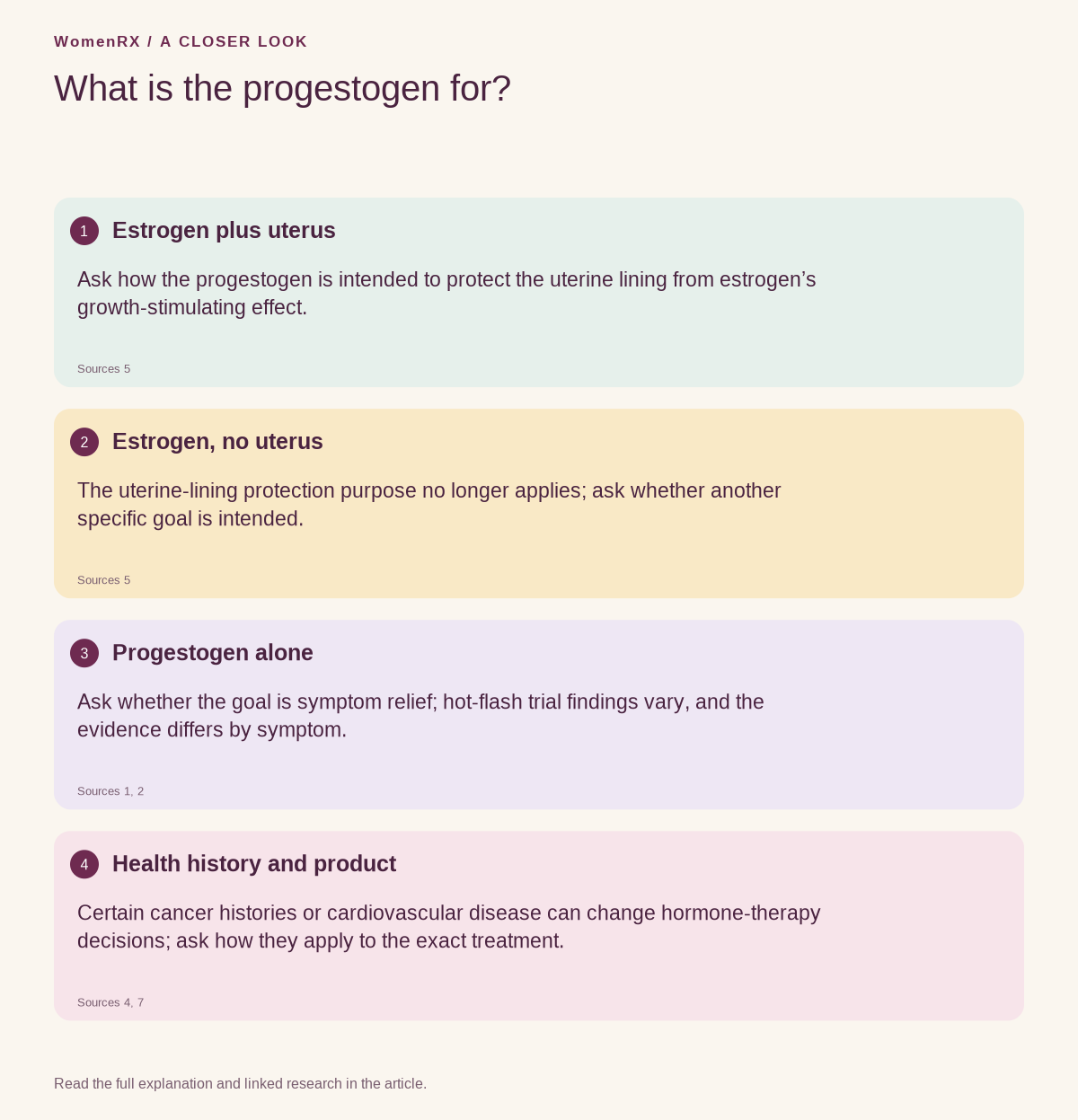
What is the progestogen for?
Estrogen plus uterus: Ask how the progestogen is intended to protect the uterine lining from estrogen’s growth-stimulating effect.5
Estrogen, no uterus: The uterine-lining protection purpose no longer applies; ask whether another specific goal is intended.5
Progestogen alone: Ask whether the goal is symptom relief; hot-flash trial findings vary, and the evidence differs by symptom.12
Health history and product: Certain cancer histories or cardiovascular disease can change hormone-therapy decisions; ask how they apply to the exact treatment.47
Read the figure as text
Use the treatment goal, uterine status, estrogen use, and health history to frame a discussion about the exact treatment.- Estrogen plus uterus: Ask how the progestogen is intended to protect the uterine lining from estrogen’s growth-stimulating effect.5
- Estrogen, no uterus: The uterine-lining protection purpose no longer applies; ask whether another specific goal is intended.5
- Progestogen alone: Ask whether the goal is symptom relief; hot-flash trial findings vary, and the evidence differs by symptom.12
- Health history and product: Certain cancer histories or cardiovascular disease can change hormone-therapy decisions; ask how they apply to the exact treatment.47
More questions, answered
Does everyone taking estrogen for menopause need progesterone?
No. The endometrial-protection reason for adding a progestogen applies when systemic estrogen is used and the uterus is present. If your uterus has been removed, ask what other purpose a progestogen would serve in your plan. 5
Is micronized progesterone proven safer than synthetic progestins?
Not across the board. Reviews describe possible differences, but breast and endometrial safety comparisons remain unsettled. A study protocol explains planned research; it does not establish that one option is safer. 5 6
Sources you can check
- Expanding the Horizons of Menopausal Hormone Therapy: A Narrative Review of Progestogen-Only and Testosterone-Only Strategies for Tailored Management.Lee HJ, Yu EH, Joo JK. · Journal of menopausal medicine · 2026Return to first citation
- Efficacy of progestin-only treatment for the management of menopausal symptoms: a systematic review.Dolitsky SN, Cordeiro Mitchell CN, Stadler SS, Segars JH. · Menopause (New York, N.Y.) · 2020Return to first citation
- The 2022 hormone therapy position statement of The North American Menopause Society.“The 2022 Hormone Therapy Position Statement of The North American Menopause Society” Advisory Panel. · Menopause (New York, N.Y.) · 2022Return to first citation
- The 2023 nonhormone therapy position statement of The North American Menopause Society.Menopause (New York, N.Y.) · 2023Return to first citation
- Progesterone, progestins and the endometrium in perimenopause and in menopausal hormone therapy.Gompel A. · Climacteric : the journal of the International Menopause Society · 2018Return to first citation
- Breast and endometrial safety of micronised progesterone versus norethisterone acetate in menopausal hormone therapy (PROBES): study protocol of a double-blind randomised controlled trial.Lundell C, Stergiopoulos N, Blomberg L, Ujvari D, Schuppe-Koistinen I, Kopp-Kallner H, Iliadis SI, Skalkidou A, Hirschberg AL. · BMJ open · 2024Return to first citation
- BIJUVA (ESTRADIOL AND PROGESTERONE) CAPSULE [MAYNE PHARMA] | US prescribing information and patient instructionsAccessed 2026-09-25Return to first citation
- PROMETRIUM (PROGESTERONE) CAPSULE [ACERTIS PHARMACEUTICALS, LLC] | US prescribing information and patient instructionsAccessed 2026-09-25Return to first citation