When Progesterone Has a Role in Menopause Care
In menopause care, progesterone is most often part of hormone therapy to protect the uterine lining, not a catch-all treatment for menopause symptoms.
If you still have a uterus and use systemic estrogen for menopause symptoms, a progestogen is generally added to reduce the risk of overgrowth in the uterine lining. Progesterone may also be prescribed for a specific reason such as secondary amenorrhea; cycles can become irregular before menopause. Bleeding after menopause needs assessment rather than an assumption that hormones are the cause. 1 3 2
Start with the reason it’s being considered
“Progesterone” can refer to a hormone or to a prescribed treatment. In menopause care, the key question is what job the treatment is meant to do. One common reason is to protect the endometrium, the lining of the uterus, when someone with a uterus uses systemic estrogen. Estrogen without a progestogen can raise the chance of endometrial hyperplasia, an abnormal thickening of that lining. 1 3
If you’ve had a hysterectomy, that particular endometrial-protection reason generally doesn’t apply because there’s no uterine lining to protect. The decision about hormone therapy still depends on the reason for treatment and your individual circumstances. 1 4
During perimenopause, cycles may change
As menopause approaches, cycles may include stretches of several months without bleeding before another period occurs. That pattern can make it hard to tell when a change is part of the transition and when bleeding needs a closer look. If progesterone treatment is being discussed, ask which menstrual condition it is intended to address. 2
Progesterone has specific medical uses beyond endometrial protection. For example, US prescribing information for oral progesterone lists secondary amenorrhea as an indication. That doesn’t mean it treats every skipped or irregular period, or that it is a general treatment for hot flashes, sleep changes, or other menopause symptoms. 1 4
With estrogen therapy, protection is the main distinction
For a postmenopausal person with an intact uterus who uses systemic estrogen, guidance and clinical evidence support adding a progestogen for endometrial protection. In a randomized trial described in the prescribing information, 6% of women receiving cyclical progesterone with conjugated estrogen developed endometrial hyperplasia over up to three years, compared with 64% receiving conjugated estrogen alone. Those figures apply to the specific treatments and trial population, not every hormone therapy regimen. 3 1
“Progestogen” is the broader term for medicines that provide this effect; progesterone is one type. Different products, routes, and schedules aren’t automatically interchangeable. A systematic review reported evidence for endometrial protection with some specific micronized progesterone regimens and found that transdermal micronized progesterone did not provide protection. The review also described limits in the guidance on the safest type, route, and duration. So if someone suggests a progesterone cream or another formulation, ask whether that exact approach is known to protect the uterine lining when used with estrogen. 3
A useful conversation is specific: What is the indication? Which treatment and schedule are intended to protect the lining? What bleeding pattern should prompt follow-up? Menopause hormone therapy is individualized and periodically reevaluated; its benefits and risks vary with factors including the type of therapy, route, timing, and whether a progestogen is used. 4
Bleeding after menopause deserves its own assessment
Bleeding after menopause can be related to hormone therapy, but it can also have other causes. Most cases are from benign sources, yet evaluation matters because an underlying malignancy is possible. Don’t assume that bleeding means you need more progesterone, or that taking progesterone makes the bleeding safe to ignore. 2
Assessment may include endometrial sampling or transvaginal ultrasound; the appropriate approach depends on the situation. If bleeding begins after menopause, is unexpected on hormone therapy, or continues, contact your care team to ask what evaluation is appropriate. 2
The practical takeaway: identify whether progesterone is being proposed for uterine-lining protection, a specific menstrual condition, or another reason. That distinction helps you weigh alternatives and know what follow-up matters.
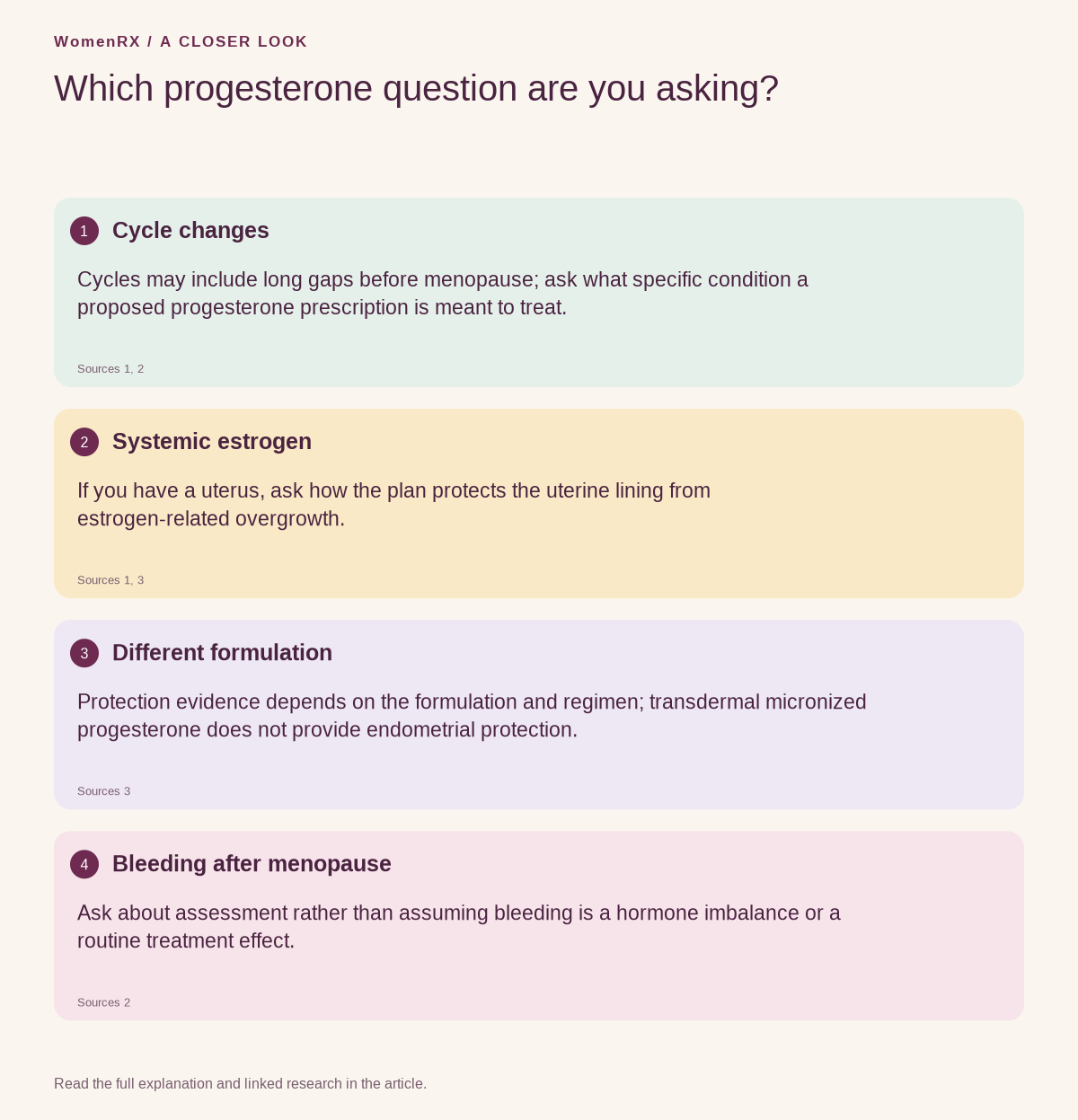
Which progesterone question are you asking?
Cycle changes: Cycles may include long gaps before menopause; ask what specific condition a proposed progesterone prescription is meant to treat.12
Systemic estrogen: If you have a uterus, ask how the plan protects the uterine lining from estrogen-related overgrowth.13
Different formulation: Protection evidence depends on the formulation and regimen; transdermal micronized progesterone does not provide endometrial protection.3
Bleeding after menopause: Ask about assessment rather than assuming bleeding is a hormone imbalance or a routine treatment effect.2
Read the figure as text
The reason for considering progesterone points to a different next discussion.- Cycle changes: Cycles may include long gaps before menopause; ask what specific condition a proposed progesterone prescription is meant to treat.12
- Systemic estrogen: If you have a uterus, ask how the plan protects the uterine lining from estrogen-related overgrowth.13
- Different formulation: Protection evidence depends on the formulation and regimen; transdermal micronized progesterone does not provide endometrial protection.3
- Bleeding after menopause: Ask about assessment rather than assuming bleeding is a hormone imbalance or a routine treatment effect.2
More questions, answered
Does progesterone treat hot flashes?
The evidence cited here supports menopause hormone therapy overall as an effective treatment for vasomotor symptoms, but it doesn’t establish progesterone alone as a hot-flash treatment. The reason for using a progestogen is often endometrial protection when systemic estrogen is used by someone with a uterus. 1 4
Does bleeding while taking hormone therapy always mean something is wrong?
Not necessarily, but bleeding can have more than one cause, including hormone therapy, and should not automatically be attributed to treatment. Bleeding after menopause may need assessment; ask what evaluation fits your circumstances, especially if it is unexpected or continues. 2
Sources you can check
- PROMETRIUM (PROGESTERONE) CAPSULE [ACERTIS PHARMACEUTICALS, LLC] | US prescribing information and patient instructionsAccessed 2026-09-25Return to first citation
- Investigation of women with postmenopausal uterine bleeding: clinical practice recommendations.Munro MG, Southern California Permanente Medical Group’s Abnormal Uterine Bleeding Working Group. · The Permanente journal · 2014Return to first citation
- The impact of micronized progesterone on the endometrium: a systematic review.Stute P, Neulen J, Wildt L. · Climacteric : the journal of the International Menopause Society · 2016Return to first citation
- The 2022 hormone therapy position statement of The North American Menopause Society.“The 2022 Hormone Therapy Position Statement of The North American Menopause Society” Advisory Panel. · Menopause (New York, N.Y.) · 2022Return to first citation