How Do You Know When to Review a Menopause Hormone-Therapy Dose?
Symptoms that persist or return are a reason to review your treatment, not proof that you need more hormone.
Arrange a treatment review if the symptoms you started hormone therapy for remain bothersome, return, or change, or if new side effects affect how you feel about treatment. The right response depends on your goals and the whole regimen, not one symptom alone. 4 If you have bleeding after menopause, raise it promptly for assessment rather than treating it as a dose question. 3
First, identify what has changed
A return of hot flashes or night sweats can make you wonder whether your estrogen dose is too low. It’s a reasonable reason to review treatment, but it isn’t a dose diagnosis. Menopause hormone therapy is individualized, and its benefits and risks vary with the product, dose, route, duration, timing of initiation, and use of a progestogen. A review looks at symptom relief alongside those factors. 4
Be specific about the symptom you want to improve. Hormone therapy is the most effective treatment for hot flashes and night sweats, also called vasomotor symptoms. But if those have improved while vaginal dryness or discomfort persists, the question may be whether that symptom needs a different approach, not whether to increase systemic therapy. For women whose bothersome vaginal or urinary symptoms aren’t relieved by over-the-counter options and who have no reason to use systemic hormone therapy, the Menopause Society describes low-dose vaginal estrogen and other treatments as options. 4
Bring a few notes, not a perfect diary
Use this short worksheet to show what has happened since you started or changed treatment:
- Symptoms: What were you treating at the start? What remains bothersome or has returned? Note the pattern and its effect on sleep or daily life.
- Timing: When did you start treatment or change the product, dose, or route? When did you notice the symptom change?
- What you actually use: Bring the product name and how you use it. Mention missed or delayed doses and any changes in routine. Product instructions differ, so don’t take extra or change your dose to test a theory.
- New effects: Note any effect that makes the treatment harder to use or changes how you feel about continuing it.
- Bleeding: Note when it happened and whether you are still having menstrual periods or are postmenopausal. Bleeding after menopause calls for assessment rather than a self-directed dose change. 3
For example, if night sweats return after a product change, knowing when the change happened and what you’ve been using gives the conversation a better starting point than “I need a higher dose.” Those notes don’t have to prove a cause. They help you and your clinician work out what question to address.
Why the whole regimen matters
Tell your clinician whether you have a uterus and whether you still have periods. These details affect how the treatment plan is considered; there is no single target dose that follows from a symptom alone. In a trial described in the US prescribing information for Prometrium, postmenopausal women with a uterus who received one specific progesterone-and-estrogen regimen had less endometrial hyperplasia than women who received that estrogen alone. That result does not establish the right progesterone regimen for every product, but it shows why reviewing estrogen separately from the rest of a treatment plan can miss an essential issue. 2
Your current goal matters too. You may have started therapy to relieve disruptive night sweats and now be deciding whether the benefit still outweighs effects you dislike. Or your symptoms may have changed. The Menopause Society recommends periodically reevaluating benefits and risks rather than treating the original prescription as a permanent answer. Age and time since menopause are part of that discussion. 4
A dose change is one possible outcome of a review, not its purpose. The US label for Bijuva, a specific combined estradiol-and-progesterone product, says adjustments are based on clinical response. It does not set a dose rule for other products or mean that every returning symptom calls for an increase. 1 Don’t adjust estrogen or progesterone on your own. Arrange a review for persistent symptoms or bothersome effects, and raise bleeding after menopause promptly so it can be assessed on its own terms. 3
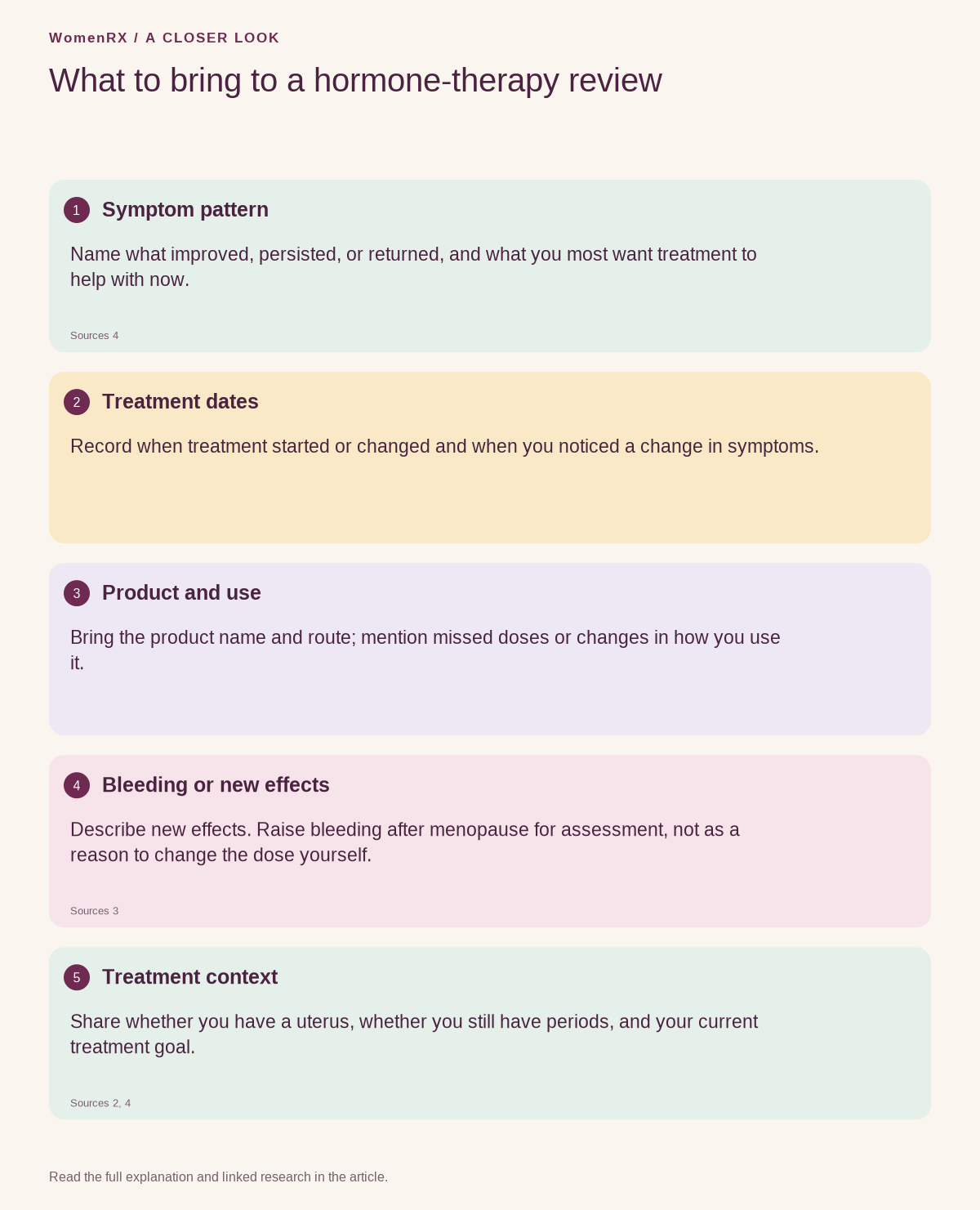
What to bring to a hormone-therapy review
Symptom pattern: Name what improved, persisted, or returned, and what you most want treatment to help with now.4
Treatment dates: Record when treatment started or changed and when you noticed a change in symptoms.
Product and use: Bring the product name and route; mention missed doses or changes in how you use it.
Bleeding or new effects: Describe new effects. Raise bleeding after menopause for assessment, not as a reason to change the dose yourself.3
Treatment context: Share whether you have a uterus, whether you still have periods, and your current treatment goal.24
Read the figure as text
These notes help distinguish a question about symptom relief from an effect or bleeding that needs separate attention.- Symptom pattern: Name what improved, persisted, or returned, and what you most want treatment to help with now.4
- Treatment dates: Record when treatment started or changed and when you noticed a change in symptoms.
- Product and use: Bring the product name and route; mention missed doses or changes in how you use it.
- Bleeding or new effects: Describe new effects. Raise bleeding after menopause for assessment, not as a reason to change the dose yourself.3
- Treatment context: Share whether you have a uterus, whether you still have periods, and your current treatment goal.24
More questions, answered
If hot flashes improve but vaginal dryness continues, does that mean my dose is too low?
Not necessarily. Vaginal or urinary symptoms may need a different treatment approach. For some women without an indication for systemic hormone therapy, low-dose vaginal estrogen or other treatments are options. Bring up the remaining symptom rather than assuming you need more systemic hormone. 4
Sources you can check
- BIJUVA (ESTRADIOL AND PROGESTERONE) CAPSULE [MAYNE PHARMA] | US prescribing information and patient instructionsAccessed 2026-09-25Return to first citation
- PROMETRIUM (PROGESTERONE) CAPSULE [ACERTIS PHARMACEUTICALS, LLC] | US prescribing information and patient instructionsAccessed 2026-09-25Return to first citation
- A perspective on the revised American College of Obstetricians and Gynecologists' guidance for transvaginal ultrasound in the evaluation of postmenopausal bleeding.Goldstein SR. · Menopause (New York, N.Y.) · 2026Return to first citation
- The 2022 hormone therapy position statement of The North American Menopause Society.“The 2022 Hormone Therapy Position Statement of The North American Menopause Society” Advisory Panel. · Menopause (New York, N.Y.) · 2022Return to first citation