When Is Progesterone Added to an Estrogen Patch?
The key question is whether you have a uterus: progestogen is usually paired with systemic estrogen to protect the uterine lining, not because every menopause symptom needs two hormones.
A clinician may add progesterone or another progestogen when you use systemic estrogen, such as a patch, and still have a uterus. Estrogen can stimulate the uterine lining; the progestogen helps reduce the risk of endometrial overgrowth. This is a different purpose from relieving hot flashes, for which estrogen is the main hormone treatment. If you don’t have a uterus, that lining-protection reason generally doesn’t apply. 2 3
The decision starts with your uterus
An estrogen patch used for menopause symptoms delivers systemic hormone therapy. When systemic estrogen is used by someone who still has a uterus, a clinician will generally pair it with a progestogen, which includes progesterone. The reason is protection of the endometrium, the lining inside the uterus. Estrogen without enough progestogen can raise the risk of endometrial hyperplasia, an abnormal thickening of that lining. 1 3
If your uterus has been removed, protecting its lining is usually not a reason to add a progestogen. Your treatment can still depend on your symptoms, health history, and the type, dose, route, and duration of hormone therapy. 2 3
Lining protection and symptom relief are different jobs
Estrogen is the hormone therapy most effective for bothersome hot flashes and night sweats. The main role of the added progestogen is to protect the uterine lining while preserving the intended estrogen treatment, rather than to provide the main relief from those symptoms. 2 3
That distinction can help make a treatment discussion clearer: if the patch is helping your hot flashes, the progestogen may still be part of the plan for a separate reason. And if you’re having side effects or bleeding, that doesn’t automatically mean the patch is ineffective. Ask what each part of the regimen is intended to do and what changes should prompt a call.
What the evidence says about protection
A 2025 Cochrane review included 72 studies involving 40,652 women. In trials comparing unopposed estrogen with continuous estrogen plus progestogen, endometrial hyperplasia at one year occurred in an estimated 46 to 75 per 1,000 women using unopposed estrogen, compared with about 3 per 1,000 using combined treatment. These are study estimates, not a prediction for one person or one specific patch regimen. The review found too few endometrial cancer events to draw conclusions about that outcome, so the clearest comparison is for hyperplasia. 1
The review assessed different hormone regimens, and its findings shouldn’t be read as proof that every progestogen or schedule offers identical protection with every estrogen product. An earlier menopause position statement also found no single preferred regimen for everyone; the type, route, and schedule can be individualized while maintaining adequate protection. 1 3
The schedule is part of the plan
Combined therapy can be continuous or sequential. Those names describe different ways estrogen and progestogen may be arranged over time, but the evidence reviewed didn’t establish one schedule as best for everyone. The right discussion includes the particular estrogen product and dose, your uterus status, your preferences, and what bleeding pattern to expect. Don’t assume that a schedule used by a friend is the right one for you. 1 3
Menopause hormone therapy’s benefits and risks can differ with dose, route, duration, timing, and whether a progestogen is used. Guidance recommends individualizing treatment and periodically revisiting its benefits and risks. 2
Useful questions to ask
You might ask: “Is my patch systemic estrogen, and do I still need endometrial protection?” “What is the progestogen in my plan meant to protect against?” “Why does this schedule fit my situation, and what bleeding should I expect?” If you have had a hysterectomy, clarify whether your uterus was completely removed and whether there is another reason for the additional hormone. These questions focus the conversation on the purpose of each medicine, rather than treating progesterone as an automatic add-on for every patch user.
Why add a progestogen?
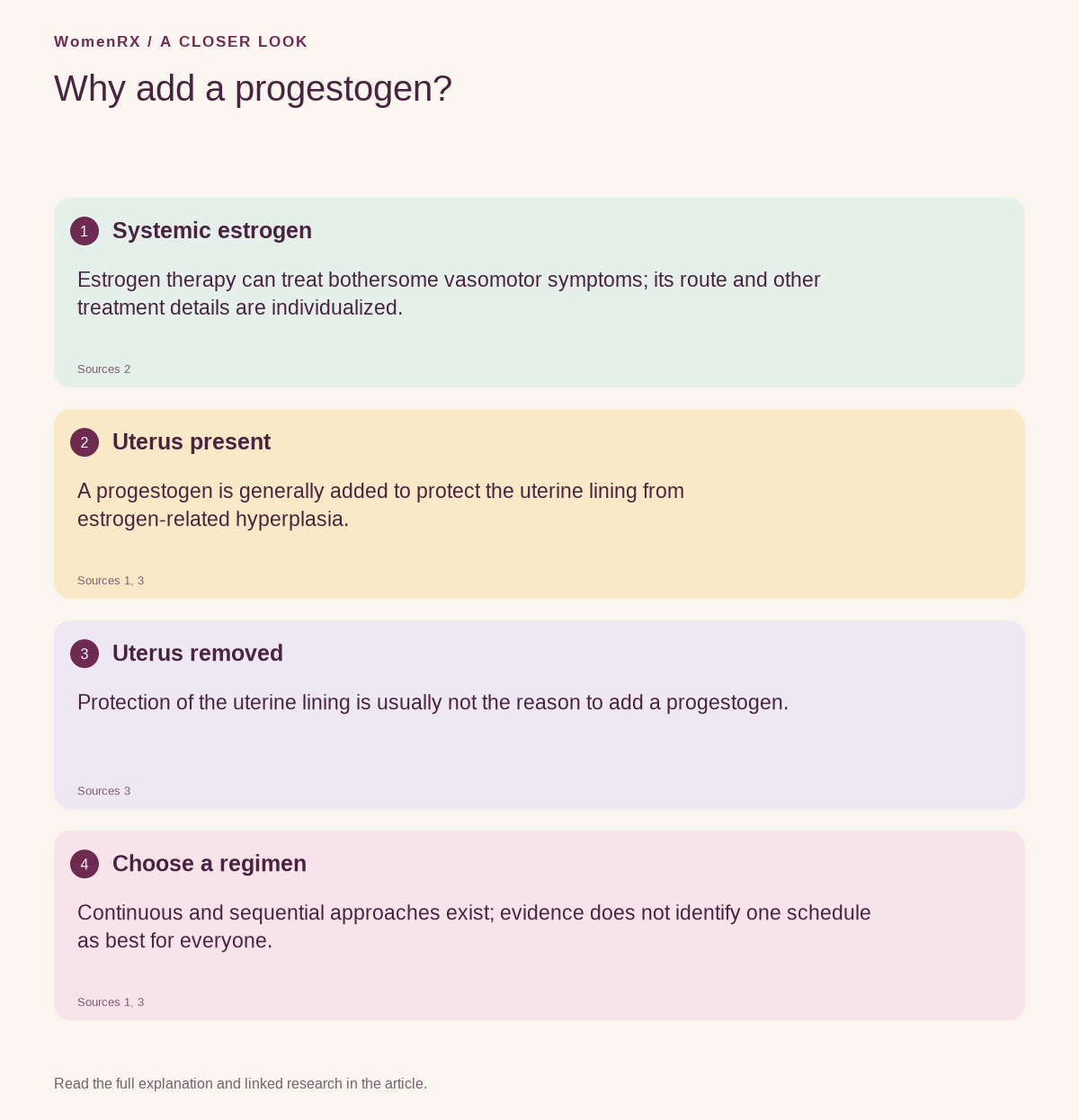
Systemic estrogen: Estrogen therapy can treat bothersome vasomotor symptoms; its route and other treatment details are individualized.2
Uterus present: A progestogen is generally added to protect the uterine lining from estrogen-related hyperplasia.13
Uterus removed: Protection of the uterine lining is usually not the reason to add a progestogen.3
Choose a regimen: Continuous and sequential approaches exist; evidence does not identify one schedule as best for everyone.13
Read the figure as text
For systemic estrogen therapy, uterus status helps determine whether endometrial protection is part of the plan.- Systemic estrogen: Estrogen therapy can treat bothersome vasomotor symptoms; its route and other treatment details are individualized.2
- Uterus present: A progestogen is generally added to protect the uterine lining from estrogen-related hyperplasia.13
- Uterus removed: Protection of the uterine lining is usually not the reason to add a progestogen.3
- Choose a regimen: Continuous and sequential approaches exist; evidence does not identify one schedule as best for everyone.13
More questions, answered
Is progesterone added to help hot flashes?
Its main role in combined systemic hormone therapy is protecting the uterine lining. Estrogen is the most effective hormone therapy for bothersome hot flashes and night sweats. 2 3
Does everyone using an estrogen patch need progesterone?
No. The usual reason to add a progestogen is to protect the lining when a person with a uterus uses systemic estrogen. If you don’t have a uterus, that specific reason generally doesn’t apply. 3
Sources you can check
- Hormone therapy in postmenopausal women and risk of endometrial hyperplasia or endometrial cancer.Kim D, Jordan V, Casciola F, Ferguson M, Humphries A, Bofill Rodriguez M, Wise MR. · The Cochrane database of systematic reviews · 2025Return to first citation
- The 2022 hormone therapy position statement of The North American Menopause Society.“The 2022 Hormone Therapy Position Statement of The North American Menopause Society” Advisory Panel. · Menopause (New York, N.Y.) · 2022Return to first citation
- Role of progestogen in hormone therapy for postmenopausal women: position statement of The North American Menopause Society.North American Menopause Society. · Menopause (New York, N.Y.) · 2003Return to first citation