Does Estrogen Cream Need to Be Used With Progesterone?
The answer depends on whether estrogen is being used locally or systemically, whether you have a uterus, and what the specific product delivers.
Not every estrogen cream needs a progestogen. Low-dose vaginal estrogen for menopause-related vaginal symptoms is generally used without one, based on evidence that has not found increased endometrial risk in the studies reviewed. Systemic estrogen is different: if you have a uterus, a progestogen is generally used to protect its lining. The word “cream” alone doesn’t tell you which situation applies. 2 4
First identify what the estrogen is meant to do
“Estrogen cream” can describe products used in different ways. Low-dose vaginal estrogen is used for menopause-related vaginal symptoms. Systemic hormone therapy is intended to deliver estrogen throughout the body and may be used for symptoms such as hot flashes. Hormone-therapy decisions depend on factors including route and whether a progestogen is included. 3
The specific vaginal formulation also matters: a systematic review found that serum estradiol levels were higher with vaginal creams than with inserts or rings in the studies it examined. That doesn’t mean every cream has the same absorption, or that the products can be compared without considering their formulation and dose. 1
Low-dose vaginal estrogen is a different case
For menopausal vaginal symptoms, a systematic evidence review supports using low-dose vaginal estrogen without a progestogen. Across the included studies, the review did not find support for increased endometrial hyperplasia or cancer with low-dose vaginal estrogen. The evidence is reassuring, but the studies don’t settle the question of long-term risk; longer-term real-world data are still needed. 2
This conclusion applies to low-dose vaginal estrogen, not automatically to every product called an estrogen cream. It also shouldn’t be stretched to mean that any dose or formulation used in any way is safe without a progestogen.
Systemic estrogen and an intact uterus
Estrogen can stimulate the endometrium, the lining of the uterus. For postmenopausal women with an intact uterus using estrogen therapy, a systematic review states that a progestogen should be used for endometrial protection. So if your estrogen product is intended to provide systemic therapy and you have a uterus, don’t assume it can be used alone just because it comes as a cream. 4
If you don’t have a uterus, there is no uterine lining to protect for this particular reason. That changes the endometrial-protection question, although other factors can still affect which hormone regimen is appropriate.
A progesterone cream on the skin isn’t a substitute by default
The product matters on the progesterone side, too. A systematic review reports that transdermal micronized progesterone does not provide endometrial protection. So a progesterone cream applied to the skin shouldn’t be assumed to protect the uterine lining when someone is using systemic estrogen. This finding is about transdermal micronized progesterone, not a claim about every product labeled “progesterone.” 4
Four details that clarify the question
When you check your regimen, look for:
- Route: Is the estrogen used in the vagina, or is it intended to provide systemic therapy?
- Purpose: Is it for menopause-related vaginal symptoms or for symptoms such as hot flashes?
- Uterine status: Do you still have a uterus? This is central to whether endometrial protection is needed with systemic estrogen.
- Exact product and dose: Vaginal estrogen formulations can differ in absorption, so the name “cream” doesn’t establish how much estrogen reaches the bloodstream. 1
If the route or purpose isn’t clear, ask the prescriber or pharmacist to identify the exact product and whether it is being used as local vaginal estrogen or systemic therapy. That distinction, along with whether you have a uterus, is more useful than a blanket rule about all estrogen creams.
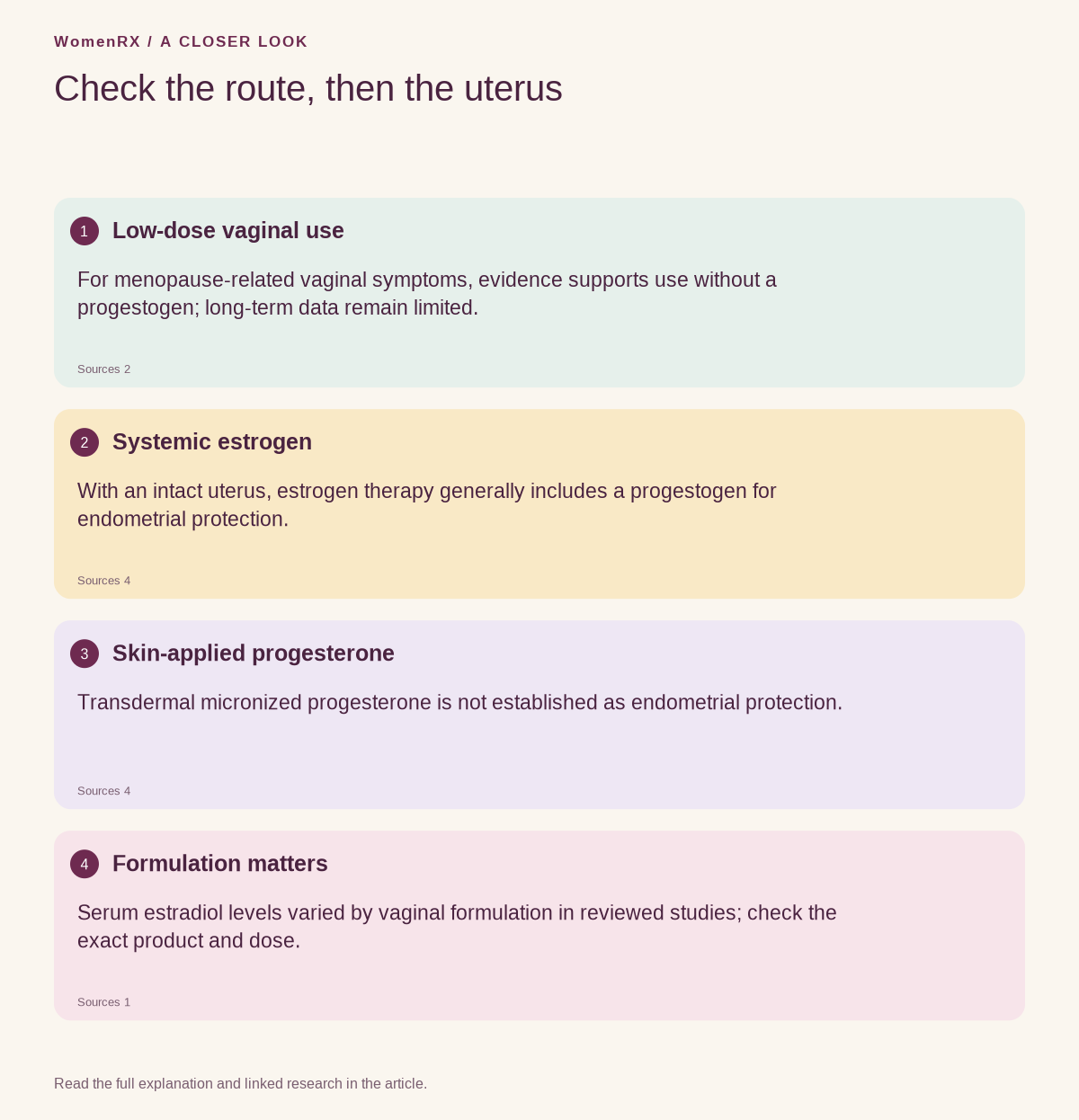
Check the route, then the uterus
Low-dose vaginal use: For menopause-related vaginal symptoms, evidence supports use without a progestogen; long-term data remain limited.2
Systemic estrogen: With an intact uterus, estrogen therapy generally includes a progestogen for endometrial protection.4
Skin-applied progesterone: Transdermal micronized progesterone is not established as endometrial protection.4
Formulation matters: Serum estradiol levels varied by vaginal formulation in reviewed studies; check the exact product and dose.1
Read the figure as text
Use these distinctions to see why the word “cream” alone can’t answer whether a progestogen is needed.- Low-dose vaginal use: For menopause-related vaginal symptoms, evidence supports use without a progestogen; long-term data remain limited.2
- Systemic estrogen: With an intact uterus, estrogen therapy generally includes a progestogen for endometrial protection.4
- Skin-applied progesterone: Transdermal micronized progesterone is not established as endometrial protection.4
- Formulation matters: Serum estradiol levels varied by vaginal formulation in reviewed studies; check the exact product and dose.1
More questions, answered
Does low-dose vaginal estrogen usually need progesterone?
For menopause-related vaginal symptoms, evidence reviews support low-dose vaginal estrogen without a concomitant progestogen. The evidence is reassuring for the studied products and durations, but longer-term data are limited. 2
Can progesterone cream applied to the skin protect the uterine lining?
Don’t assume it can. A systematic review reports that transdermal micronized progesterone does not provide endometrial protection. 4
Sources you can check
- Safety of vaginal estrogens: a systematic review.Crandall CJ, Diamant A, Santoro N. · Menopause (New York, N.Y.) · 2020Return to first citation
- Endometrial safety of low-dose vaginal estrogens in menopausal women: a systematic evidence review.Constantine GD, Graham S, Lapane K, Ohleth K, Bernick B, Liu J, Mirkin S. · Menopause (New York, N.Y.) · 2019Return to first citation
- The 2022 hormone therapy position statement of The North American Menopause Society.“The 2022 Hormone Therapy Position Statement of The North American Menopause Society” Advisory Panel. · Menopause (New York, N.Y.) · 2022Return to first citation
- The impact of micronized progesterone on the endometrium: a systematic review.Stute P, Neulen J, Wildt L. · Climacteric : the journal of the International Menopause Society · 2016Return to first citation