What Is Estrogen Cream Used For, and Which Type Is It?
“Estrogen cream” can mean a vaginal medicine or a skin-applied product, and the route changes what it is meant to treat and what questions matter.
The phrase “estrogen cream” doesn’t identify one treatment. A prescription vaginal estrogen cream is used locally for menopause-related vaginal symptoms; it isn’t the same as hormone therapy meant to act throughout the body. A skin-applied product, compounded cream, or cosmetic product needs to be identified by its ingredients, instructions, and intended use. Check the exact product before assuming what it treats or how its risks compare. 1 2 6
Start with where the cream goes
The word cream describes a form, not a purpose. The first useful question is whether the product is inserted into the vagina, applied to the skin as a transdermal hormone product, or sold as a compounded or cosmetic topical product. Those categories shouldn’t be treated as interchangeable.
A prescription vaginal estrogen cream such as Estrace is labeled for vaginal use. Vaginal estrogen is used for menopause-related vaginal dryness and irritation, and local vaginal estrogen is one option for genitourinary syndrome of menopause (GSM), which can include vaginal and urinary symptoms. A vaginal cream is not automatically a treatment for hot flashes, sleep problems, or other symptoms throughout the body. 1 2 5 6
For a skin-applied product, the word cream alone can’t tell you whether it is intended to provide systemic hormone therapy, what symptoms it is intended to treat, or how much hormone reaches the body. The North American Menopause Society notes that hormone-therapy risks vary with factors including route, type, dose, duration, and whether a progestogen is used. Look for the product’s active ingredient and directions, and confirm its intended route and use with the prescriber or pharmacist rather than borrowing guidance for vaginal estrogen. 6
Compounded creams and cosmetic products also shouldn’t be assumed to have the same ingredients, purpose, or evidence as a prescription vaginal medicine or a systemic hormone product. The label and the person who supplied it are the starting points for identifying what you have. If the product’s ingredients or intended use aren’t clear, don’t infer them from the word estrogen or cream.
What vaginal estrogen cream may help with
Menopause-related changes in the vagina and urinary tract can be grouped under GSM. For vaginal dryness or irritation, low-dose vaginal estrogen is a treatment option when symptoms continue despite over-the-counter approaches. The 2025 American urology guideline describes local low-dose vaginal estrogen as having the most robust evidence base among GSM treatments, while also emphasizing that treatment choices should reflect a person’s goals and preferences. 5 6
Some people with GSM also have urinary symptoms, but those symptoms can have other causes. A 2023 systematic review concluded that vaginal estrogen improved dysuria, frequency, urge and stress incontinence, and recurrent urinary tract infections in menopausal women. The review did not list urinary urgency as an outcome that vaginal estrogen improved; urgency and urge incontinence shouldn’t be confused. It also reported that systemic hormone therapy may cause or worsen urinary incontinence or other urinary symptoms. 4
Vaginal estrogen does not treat every menopause symptom. If the main concern is hot flashes or night sweats, ask about options intended for symptoms throughout the body rather than assuming a vaginal cream will help. Systemic hormone therapy is an effective treatment for vasomotor symptoms, but its benefit-risk balance depends on individual factors, including age, time since menopause, route, and health history. 6
Why the exact product matters for safety
Local vaginal estrogen and systemic hormone therapy aren’t risk-free synonyms for each other. Vaginal estrogen generally results in little estrogen reaching the rest of the body, but absorption can occur. The US prescribing information for Estrace vaginal cream specifically says systemic absorption may occur and includes warnings and precautions associated with estrogen treatment. 1 2
If you have a uterus, ask whether the particular product and treatment plan call for a progestogen. NHS guidance says low-dose vaginal estrogen generally doesn’t require one because little medicine reaches the rest of the body. That general guidance doesn’t replace the instructions for a specific US product: Estrace’s patient information warns that estrogen-alone use may increase the chance of cancer of the uterus and says unusual vaginal bleeding should be checked. 1 2
Unusual bleeding, including bleeding after menopause, deserves attention rather than being assumed to be a routine cream effect. Estrace’s patient information specifically says to report unusual vaginal bleeding while using it. 1
Questions that identify what you have
Before using a product, get clear answers to these questions:
- What is the active ingredient, and is it a prescription medicine, compounded product, or cosmetic product?
- Is it meant to be inserted vaginally or applied to skin? Is the intended effect local or systemic?
- Which symptoms is this exact product meant to treat, and what would count as a reason to reassess it?
- If I have a uterus, does this product’s labeling or my treatment plan call for a progestogen?
- What should I do if I notice unusual vaginal bleeding?
- Does the product affect condoms or diaphragms? Some vaginal estrogen creams and gels can damage them, so check the product instructions or ask a pharmacist. 3
These questions do more than sort out terminology. They help you match the evidence and safety discussion to the product you’re actually considering, rather than to a different kind of estrogen cream.
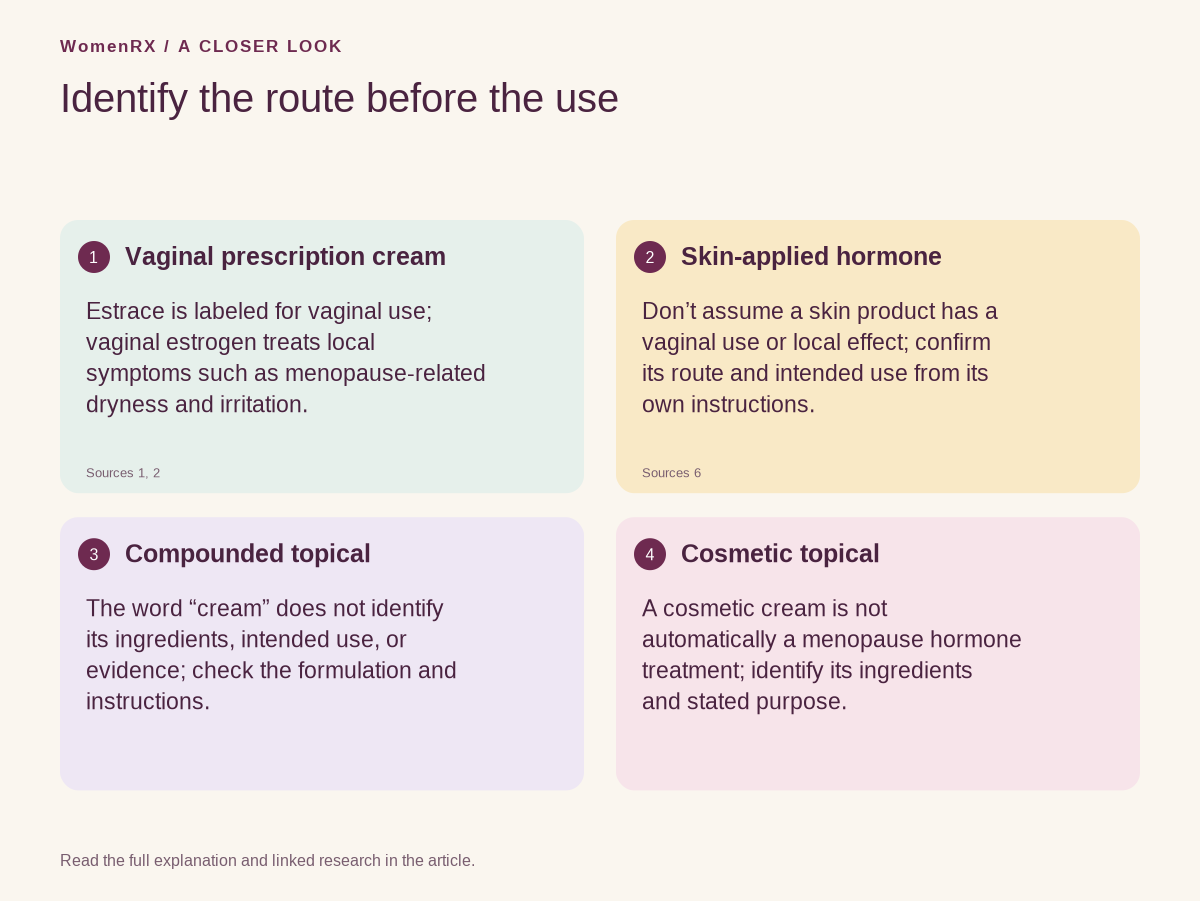
Identify the route before the use
Vaginal prescription cream: Estrace is labeled for vaginal use; vaginal estrogen treats local symptoms such as menopause-related dryness and irritation.12
Skin-applied hormone: Don’t assume a skin product has a vaginal use or local effect; confirm its route and intended use from its own instructions.6
Compounded topical: The word “cream” does not identify its ingredients, intended use, or evidence; check the formulation and instructions.
Cosmetic topical: A cosmetic cream is not automatically a menopause hormone treatment; identify its ingredients and stated purpose.
Read the figure as text
The form “cream” isn’t enough to identify a menopause treatment. Route and product instructions help distinguish what questions apply.- Vaginal prescription cream: Estrace is labeled for vaginal use; vaginal estrogen treats local symptoms such as menopause-related dryness and irritation.12
- Skin-applied hormone: Don’t assume a skin product has a vaginal use or local effect; confirm its route and intended use from its own instructions.6
- Compounded topical: The word “cream” does not identify its ingredients, intended use, or evidence; check the formulation and instructions.
- Cosmetic topical: A cosmetic cream is not automatically a menopause hormone treatment; identify its ingredients and stated purpose.
More questions, answered
Does vaginal estrogen cream help hot flashes?
Vaginal estrogen is used locally for symptoms such as vaginal dryness and irritation; it does not treat other menopause symptoms such as hot flashes. Ask about a treatment intended for symptoms throughout the body if hot flashes are your main concern. 2 6
Does vaginal estrogen cream always mean I need progesterone?
Not necessarily. NHS guidance says low-dose vaginal estrogen generally doesn’t require a progestogen, but the exact product and your health history matter. Estrace’s US patient information warns that estrogen-alone use may increase the chance of uterine cancer and says unusual bleeding should be checked, so ask how its instructions apply to your treatment plan. 1 2
Sources you can check
- ESTRACE (ESTRADIOL) CREAM [ALLERGAN, INC.] | US prescribing information and patient instructionsAccessed 2026-09-25Return to first citation
- About vaginal oestrogen - NHSAccessed 2026-09-25Return to first citation
- How and when to use vaginal oestrogen - NHSAccessed 2026-09-25Return to first citation
- Menopause hormone therapy and urinary symptoms: a systematic review.Christmas MM, Iyer S, Daisy C, Maristany S, Letko J, Hickey M. · Menopause (New York, N.Y.) · 2023Return to first citation
- The AUA/SUFU/AUGS Guideline on Genitourinary Syndrome of Menopause.Kaufman MR, Ackerman AL, Amin KA, Coffey M, Danan E, Faubion SS, Hardart A, Goldstein I, Ippolito GM, Northington GM, Powell CR, Rubin RS, Westney OL, Wilson TS, Lee UJ. · The Journal of urology · 2025Return to first citation
- The 2022 hormone therapy position statement of The North American Menopause Society.“The 2022 Hormone Therapy Position Statement of The North American Menopause Society” Advisory Panel. · Menopause (New York, N.Y.) · 2022Return to first citation