What Is Estrogen Body Cream, and Is It an Approved Treatment?
“Estrogen body cream” isn’t a precise medical category, so the named product, how it’s made, and what it’s labeled to treat matter.
Some estrogen medicines are FDA-approved for menopause-related symptoms, but that doesn’t make every cream called “estrogen” an approved treatment. A custom-compounded cream is not FDA-approved, and a cosmetic claim or small skin study doesn’t establish menopause benefits. Check the exact product and its labeled use before treating it as hormone therapy. 1 3 4
“Estrogen body cream” can mean different things
The phrase doesn’t identify one standardized medicine. It might refer to a prescription hormone product, a custom-compounded preparation, or a cosmetic marketed for skin. Those categories aren’t interchangeable. The active ingredient, formulation, route, regulatory status, and intended use all matter.
FDA-approved hormone products are available for symptoms related to menopause. Approval applies to a particular product and its reviewed uses, not to every preparation containing estrogen. So the word “estrogen,” or a claim that a cream is “bioidentical,” doesn’t establish that the product is approved or intended to treat hot flashes, night sweats, or another menopause symptom. 3 4
Prescription medicine, compounded cream, or cosmetic?
A named FDA-approved medicine: Its approval and labeled use belong to that specific product. Menopause hormone therapy decisions also depend on the treatment’s route and other individual factors; products shouldn’t be treated as interchangeable just because they contain estrogen. 4 5
A custom-compounded hormone cream: A pharmacy may prepare a customized medicine for a particular prescription. Compounded hormones are not FDA-approved, and their content can be uncertain. Evidence supporting their safety and effectiveness is lacking compared with approved products. Compounding can have a limited role when an approved product isn’t suitable, such as because of an allergy or the need for a formulation or dose that isn’t available. 2 3
A cosmetic or skin-care product: A claim about improving skin appearance is not the same as an approved claim to treat menopause symptoms. In one small randomized trial, 30 postmenopausal women used estradiol or genistein gel on facial skin for 24 weeks; researchers measured hyaluronic acid in skin biopsies. That study does not establish that a product sold as body cream is an approved or effective treatment for hot flashes or other menopause symptoms. 1
Match the product to the reason you’re considering it
If you’re looking for relief from hot flashes or night sweats, ask about treatments specifically intended for those symptoms. Hormone therapy is an effective option for many women, but its benefit-risk balance varies with factors including age, time since menopause, route, and whether a progestogen is used. 5
If your concern is vaginal dryness or discomfort with sex, a cream intended for use on the body’s skin is not automatically a treatment for vaginal symptoms. Menopause guidance discusses low-dose vaginal estrogen as a distinct option for bothersome genitourinary symptoms in appropriate situations. Product and route matter: don’t assume a skin-applied cream can be used vaginally, or that a vaginal product is intended for general body skin. 5
For skin changes, the small facial-skin trial offers a limited research finding, not proof that estrogen body cream is an established skin treatment. Its results shouldn’t be stretched to other products, application sites, or menopause symptoms. 1
What to check before using a product
Look for the exact product name, active ingredient, whether it’s a prescription or compounded preparation, and the intended route and use. If a seller or prescriber calls it an approved menopause treatment, ask which specific approved product and indication they mean. A pharmacist or prescribing clinician can help identify whether the product is an FDA-approved medicine or a custom-compounded preparation.
The useful distinction isn’t simply “natural” versus “synthetic.” Some FDA-approved hormone formulations contain hormones with the same molecular structure as hormones made by the body; “bioidentical” by itself doesn’t tell you whether a preparation is approved or well-supported. 2 3
If you’re considering menopause treatment, start with the symptom you want to treat and the exact product being offered. That keeps a skin-care claim, a compounded prescription, and a product with an approved menopause indication from being mistaken for the same thing.
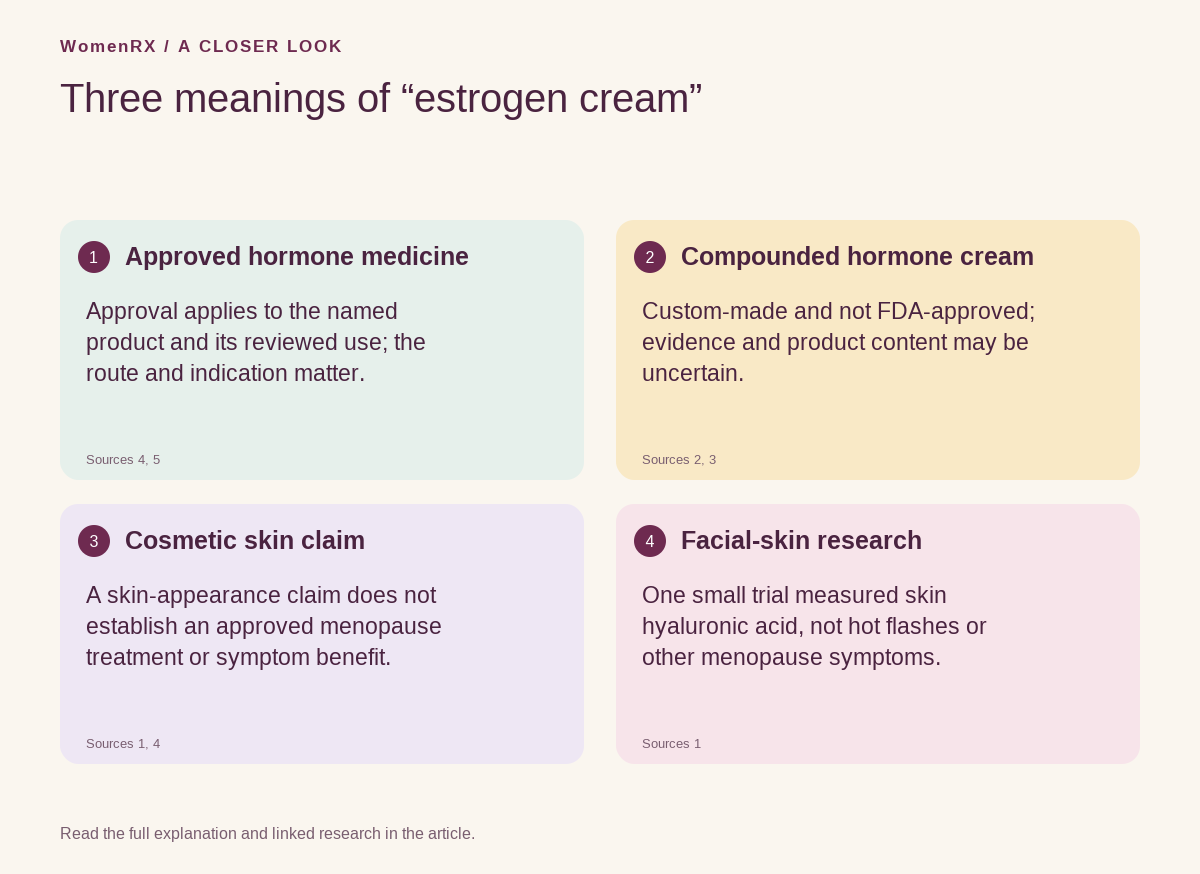
Three meanings of “estrogen cream”
Approved hormone medicine: Approval applies to the named product and its reviewed use; the route and indication matter.45
Compounded hormone cream: Custom-made and not FDA-approved; evidence and product content may be uncertain.23
Cosmetic skin claim: A skin-appearance claim does not establish an approved menopause treatment or symptom benefit.14
Facial-skin research: One small trial measured skin hyaluronic acid, not hot flashes or other menopause symptoms.1
Read the figure as text
The same casual label can refer to products with different regulatory status, evidence, and intended uses.- Approved hormone medicine: Approval applies to the named product and its reviewed use; the route and indication matter.45
- Compounded hormone cream: Custom-made and not FDA-approved; evidence and product content may be uncertain.23
- Cosmetic skin claim: A skin-appearance claim does not establish an approved menopause treatment or symptom benefit.14
- Facial-skin research: One small trial measured skin hyaluronic acid, not hot flashes or other menopause symptoms.1
More questions, answered
Does “bioidentical” mean an estrogen cream is FDA-approved?
No. Bioidentical describes a hormone’s molecular structure, not its approval status. FDA-approved hormone formulations can be bioidentical, while custom-compounded products marketed with the same word are not FDA-approved. 2 3
Does research on estrogen gel for facial skin prove it treats menopause symptoms?
No. A small trial studied skin hyaluronic acid after facial application; it did not test treatment of hot flashes or establish that a body cream is an approved menopause medicine. 1
Sources you can check
- Hyaluronic acid concentration in postmenopausal facial skin after topical estradiol and genistein treatment: a double-blind, randomized clinical trial of efficacy.Patriarca MT, Barbosa de Moraes AR, Nader HB, Petri V, Martins JR, Gomes RC, Soares JM. · Menopause (New York, N.Y.) · 2013Return to first citation
- Fear, misinformation, and pharmaceutical messianism in the promotion of compounded bioidentical hormone therapy.Kauffman RP, MacLaughlin EJ, Courtney LA, Vineyard DD. · Frontiers in reproductive health · 2024Return to first citation
- Compounded bioidentical hormone therapy: new recommendations from the 2020 National Academies of Sciences, Engineering, and Medicine.Stuenkel CA. · Menopause (New York, N.Y.) · 2021Return to first citation
- The Clinical Utility of Compounded Bioidentical Hormone Therapy: A Review of Safety, Effectiveness, and UseNational Academies of Sciences, Engineering, and Medicine; Health and Medicine Division; Board on Health Sciences Policy; Committee on the Clinical Utility of Treating Patients wit... · 2020Return to first citation
- The 2022 hormone therapy position statement of The North American Menopause Society.“The 2022 Hormone Therapy Position Statement of The North American Menopause Society” Advisory Panel. · Menopause (New York, N.Y.) · 2022Return to first citation