What to Know About Estrogen Body Cream With Progesterone
A progesterone ingredient on the label doesn’t prove that a particular cream delivers a tested dose or protects the uterine lining.
Check the exact hormones, amount per application, route, and whether the product is compounded. A small trial studied progesterone cream applied to the skin alongside estrogen taken by mouth; it did not test a combined estrogen-and-progesterone body cream. Its six-month findings don’t establish that another cream reliably delivers hormones or protects the uterine lining. 1
Start with what the product actually is
“Estrogen body cream with progesterone” doesn’t tell you enough to judge what the product is intended to do. Check the exact estrogen and progesterone ingredients, the amount of each in an application, where it’s meant to be applied, and whether it’s compounded. Also ask whether the goal is to treat symptoms throughout the body or symptoms in a particular area. Those details matter when comparing a product with a study or another hormone regimen.
A label listing progesterone shows what the product contains, not whether the amount reaching the body has been shown to protect the uterine lining. The study most directly relevant to progesterone cream tested a different combination: participants took estrogen by mouth and applied progesterone cream to their skin. It did not test a cream containing both hormones. 1
What the small trial can, and can’t, tell you
In a randomized crossover trial, 26 menopausal women completed two six-month treatment periods. Both regimens included daily oral conjugated equine estrogen. One paired it with oral medroxyprogesterone acetate; the other paired it with progesterone cream applied to the skin twice daily. 1
Among 52 post-treatment endometrial biopsies, none showed hyperplasia. Twelve showed proliferative endometrium: seven after the oral-progestin regimen and five after the progesterone-cream regimen. The researchers described the findings as preliminary. 1
That result is not proof that every progesterone cream protects the uterine lining. It also can’t establish the effect of a different progesterone formulation, a combined estrogen-and-progesterone cream, or use beyond the study’s six-month treatment periods. A finding from one specific regimen shouldn’t be treated as evidence for a product with different ingredients, amounts, or route. 1
Why your uterus and the estrogen route matter
If you have a uterus and the cream is intended to deliver estrogen into your body, ask how the proposed regimen addresses the uterine lining. Don’t assume that the word “progesterone” on the label answers that question. Ask what evidence supports the specific product and regimen for that purpose.
The North American Menopause Society notes that hormone-therapy risks vary with factors including the type, dose, duration, and route of treatment, and whether a progestogen is used. That’s a reason to assess the whole regimen, not just one ingredient in isolation. 2
A focused set of questions to ask
Before deciding whether the cream fits your intended use, ask:
- What are the exact hormone ingredients, and how much of each is in one application?
- Where is the cream meant to be applied, and what is the intended treatment effect?
- Is it compounded? If so, what evidence supports this particular formulation and regimen?
- If I have a uterus and this is intended to deliver estrogen into my body, how does the plan address the uterine lining?
The useful distinction is between a cream that contains progesterone and a regimen shown to provide the effect you need. The small trial offers limited findings for one progesterone cream used with oral estrogen; it doesn’t establish dependable hormone delivery or uterine protection from a different combined body cream. 1
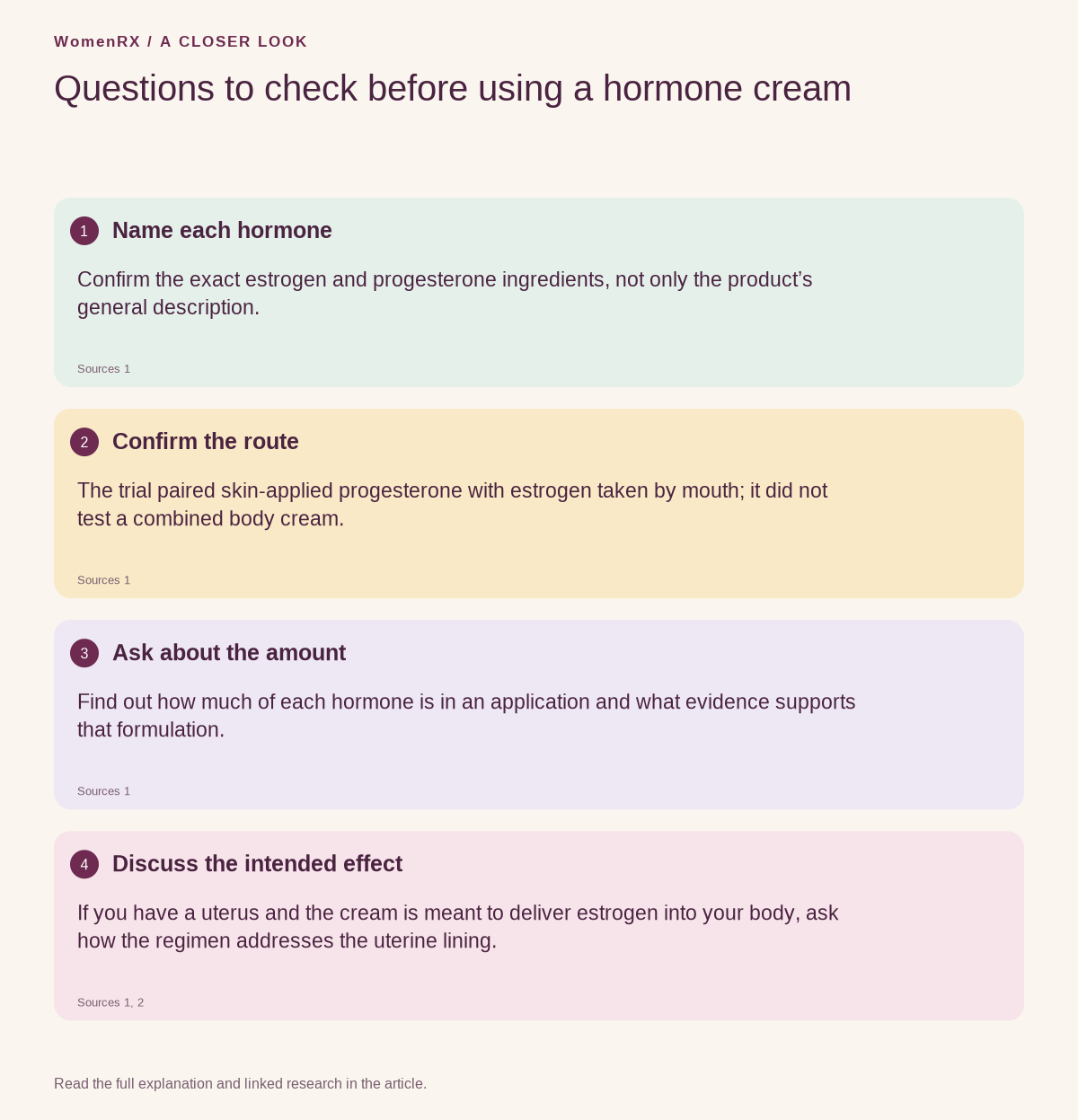
Questions to check before using a hormone cream
Name each hormone: Confirm the exact estrogen and progesterone ingredients, not only the product’s general description.1
Confirm the route: The trial paired skin-applied progesterone with estrogen taken by mouth; it did not test a combined body cream.1
Ask about the amount: Find out how much of each hormone is in an application and what evidence supports that formulation.1
Discuss the intended effect: If you have a uterus and the cream is meant to deliver estrogen into your body, ask how the regimen addresses the uterine lining.12
Read the figure as text
These details help you compare the proposed product with the limited progesterone-cream trial and clarify what the regimen is meant to do.- Name each hormone: Confirm the exact estrogen and progesterone ingredients, not only the product’s general description.1
- Confirm the route: The trial paired skin-applied progesterone with estrogen taken by mouth; it did not test a combined body cream.1
- Ask about the amount: Find out how much of each hormone is in an application and what evidence supports that formulation.1
- Discuss the intended effect: If you have a uterus and the cream is meant to deliver estrogen into your body, ask how the regimen addresses the uterine lining.12
Sources you can check
- Transdermal progesterone cream as an alternative progestin in hormone therapy.Leonetti HB, Landes J, Steinberg D, Anasti JN. · Alternative therapies in health and medicine · 2005Return to first citation
- The 2022 hormone therapy position statement of The North American Menopause Society.“The 2022 Hormone Therapy Position Statement of The North American Menopause Society” Advisory Panel. · Menopause (New York, N.Y.) · 2022Return to first citation