What a Combined Estrogen and Progesterone Cream Can’t Promise
A cream may list both hormones, but that alone doesn’t tell you how much reaches your body or whether it protects your uterine lining.
A compounded estrogen-and-progesterone cream isn’t automatically equivalent to a studied menopause treatment. “Bioidentical” describes the hormones’ molecular structure, not proof that a particular cream has been tested for consistent content, symptom relief, or protection of the uterine lining. If you have a uterus, the key question is whether its progesterone component has been shown to adequately oppose its estrogen component. That can’t be assumed from the ingredient list. 35

Start with what the cream actually contains
“Bioidentical” means a hormone has the same chemical and molecular structure as a hormone your body makes. It doesn’t mean the product is necessarily custom-compounded: FDA-approved hormone formulations can contain bioidentical hormones, too. A cream labeled “estradiol and progesterone” tells you which hormones are intended to be in it, but not whether that particular formulation has been studied for the use you’re considering. 5
Ask for the exact formulation rather than relying on the word balanced. Which estrogen does it contain? How much of each hormone is intended in an application? Is it a custom-compounded preparation or an FDA-approved product? Those details matter because hormone therapy’s risks and benefits vary with the type, dose, route, and use of a progestogen. 6
Why putting both hormones in one cream isn’t the whole answer
There are three separate questions behind a combined formula.
Is the prepared product consistent? A custom-compounded medication is made for an individual prescription rather than evaluated and approved as that finished product by the FDA. Reviews of compounded hormone therapy have raised concerns about uncertain content and the lack of product-specific safety and effectiveness data. That does not prove every compounded cream is incorrectly made. It means the word “compounded” isn’t evidence that each hormone reaches you at the intended amount. 35
What gets absorbed? A label can state what was put into a cream, but it can’t by itself establish how much estradiol or progesterone reaches the bloodstream or uterine lining. A review discussing the 2020 National Academies analysis reported very little high-quality information on how compounded hormone creams and other formulations are absorbed and processed. Results from one route or formulation shouldn’t be carried over to another without evidence. 4
Does the progesterone protect the uterus? Estrogen can stimulate growth of the uterine lining. For someone with a uterus using estrogen therapy that affects that lining, adding an adequately studied progestogen regimen has been shown to reduce endometrial hyperplasia, a change that can precede cancer. The mere presence of progesterone in a combined cream does not establish that this particular amount, delivery route, and schedule provide that protection. 13
That last distinction is easy to miss. A cream might be discussed for hot flashes or other menopause symptoms, while the safety question is whether its progesterone component sufficiently opposes estrogen’s effects on the uterine lining. Feeling better would not answer that question. A review identified three randomized trials of compounded progesterone cream for vasomotor symptoms, but none assessed endometrial safety using the FDA methodology described by the review. That finding concerns the trials reviewed; it doesn’t prove that every possible cream is unsafe or protective. 3
What a studied combination does, and doesn’t, tell you
An FDA-approved estradiol-and-progesterone capsule offers a useful contrast, not a substitute set of instructions for a cream. Its prescribing information describes a 52-week safety trial with endometrial biopsies in postmenopausal women taking that specific oral combination. Those findings belong to the tested capsule and its studied regimens. They cannot establish endometrial protection for a cream simply because both products name estradiol and progesterone. 2
Route matters in another way: a vaginal estradiol cream and a cream intended to be applied to the skin are not interchangeable categories. The prescribing information for a vaginal estradiol product addresses its own use and endometrial warnings; it does not test a compounded, combined skin cream. If your main concern is vaginal dryness or discomfort rather than hot flashes, say so. The Menopause Society’s position statement discusses low-dose vaginal estrogen and other options for bothersome genitourinary symptoms when over-the-counter measures haven’t helped and systemic hormone therapy isn’t otherwise indicated. 16
The useful comparison to make before choosing
If a combined cream has been proposed, ask what symptom it is meant to treat and what evidence supports that exact formulation and route. Then ask the separate uterine-safety question: if you have a uterus, what evidence supports the plan for protecting its lining? An ingredient list, a claim that the formula is natural, or evidence from an oral capsule can’t answer that on its own. FDA-approved bioidentical formulations exist, so it’s also reasonable to compare the proposed cream with studied options that address your particular symptoms. 2356
If you have bleeding after menopause, or persistent or recurring unusual bleeding while using hormone therapy, have it evaluated rather than treating it as proof the hormones are simply adjusting. Postmenopausal bleeding can have more than one cause, including a problem with the uterine lining. 1
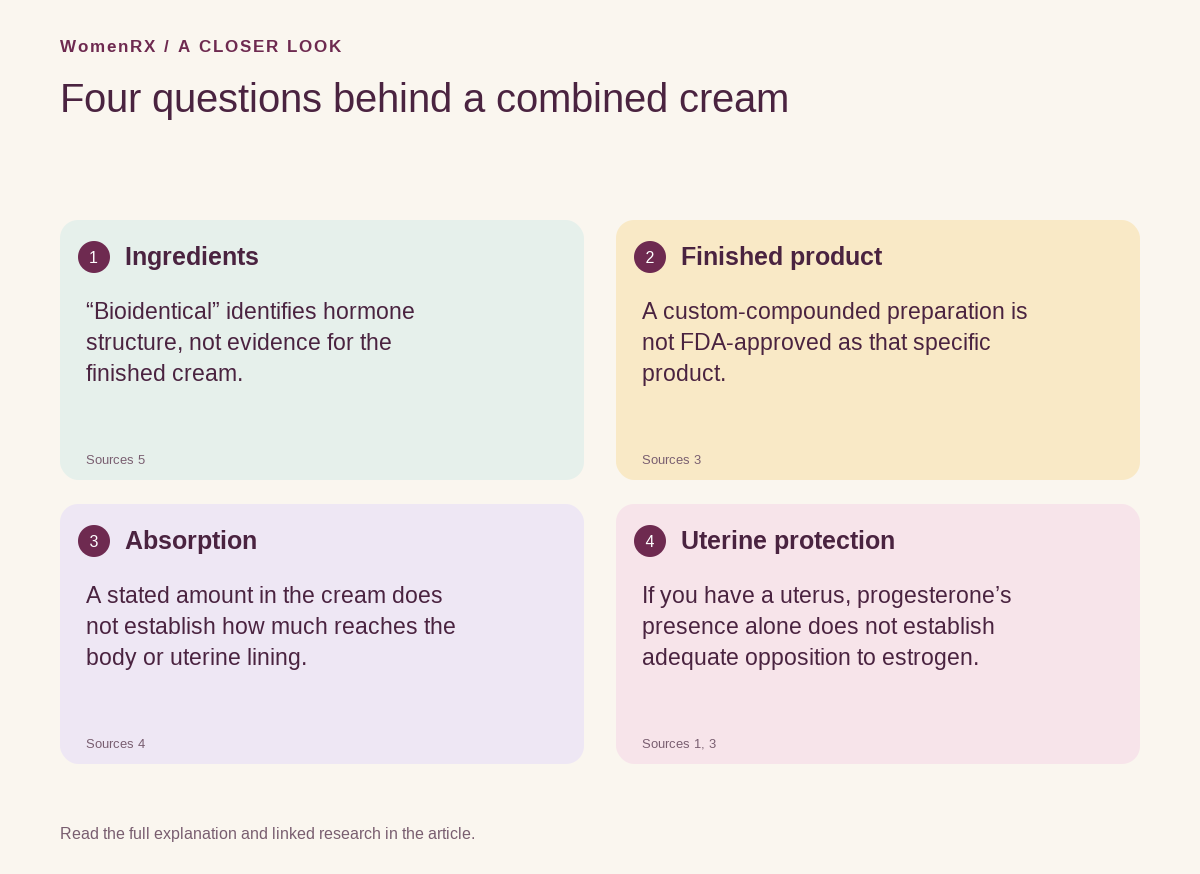
Four questions behind a combined cream
Ingredients: “Bioidentical” identifies hormone structure, not evidence for the finished cream.5
Finished product: A custom-compounded preparation is not FDA-approved as that specific product.3
Absorption: A stated amount in the cream does not establish how much reaches the body or uterine lining.4
Uterine protection: If you have a uterus, progesterone’s presence alone does not establish adequate opposition to estrogen.13
Read the figure as text
Each question requires its own answer; listing two hormones does not settle the others.- Ingredients: “Bioidentical” identifies hormone structure, not evidence for the finished cream.5
- Finished product: A custom-compounded preparation is not FDA-approved as that specific product.3
- Absorption: A stated amount in the cream does not establish how much reaches the body or uterine lining.4
- Uterine protection: If you have a uterus, progesterone’s presence alone does not establish adequate opposition to estrogen.13
More questions, answered
Does “bioidentical” mean a cream is safer?
No. The term describes molecular structure, not the safety or effectiveness of a finished product. Both FDA-approved formulations and custom-compounded preparations may contain bioidentical hormones, but a compounded preparation has not undergone FDA approval as that specific product. 35
Can symptom relief show that the progesterone is working?
Symptom relief and endometrial protection are different outcomes. Whether progesterone adequately opposes estrogen’s effect on the uterine lining requires relevant safety evidence; feeling fewer hot flashes cannot establish it. 13
Sources you can check
- ESTRACE (ESTRADIOL) CREAM [ALLERGAN, INC.] | US prescribing information and patient instructionsAccessed 2026-09-25Return to first citation
- BIJUVA (ESTRADIOL AND PROGESTERONE) CAPSULE [MAYNE PHARMA] | US prescribing information and patient instructionsAccessed 2026-09-25Return to first citation
- Update on medical and regulatory issues pertaining to compounded and FDA-approved drugs, including hormone therapy.Pinkerton JV, Pickar JH. · Menopause (New York, N.Y.) · 2016Return to first citation
- Fear, misinformation, and pharmaceutical messianism in the promotion of compounded bioidentical hormone therapy.Kauffman RP, MacLaughlin EJ, Courtney LA, Vineyard DD. · Frontiers in reproductive health · 2024Return to first citation
- Compounded bioidentical hormone therapy: new recommendations from the 2020 National Academies of Sciences, Engineering, and Medicine.Stuenkel CA. · Menopause (New York, N.Y.) · 2021Return to first citation
- The 2022 hormone therapy position statement of The North American Menopause Society.“The 2022 Hormone Therapy Position Statement of The North American Menopause Society” Advisory Panel. · Menopause (New York, N.Y.) · 2022Return to first citation