How to Choose Safely Among Estrogen and Progesterone Cream Claims
To assess a menopause cream, look past “bioidentical” and check its ingredients, intended use, and evidence for that specific formulation.
Start with the symptom you want to treat, then check the cream’s active ingredients, whether it’s meant for vaginal or skin use, and whether it’s an FDA-approved medication or a compounded preparation. These products aren’t interchangeable. If a cream contains progesterone, don’t assume it provides uterine protection alongside estrogen; ask how that claim is supported. 1 2 3

First, match the treatment to the symptom
Hot flashes and vaginal symptoms can both occur around menopause, but a cream marketed for one shouldn’t be assumed to treat the other. Hormone therapy is the most effective treatment for hot flashes and other vasomotor symptoms. For bothersome vaginal and urinary symptoms that haven’t improved with over-the-counter therapies, low-dose vaginal estrogen is one recommended option when systemic hormone therapy isn’t otherwise indicated. 3
That distinction gives you a useful first question: What is this product supposed to do? A vaginal estradiol cream, a hormone product applied to the skin, and a cosmetic cream may all have “estrogen” in their marketing, but their intended uses and supporting evidence differ. Check the active ingredients and directions rather than relying on the word cream.
Read the product claim, not just the hormone name
For a product you’re considering, find out whether the active ingredient is estradiol, another estrogen, progesterone, or a combination. Then check where the product is meant to be applied and whether it’s an FDA-approved medication or a compounded preparation. If those basics aren’t clear, ask for the exact product information before treating its claims as medical guidance.
“Bioidentical” doesn’t settle the question of effectiveness or safety. A systematic review of compounded bioidentical hormone therapy included 29 randomized trials involving 1,808 perimenopausal and postmenopausal women, but the preparations, routes, and strengths varied. The trials did not provide enough evidence to assess clinical risks of breast cancer, endometrial cancer, or cardiovascular disease. The review therefore can’t establish the long-term safety of a particular compounded estrogen-and-progesterone cream. 2
Nor does one product’s label tell you what another cream will do. Prescribing information for a vaginal estradiol cream notes that estrogen products can be absorbed through skin and mucous membranes. That fact alone doesn’t tell you how much hormone a different skin cream delivers or whether it will relieve hot flashes. 1
If progesterone is included, ask what job it’s meant to do
This question matters particularly if you have a uterus and are considering estrogen. Unopposed estrogen therapy can raise endometrial cancer risk in women with a uterus, and menopause guidance says hormone therapy’s risks depend in part on the route and whether a progestogen is used. But seeing “progesterone” on a cream’s label doesn’t establish that the formulation provides adequate protection for the uterine lining. Ask the prescriber how the specific treatment plan addresses that concern and what evidence supports the cream’s claimed role. 1 2 3
Don’t assume this means you should add a progesterone cream to vaginal estrogen, either. The question is whether you need local treatment for vaginal symptoms, systemic treatment for hot flashes, or something else. The answer depends on the treatment and your circumstances, not a rule that applies to every product called estrogen cream. 3
A practical way to screen a cream
Before using one, try to get clear answers to these five questions:
- What’s in it? Look for the active hormone ingredients, not only phrases such as “natural” or “bioidentical.”
- Where does it go? Check whether the directions specify vaginal use or application to the skin.
- What is its product status? Is it an FDA-approved medication or a compounded preparation? Ask for information about the exact formulation.
- What symptom is it meant to treat? Ask what evidence supports that ingredient and route for your intended use.
- What is the plan for uterine safety? If you have a uterus and are considering estrogen, ask how the full treatment plan addresses endometrial risk rather than assuming a progesterone cream does so. 1 2 3
One symptom deserves attention regardless of a cream’s marketing: unusual vaginal bleeding after menopause should be evaluated to find its cause. Vaginal estradiol prescribing information specifically advises reporting unusual bleeding while using that product. 1
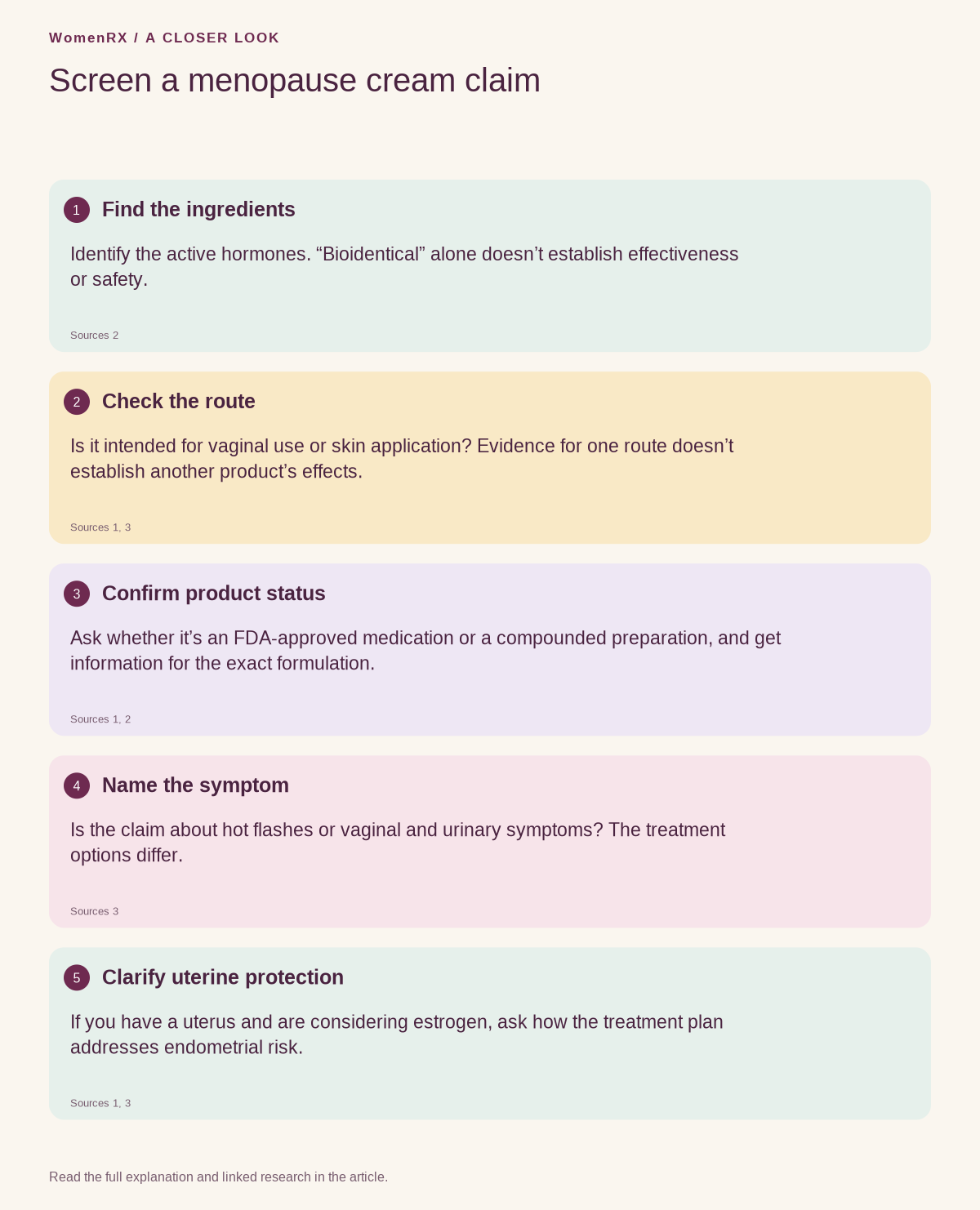
Screen a menopause cream claim
Find the ingredients: Identify the active hormones. “Bioidentical” alone doesn’t establish effectiveness or safety.2
Check the route: Is it intended for vaginal use or skin application? Evidence for one route doesn’t establish another product’s effects.13
Confirm product status: Ask whether it’s an FDA-approved medication or a compounded preparation, and get information for the exact formulation.12
Name the symptom: Is the claim about hot flashes or vaginal and urinary symptoms? The treatment options differ.3
Clarify uterine protection: If you have a uterus and are considering estrogen, ask how the treatment plan addresses endometrial risk.13
Read the figure as text
Use these questions to find out what a cream is, what it claims to treat, and what still needs a treatment decision.- Find the ingredients: Identify the active hormones. “Bioidentical” alone doesn’t establish effectiveness or safety.2
- Check the route: Is it intended for vaginal use or skin application? Evidence for one route doesn’t establish another product’s effects.13
- Confirm product status: Ask whether it’s an FDA-approved medication or a compounded preparation, and get information for the exact formulation.12
- Name the symptom: Is the claim about hot flashes or vaginal and urinary symptoms? The treatment options differ.3
- Clarify uterine protection: If you have a uterus and are considering estrogen, ask how the treatment plan addresses endometrial risk.13
Sources you can check
- ESTRACE (ESTRADIOL) CREAM [ALLERGAN, INC.] | US prescribing information and patient instructionsAccessed 2026-09-25Return to first citation
- Safety and efficacy of compounded bioidentical hormone therapy (cBHT) in perimenopausal and postmenopausal women: a systematic review and meta-analysis of randomized controlled trials.Liu Y, Yuan Y, Day AJ, Zhang W, John P, Ng DJ, Banov D. · Menopause (New York, N.Y.) · 2022Return to first citation
- The 2022 hormone therapy position statement of The North American Menopause Society.“The 2022 Hormone Therapy Position Statement of The North American Menopause Society” Advisory Panel. · Menopause (New York, N.Y.) · 2022Return to first citation