How to Choose Safely When Comparing Progesterone Creams
Before buying a menopause cream, check what it contains, what it’s meant to do, and whether evidence supports that use.
Don’t choose a progesterone cream by its percentage or the word “bioidentical.” Trials reviewed to date don’t support progesterone cream for menopause-related hot flashes, and results from one formula can’t establish that another works. If you use systemic estrogen and have a uterus, the key question is whether the cream is meant to protect the uterine lining. Evidence for a cream does not establish that role. 1 6

Start with the job you want the cream to do
“Menopause support” can mean different things: easing hot flashes, changing skin texture, or providing a progestogen alongside systemic estrogen. Those are separate goals, and evidence for one doesn’t establish benefit for another.
For hot flashes and night sweats, a review of three randomized trials found that only one, using a progesterone cream compounded specifically for the study, showed better results than placebo. Two trials of manufactured progesterone creams did not find them more effective than placebo. The review concluded that the available trial evidence did not support progesterone cream for menopause-related vasomotor symptoms. 6
There is a small skin study, but it answers a different question. In a randomized trial of 40 peri- and postmenopausal women, a 2% cream was studied for 16 weeks; researchers reported improvements in some measures of skin elasticity and firmness. That result does not establish relief of hot flashes or protection of the uterine lining. 4
If you use systemic estrogen, ask about your uterus
Estrogen can stimulate the lining of the uterus. In a trial of postmenopausal women with an intact uterus, endometrial hyperplasia over up to 36 months was reported in 64% of those receiving conjugated estrogen alone, compared with 6% receiving conjugated estrogen plus cyclic oral progesterone. That finding concerns a specific oral progesterone regimen, not a cream. 1
So if you still have a uterus and use systemic estrogen, don’t assume a cream can serve as the progestogen in your treatment plan just because its label lists progesterone or a high percentage. The evidence about a cream’s skin effects, or about symptoms, does not show that it protects the uterine lining. If you don’t have a uterus, that particular endometrial-protection question is different; it still doesn’t make a cream a proven hot-flash treatment. 1 4 6
Check what the product actually is
Before buying, identify whether you’re looking at a prescription product, a compounded preparation, or a nonprescription product. Ask for the active ingredient, the amount or concentration, and the intended use. “Bioidentical” describes a chemical similarity claim; by itself, it doesn’t tell you whether a particular cream has been shown to work for your goal. The reviewed trials had different results for a study-specific compounded cream and manufactured creams. 1 6
Don’t treat the percentage on a label as proof of how much hormone reaches your bloodstream or whether the cream does what you want. One study found a small rise in blood progesterone with the specific 2% cream it tested. That finding cannot establish absorption or effectiveness for a different formula. 4
If the ingredient is wild yam extract rather than progesterone, that’s a different product. In a small crossover trial of 23 menopausal women, wild yam cream did not improve symptoms more than placebo and did not change measured progesterone levels. 5
A short buying check
Before purchasing, get clear answers to these questions:
- What is the active ingredient? Is it progesterone, wild yam extract, or another ingredient?
- What kind of product is it? Is it prescription, compounded, or nonprescription? Ask who prepared it and what documentation comes with it.
- What is the intended use? Is the claim about hot flashes, skin, or a role alongside systemic estrogen?
- What evidence matches that use and formula? A result for one cream or one purpose doesn’t establish a benefit for another.
- If you use systemic estrogen, what is the plan for your uterine lining? If you have a uterus, ask the prescriber to explain how the prescribed plan addresses that question. Evidence for oral progesterone cannot simply be transferred to a cream. 1 4 6
For bothersome hot flashes, menopause guidance identifies hormone therapy as the most effective treatment for vasomotor symptoms, with nonhormonal options also supported by evidence. A progesterone cream should not be treated as an evidence-backed substitute for those options based on its name or label alone. 2 3
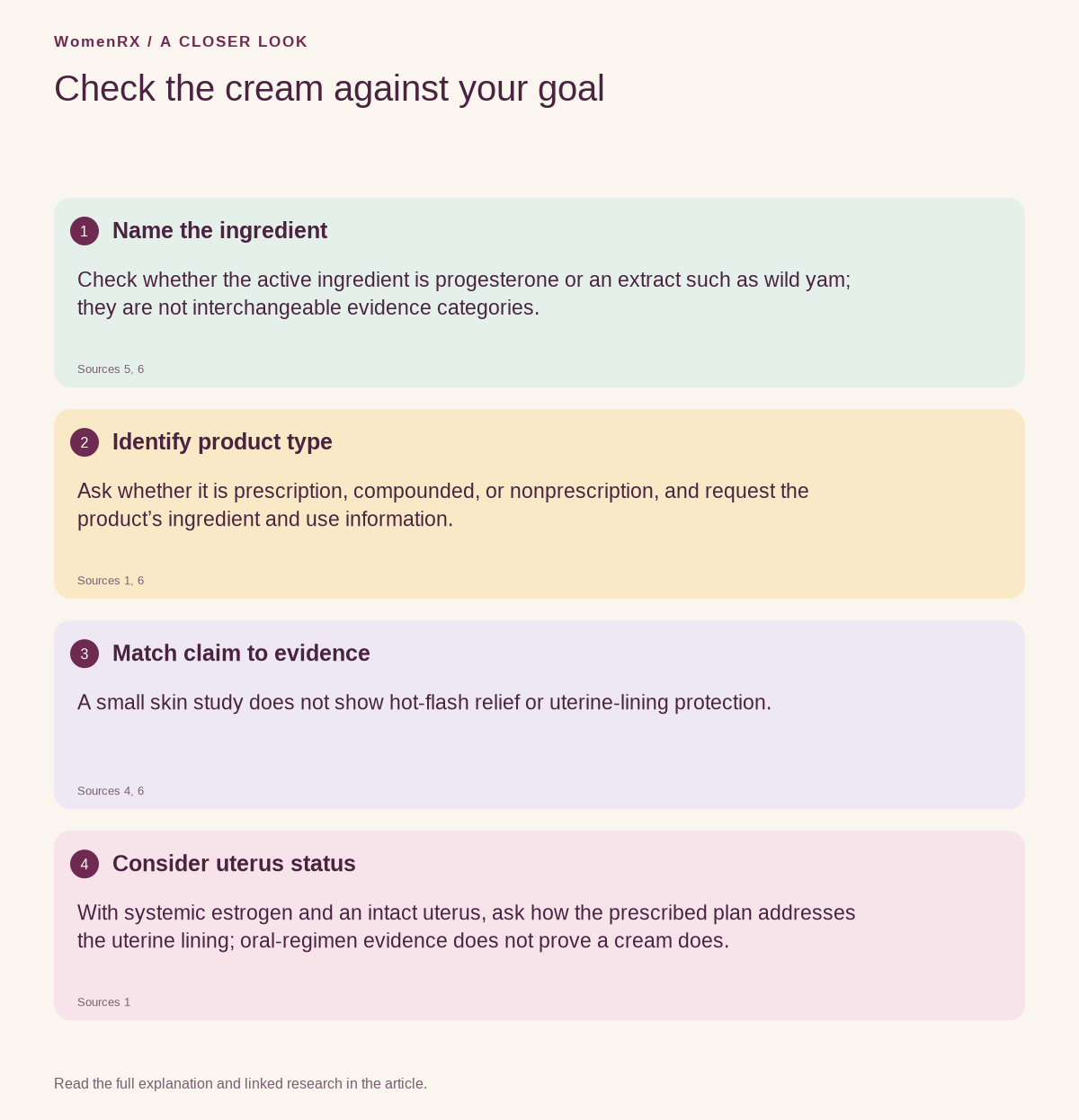
Check the cream against your goal
Name the ingredient: Check whether the active ingredient is progesterone or an extract such as wild yam; they are not interchangeable evidence categories.56
Identify product type: Ask whether it is prescription, compounded, or nonprescription, and request the product’s ingredient and use information.16
Match claim to evidence: A small skin study does not show hot-flash relief or uterine-lining protection.46
Consider uterus status: With systemic estrogen and an intact uterus, ask how the prescribed plan addresses the uterine lining; oral-regimen evidence does not prove a cream does.1
Read the figure as text
Separate the product’s identity from its claim, then consider whether systemic estrogen and an intact uterus make endometrial protection part of the question.- Name the ingredient: Check whether the active ingredient is progesterone or an extract such as wild yam; they are not interchangeable evidence categories.56
- Identify product type: Ask whether it is prescription, compounded, or nonprescription, and request the product’s ingredient and use information.16
- Match claim to evidence: A small skin study does not show hot-flash relief or uterine-lining protection.46
- Consider uterus status: With systemic estrogen and an intact uterus, ask how the prescribed plan addresses the uterine lining; oral-regimen evidence does not prove a cream does.1
Sources you can check
- PROMETRIUM (PROGESTERONE) CAPSULE [ACERTIS PHARMACEUTICALS, LLC] | US prescribing information and patient instructionsAccessed 2026-09-25Return to first citation
- The 2022 hormone therapy position statement of The North American Menopause Society.“The 2022 Hormone Therapy Position Statement of The North American Menopause Society” Advisory Panel. · Menopause (New York, N.Y.) · 2022Return to first citation
- The 2023 nonhormone therapy position statement of The North American Menopause Society.Menopause (New York, N.Y.) · 2023Return to first citation
- Effects and side-effects of 2% progesterone cream on the skin of peri- and postmenopausal women: results from a double-blind, vehicle-controlled, randomized study.Holzer G, Riegler E, Hönigsmann H, Farokhnia S, Schmidt JB. · The British journal of dermatology · 2005Return to first citation
- Effects of wild yam extract on menopausal symptoms, lipids and sex hormones in healthy menopausal women.Komesaroff PA, Black CV, Cable V, Sudhir K. · Climacteric : the journal of the International Menopause Society · 2001Return to first citation
- Bioidentical progesterone cream for menopause-related vasomotor symptoms: is it effective?Whelan AM, Jurgens TM, Trinacty M. · The Annals of pharmacotherapy · 2013Return to first citation