Estrogen and Progesterone Creams: What’s the Difference?
The route, ingredients, and exact product matter more than the word “cream” on the label.
Some estrogen creams are used vaginally, and a vaginal estradiol gel has been studied for vaginal atrophy. Estradiol gels applied to the skin can deliver estrogen systemically. 87 If you have a uterus and use systemic estrogen, the uterine lining may need protection, but progesterone cream shouldn’t be assumed to provide it. A combined prescription product with trial evidence is an oral capsule, not a cream. 152
“Cream” doesn’t tell you where the hormone goes
A hormone product’s route and formulation shape what it’s meant to do and what evidence applies. A vaginal estrogen cream, an estradiol gel rubbed on the skin, and a custom-compounded cream aren’t interchangeable simply because they’re applied to the body.
For example, the U.S. prescribing information for vaginal estradiol cream says systemic absorption may occur. A small randomized trial studied a different product, vaginal estradiol gel, for vaginal atrophy in postmenopausal women. The gel improved several measures of vaginal tissue, with no significant difference in serum estradiol between groups at eight weeks. Those findings relate to that vaginal product and study; they don’t establish how every cream is absorbed. 18
By contrast, a study in ten postmenopausal women found that estradiol gel applied to the skin produced dose-dependent serum estradiol levels. A separate analysis of a clinical trial found reduced moderate to severe vasomotor symptoms with estradiol gel. These are examples of skin-applied estradiol being used for systemic effects, not evidence that every topical estrogen product has the same purpose or absorption. 79
Why the uterus matters with systemic estrogen
Estrogen can stimulate the lining of the uterus. For a person with a uterus using systemic estrogen, estrogen without adequate progestogen can increase the risk of endometrial overgrowth, called hyperplasia, which can sometimes precede cancer. Adding a progestogen has been shown to reduce the risk of hyperplasia. This is a reason to clarify the plan when systemic estrogen is involved, not a reason to assume that every vaginal product creates the same exposure. 14
“Vaginal” doesn’t guarantee zero absorption: the prescribing information for one vaginal estradiol cream says systemic absorption may occur. That product-specific warning doesn’t establish that every vaginal estrogen cream needs the same approach to uterine protection. The amount and kind of exposure depend on the product and regimen. 1
A person considering systemic estrogen can ask what the plan is for the uterine lining and which specific product and route the plan covers. A review of six trials, including 518 perimenopausal and postmenopausal women taking systemic estrogen, compared an intrauterine levonorgestrel system with systemic progestogens. The review found comparable endometrial findings for most comparisons, but reported a methodological limitation and insufficient evidence for several other outcomes. It does not establish that progesterone cream provides the same protection. 4
What the progesterone-cream evidence can, and can’t, say
One small crossover trial compared a particular transdermal progesterone cream plus estrogen with oral medroxyprogesterone plus estrogen. Twenty-six women completed both six-month treatment periods. No hyperplasia was found in the 52 post-treatment biopsies. That is a preliminary finding about that product and study; it does not prove that progesterone creams reliably protect the uterine lining across products, doses, or longer use. 5
That distinction matters: a study that did not observe hyperplasia in a small group is not the same as evidence that a cream reliably provides protection. The study also doesn’t establish that a different cream, including a compounded one, delivers the same amount or has the same effect. 5
Prescription, compounded, and over-the-counter aren’t synonyms
The named prescription products here have specific formulations, routes, and U.S. prescribing information. For example, the U.S. label for Estrace describes a vaginal estradiol cream, while the label for Bijuva describes an oral capsule containing estradiol and progesterone. A compounded preparation may also be prescribed, but it is custom-made rather than the named formulation covered by those labels. The product-specific findings don’t transfer to it. In a 52-week safety trial of Bijuva, one case of endometrial hyperplasia was reported in each of the two Bijuva groups. Those results apply to that oral product and trial, not to a combined cream. 12
Compounded hormones are custom-made preparations. A review warns that their manufacturing quality isn’t assured. The review doesn’t quantify dose variation across products, and it doesn’t establish that a compounded preparation is equivalent to a named prescription medicine with product-specific evidence. 6
“Over the counter” means a medicine can be bought without a prescription. In the U.S., the FDA decides whether a medicine can be sold over the counter. That general rule doesn’t establish the regulatory status of any particular hormone cream, what it contains, how much is absorbed, or whether it has evidence for the effect claimed. 3
Check the product, not just the word “hormone”
Look for the exact ingredients, whether the product is applied vaginally or to the skin, and whether it’s a named prescription medicine or a custom preparation. If estrogen is part of the plan and you have a uterus, clarify whether it’s intended to act locally or systemically and how the lining is addressed. Don’t infer that progesterone is included, or that it protects the lining, just because a product is called “bioidentical,” “natural,” or “hormone cream.” The evidence for a specific product and route is what matters.
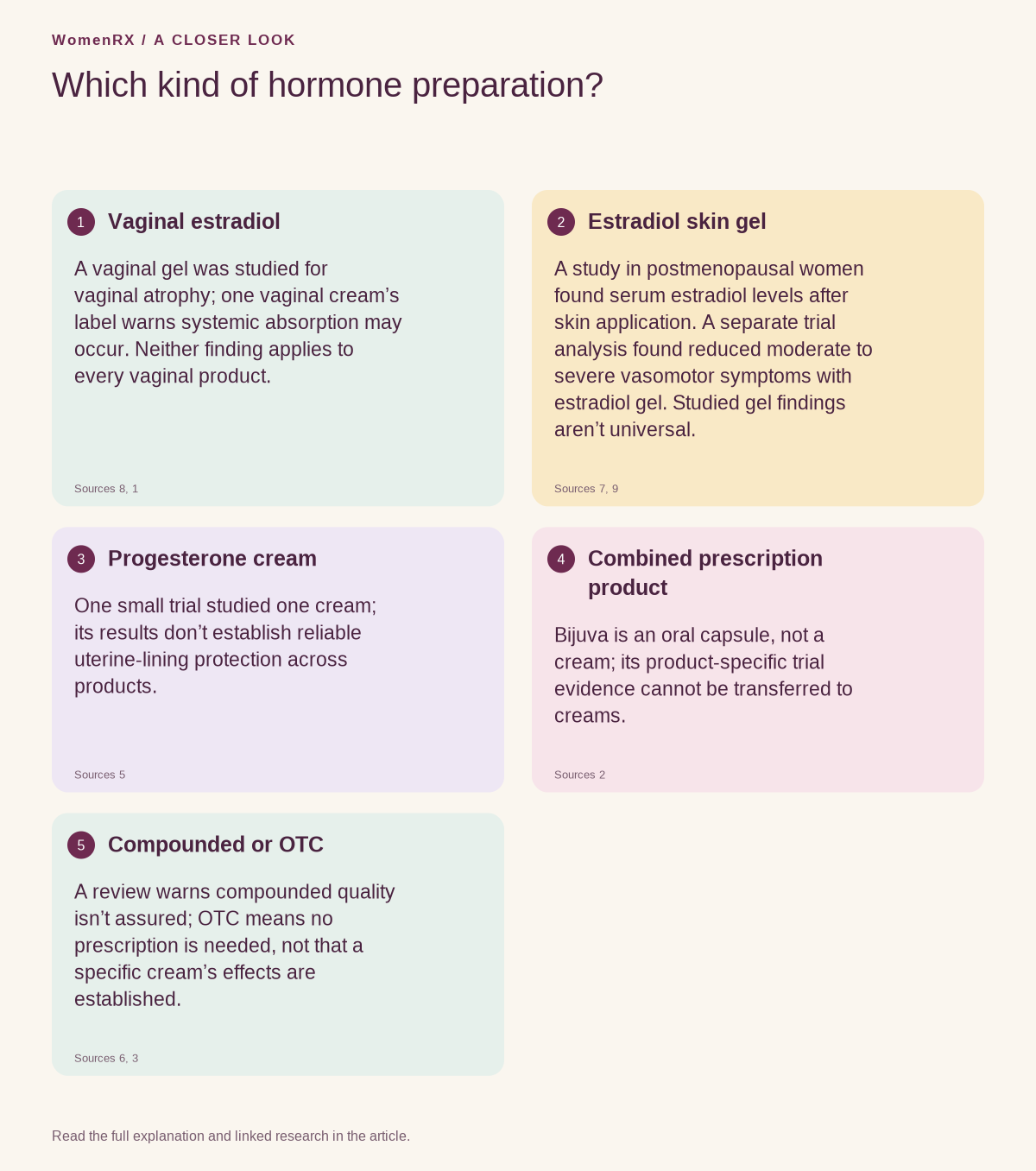
Which kind of hormone preparation?
Vaginal estradiol: A vaginal gel was studied for vaginal atrophy; one vaginal cream’s label warns systemic absorption may occur. Neither finding applies to every vaginal product.81
Estradiol skin gel: A study in postmenopausal women found serum estradiol levels after skin application. A separate trial analysis found reduced moderate to severe vasomotor symptoms with estradiol gel. Studied gel findings aren’t universal.79
Progesterone cream: One small trial studied one cream; its results don’t establish reliable uterine-lining protection across products.5
Combined prescription product: Bijuva is an oral capsule, not a cream; its product-specific trial evidence cannot be transferred to creams.2
Compounded or OTC: A review warns compounded quality isn’t assured; OTC means no prescription is needed, not that a specific cream’s effects are established.63
Read the figure as text
The label “cream” doesn’t establish route, purpose, absorption, or evidence. These examples show what can be said about each category and where not to assume equivalence.- Vaginal estradiol: A vaginal gel was studied for vaginal atrophy; one vaginal cream’s label warns systemic absorption may occur. Neither finding applies to every vaginal product.81
- Estradiol skin gel: A study in postmenopausal women found serum estradiol levels after skin application. A separate trial analysis found reduced moderate to severe vasomotor symptoms with estradiol gel. Studied gel findings aren’t universal.79
- Progesterone cream: One small trial studied one cream; its results don’t establish reliable uterine-lining protection across products.5
- Combined prescription product: Bijuva is an oral capsule, not a cream; its product-specific trial evidence cannot be transferred to creams.2
- Compounded or OTC: A review warns compounded quality isn’t assured; OTC means no prescription is needed, not that a specific cream’s effects are established.63
More questions, answered
Does a skin-applied hormone always stay in the skin?
No. In a study of postmenopausal women, estradiol gel applied to the skin produced measurable, dose-dependent serum estradiol levels. Absorption depends on the actual product and route, so “topical” alone doesn’t tell you whether an effect is local or systemic. 7
Is a combined prescription hormone product necessarily a cream?
No. Bijuva is a prescription capsule containing estradiol and progesterone. Its product-specific trial results don’t establish the effects or reliability of a compounded combined cream. 2
Sources you can check
- ESTRACE (ESTRADIOL) CREAM [ALLERGAN, INC.] | US prescribing information and patient instructionsAccessed 2026-09-25Return to first citation
- BIJUVA (ESTRADIOL AND PROGESTERONE) CAPSULE [MAYNE PHARMA] | US prescribing information and patient instructionsAccessed 2026-09-25Return to first citation
- Over-the-Counter Medicines: MedlinePlusAccessed 2026-09-25Return to first citation
- Effects of the levonorgestrel-releasing intrauterine system plus estrogen therapy in perimenopausal and postmenopausal women: systematic review and meta-analysis.Somboonporn W, Panna S, Temtanakitpaisan T, Kaewrudee S, Soontrapa S. · Menopause (New York, N.Y.) · 2011Return to first citation
- Transdermal progesterone cream as an alternative progestin in hormone therapy.Leonetti HB, Landes J, Steinberg D, Anasti JN. · Alternative therapies in health and medicine · 2005Return to first citation
- Custom-compounded bioidentical hormone therapy: why so popular despite potential harm? The case against routine use.L'Hermite M. · Climacteric : the journal of the International Menopause Society · 2017Return to first citation
- Study on the Pharmacokinetics and Pharmacodynamics of Transdermal Estradiol Gel Administered Repeatedly in Postmenopausal Women.Sirviö J, Ahtola-Sätilä T, Kirjavainen M, Rytilä P. · Drugs in R&D · 2026Return to first citation
- Effect of estradiol vaginal gel on vaginal atrophy in postmenopausal women: A randomized double-blind controlled trial.Tanmahasamut P, Jirasawas T, Laiwejpithaya S, Areeswate C, Dangrat C, Silprasit K. · The journal of obstetrics and gynaecology research · 2020Return to first citation
- Estradiol gel 0.1% relieves vasomotor symptoms independent of age, ovarian status, or uterine status.Hedrick RE, Ackerman RT, Koltun WD, Halvorsen MB. · Menopause (New York, N.Y.) · 2010Return to first citation