Estradiol and Progesterone Creams: What Are They Used For?
The route, purpose, and regulatory status of a hormone cream are separate questions, and the answers matter most when systemic estrogen and a uterus are involved.
Vaginal estradiol is used for menopause-related genitourinary symptoms and is absorbed mainly locally compared with systemic hormone therapy. A skin-applied hormone cream is a different route, and its label alone doesn’t show how much hormone is absorbed or whether it treats symptoms effectively. If you have a uterus and use systemic estrogen, ask exactly what treatment is intended to protect the uterine lining. 1 3
Start with where the cream goes
“Estradiol cream” doesn’t identify a single treatment. Vaginal estrogen is used for menopause-related genitourinary symptoms. Guidance describes it as absorbed mainly locally, with minimal bloodstream absorption compared with systemic hormone therapy. That local-absorption description applies to vaginal estrogen, not automatically to every cream containing estradiol. 1
Systemic hormone therapy is a separate approach, often used for bothersome symptoms such as hot flashes and night sweats. Hormone therapy is the most effective treatment for vasomotor symptoms, and its benefits and risks vary with factors such as hormone type, dose, route, duration, and timing. 2
Some compounded hormone creams are applied to the skin. Don’t assume that a skin-applied product behaves like a vaginal product, or that the word “cream” tells you how much enters your bloodstream. A laboratory study of compounded hormone creams measured the amount of estradiol and progesterone in the products; it did not measure absorption through skin or how well the creams treated symptoms. 3
Check whether the exact product is FDA-approved or compounded
A prescription by itself doesn’t tell you whether the exact formulation is FDA-approved or compounded. Check the product name, ingredients, strength, and route on the package or prescription. If that still isn’t clear, ask the pharmacist or prescriber: “Is this exact product FDA-approved, or was it compounded?”
Compounded medicines are prepared by a pharmacy and aren’t subject to the same FDA oversight or routine regulatory testing for quality, purity, and potency as noncompounded FDA-approved drugs. In a laboratory study, researchers tested compounded estradiol and progesterone products from 13 pharmacies and found variation in measured hormone content between pharmacies and within products. That doesn’t mean every compounded product has an inaccurate dose. It does mean the label alone can’t guarantee that different compounded products contain exactly the same measured amount. 3
If you have a uterus, make the protection plan clear
Systemic estrogen can stimulate the uterine lining. For someone with a uterus using systemic estrogen, a progestogen is used to reduce the risk of endometrial overgrowth. The amount and duration of estrogen and progestogen matter, so ask what part of your treatment plan is intended to protect the lining. 3
Don’t assume that progesterone in a cream provides that protection just because it appears on the label or is combined with estradiol. The compounded-cream study measured product content, not absorption through skin or endometrial outcomes. Ask whether the specific progestogen and route in your plan are intended to provide uterine protection. 3
This is a different question from whether vaginal estrogen is being used locally for genitourinary symptoms. Guidance says vaginal estrogen can be used on its own or alongside systemic hormone therapy. If you have a uterus, clarify whether you’re using local vaginal estrogen, systemic estrogen, or both, because the uterine-protection question depends on the treatment plan. 1
Questions that separate the tradeoffs
- What is the exact product, and where is it used: in the vagina or on the skin?
- Is the exact formulation FDA-approved or compounded?
- Is the goal to treat genitourinary symptoms, hot flashes, or something else?
- If this is a skin-applied cream, what is known about its absorption and intended effect?
- If I have a uterus and use systemic estrogen, what is intended to protect the uterine lining?
- If progesterone is in a cream, is that specific product and route meant to provide that protection?
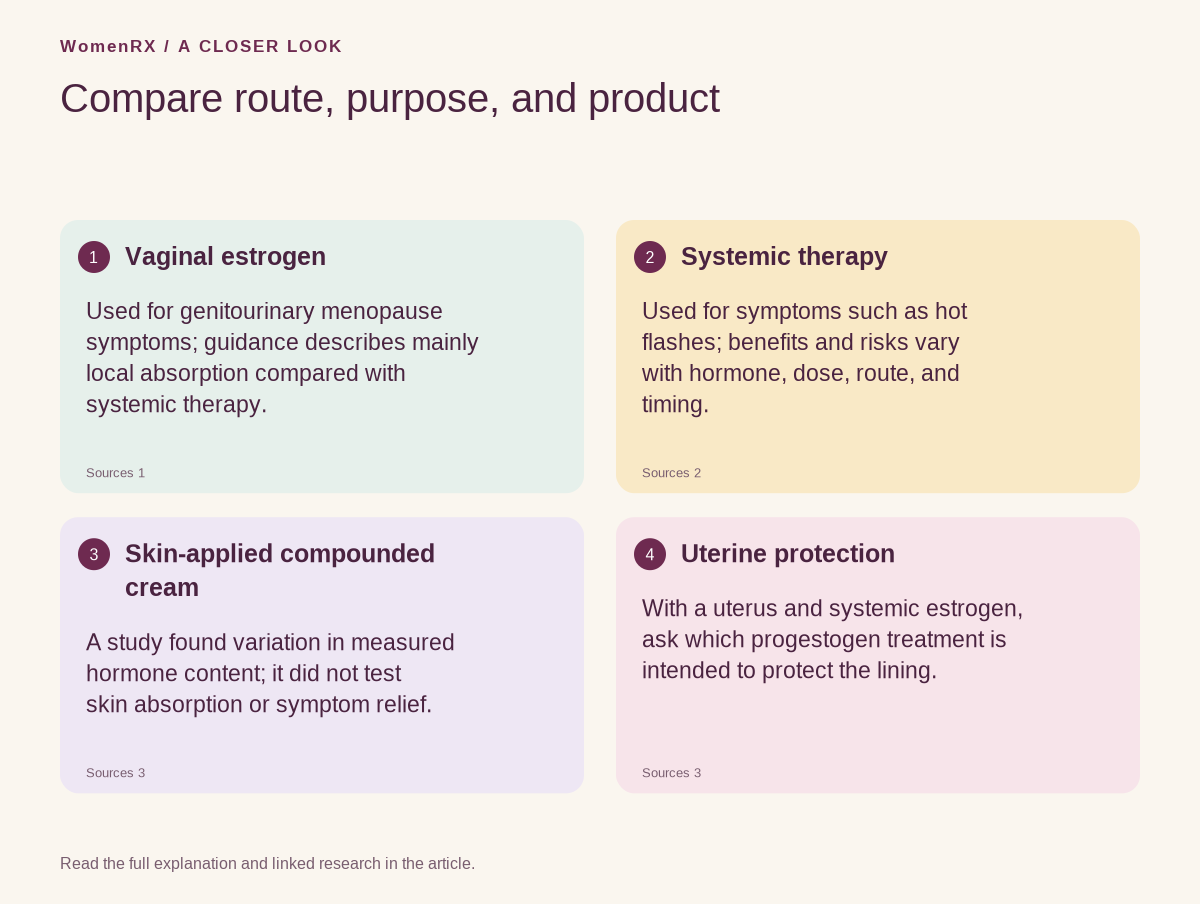
Compare route, purpose, and product
Vaginal estrogen: Used for genitourinary menopause symptoms; guidance describes mainly local absorption compared with systemic therapy.1
Systemic therapy: Used for symptoms such as hot flashes; benefits and risks vary with hormone, dose, route, and timing.2
Skin-applied compounded cream: A study found variation in measured hormone content; it did not test skin absorption or symptom relief.3
Uterine protection: With a uterus and systemic estrogen, ask which progestogen treatment is intended to protect the lining.3
Read the figure as text
A cream’s route, intended use, and manufacturing status answer different questions. Check each one rather than treating all hormone creams as equivalent.- Vaginal estrogen: Used for genitourinary menopause symptoms; guidance describes mainly local absorption compared with systemic therapy.1
- Systemic therapy: Used for symptoms such as hot flashes; benefits and risks vary with hormone, dose, route, and timing.2
- Skin-applied compounded cream: A study found variation in measured hormone content; it did not test skin absorption or symptom relief.3
- Uterine protection: With a uterus and systemic estrogen, ask which progestogen treatment is intended to protect the lining.3
Sources you can check
- Recommendations | Menopause: identification and management | Guidance | NICEAccessed 2026-09-25Return to first citation
- The 2022 hormone therapy position statement of The North American Menopause Society.“The 2022 Hormone Therapy Position Statement of The North American Menopause Society” Advisory Panel. · Menopause (New York, N.Y.) · 2022Return to first citation
- Determination of estradiol and progesterone content in capsules and creams from compounding pharmacies.Stanczyk FZ, Niu C, Azen C, Mirkin S, Amadio JM. · Menopause (New York, N.Y.) · 2019Return to first citation