What does progesterone do, and when is it used as a medicine?
Progesterone’s natural role changes across the menstrual cycle and pregnancy, while prescribed versions are used for specific treatment goals, including protecting the uterine lining during some menopause hormone therapy.
Progesterone is a hormone made mainly by the ovary after ovulation and by the placenta during pregnancy. It helps change the uterine lining during the cycle. As a medicine, progesterone or a related progestogen may be included with estrogen in menopause hormone therapy to protect the uterine lining. The exact medicine and formulation depend on the treatment goal. 3 1
The hormone’s role changes over time
Progesterone is part of the body’s reproductive hormone system, but its levels and role aren’t constant. In a menstrual cycle, the ovary’s corpus luteum, which forms after ovulation, produces progesterone. The hormone helps shift the uterine lining into a secretory phase, readying it for a possible pregnancy. If pregnancy doesn’t occur, the corpus luteum regresses and progesterone production falls. 3
During pregnancy, the corpus luteum supports progesterone production early on; over the first few months, the placenta takes over that role. Progesterone also has actions beyond the reproductive system, including in the mammary gland, brain, cardiovascular system, and bones. 3
Menopause is different from a single, sudden drop in progesterone. During perimenopause, ovarian function and hormone production can fluctuate; after the transition, ovarian reproductive function has ceased. Individual patterns and experiences vary. 4
A hormone and a medicine aren’t always the same thing
Progesterone is the hormone itself. Progestogen is the broader term for progesterone and medicines that act on progesterone receptors. Some of those medicines, called progestins, are synthetic molecules rather than progesterone itself. They can share a receptor target without being chemically identical, so the name on a prescription matters. 3 1 2
One example is micronized progesterone, used in some menopausal hormone therapy regimens. Another is levonorgestrel delivered by an intrauterine system. Both are discussed as ways to provide progestogen activity alongside estrogen, but they are different medicines and formulations. They shouldn’t be treated as interchangeable based on the word “progesterone” alone. 1
A key use in menopause care: protecting the uterine lining
Estrogen can stimulate the lining of the uterus. When menopausal hormone therapy includes estrogen and the uterine lining is present, a progestogen may be included to counter that effect and protect the endometrium. This is a different purpose from replacing the body’s natural progesterone pattern or treating every symptom attributed to menopause. 1
The treatment goal helps explain why formulations differ. A clinician may discuss micronized progesterone or an intrauterine levonorgestrel system as part of combined hormone therapy; the position paper describing these approaches focuses on endometrial protection. Which approach is appropriate depends on the treatment plan, not just a hormone level or the general label “progesterone.” 1
What to take from the distinction
Progesterone has a normal, changing role in the body. A progesterone medicine is a treatment chosen for a particular purpose, and some medicines called progestogens are not progesterone itself. In menopause care, the useful question is often: What is this medicine meant to do in this regimen? If estrogen is part of the plan, ask whether the progestogen’s role is to protect the uterine lining and which formulation is being considered.
This distinction matters because evidence about the body’s natural hormone doesn’t automatically show that taking a medicine will improve a symptom or benefit every woman. The cited menopause position paper addresses specific hormone-therapy approaches; it does not establish progesterone as a general treatment for all menopause symptoms. 1 4
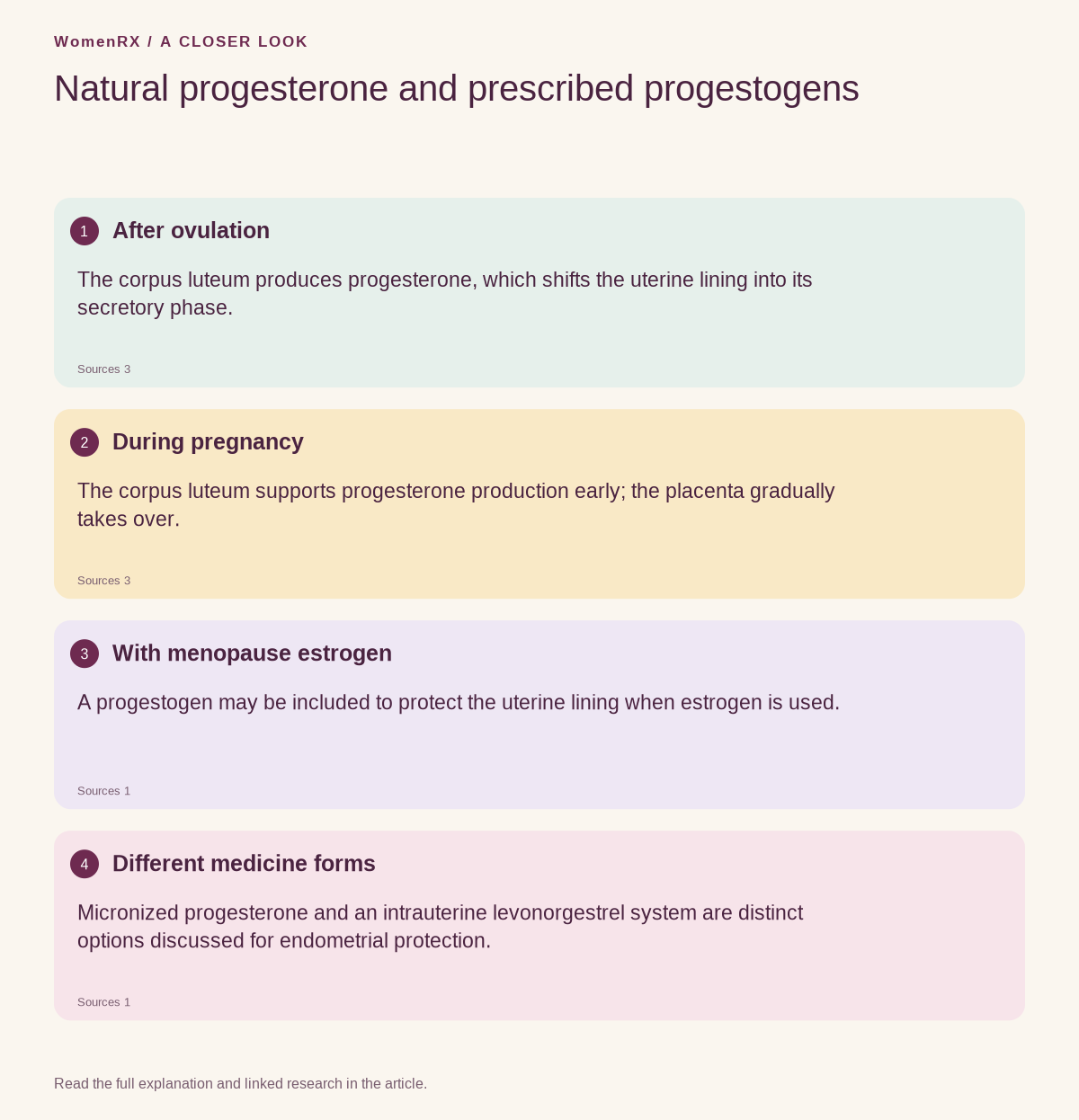
Natural progesterone and prescribed progestogens
After ovulation: The corpus luteum produces progesterone, which shifts the uterine lining into its secretory phase.3
During pregnancy: The corpus luteum supports progesterone production early; the placenta gradually takes over.3
With menopause estrogen: A progestogen may be included to protect the uterine lining when estrogen is used.1
Different medicine forms: Micronized progesterone and an intrauterine levonorgestrel system are distinct options discussed for endometrial protection.1
Read the figure as text
The same hormone family appears in different contexts: the body’s cycle and pregnancy, and specific medicine regimens.- After ovulation: The corpus luteum produces progesterone, which shifts the uterine lining into its secretory phase.3
- During pregnancy: The corpus luteum supports progesterone production early; the placenta gradually takes over.3
- With menopause estrogen: A progestogen may be included to protect the uterine lining when estrogen is used.1
- Different medicine forms: Micronized progesterone and an intrauterine levonorgestrel system are distinct options discussed for endometrial protection.1
More questions, answered
Are progesterone and progestin the same thing?
No. Progesterone is a specific hormone; progestins are synthetic medicines that can act on progesterone receptors. “Progestogen” can refer to progesterone and related medicines. 3 1 2
Does everyone using menopause hormone therapy need progesterone?
The role described here is protecting the uterine lining when estrogen is used in a regimen and the lining is present. Whether a progestogen is part of a particular treatment plan depends on the person’s situation and the regimen. 1
Sources you can check
- Position paper of the expert panel of the Polish Society of Menopause and Andropause on the use of Oestrogel® in menopausal hormone therapy.Bińkowska M, Paszkowski T, Skrzypulec-Plinta V, Zgliczyński W. · Przeglad menopauzalny = Menopause review · 2025Return to first citation
- Met909 plays a key role in the activation of the progesterone receptor and also in the high potency of 13-ethyl progestins.Petit-Topin I, Turque N, Fagart J, Fay M, Ulmann A, Gainer E, Rafestin-Oblin ME. · Molecular pharmacology · 2009Return to first citation
- Progesterone in gender-affirming therapy of trans women.Milionis C, Ilias I, Koukkou E. · World journal of biological chemistry · 2022Return to first citation
- Menopause: Physiology, definitions, and symptoms.Gatenby C, Simpson P. · Best practice & research. Clinical endocrinology & metabolism · 2024Return to first citation