When Might Progesterone Help, and What Is It Being Used For?
Progesterone’s purpose can range from protecting the uterine lining to being tried for symptoms, and each calls for a different way to judge whether it’s helping.
There isn’t one expected time for progesterone to help, because its role matters. With systemic estrogen, a progestogen is generally used to protect the uterine lining if you have a uterus; you may not feel that protection. For hot flashes, small trials assessed symptoms over 12 weeks, but results don’t establish a universal timeline or benefit for everyone. 1 2 4
First, clarify the reason it was prescribed
Progesterone may be prescribed alongside systemic estrogen for a purpose you won’t necessarily notice: protecting the endometrium, the lining of the uterus. Estrogen can stimulate that lining. For someone with an intact uterus using menopausal estrogen therapy, a progestogen is used to reduce the risk of endometrial overgrowth. A systematic review included 84 randomized trials, but study quality and the formulations and schedules studied varied. The protection shown for a particular regimen shouldn’t be assumed to apply to every product or schedule. 1
If you’ve had your uterus removed, that specific reason for adding a progestogen usually doesn’t apply. There may be another reason for your prescription, so it’s worth asking what it’s intended to do in your case. The same question matters if you’re using progesterone without systemic estrogen: its role is different from endometrial protection, and the evidence for one use doesn’t establish benefit for another.
If the goal is fewer hot flashes
There’s some trial evidence for oral micronized progesterone used on its own for hot flashes and night sweats, but it doesn’t give everyone a reliable “you’ll feel better by” date. In a 2012 randomized trial, healthy postmenopausal women recorded symptoms during a 12-week treatment period. The progesterone group had a greater average reduction in symptom scores than the placebo group. That result describes this study population and its measurement period, not a guaranteed response for an individual. 4
A later placebo-controlled trial also followed women for 12 weeks, but recruitment stopped early and the results were underpowered to determine whether progesterone worked. Symptoms declined substantially in the placebo group too. Taken together, the trials suggest that a 12-week period has been used to assess hot-flash outcomes in research, but they don’t establish a universal onset time or a certain benefit. 2
If hot flashes are the reason for your prescription, ask your prescriber what change to look for and when to review it. Tracking how often they happen and how disruptive they are can make that conversation more specific. If they persist or the treatment is hard to tolerate, raise that rather than assuming the same timeline applies to everyone.
Mood and other symptoms need their own evidence
A study of mood in the menopause transition tested estradiol together with intermittent micronized progesterone, not progesterone by itself. It looked at prevention of depressive symptoms in women who did not have significant symptoms at the start. The reported benefit was seen among women in the early transition, not the late transition or postmenopause. That finding can’t establish progesterone alone as a treatment for low mood. 3
So, if your prescription is meant to help with mood, sleep, or another symptom, ask what evidence and outcome apply to that specific use. A change in one symptom doesn’t automatically show that progesterone is helping another.
A useful question at your next review
Try asking: “Is this for lining protection, symptom relief, or both, and what should we use to decide whether it’s working?” If it’s for lining protection, the outcome is preventive rather than a noticeable symptom change. If it’s for symptoms, agree on what you’ll track and when you’ll revisit persistent symptoms or troublesome effects. Don’t change or stop a prescribed regimen on the assumption that all progesterone uses have the same purpose or response time.
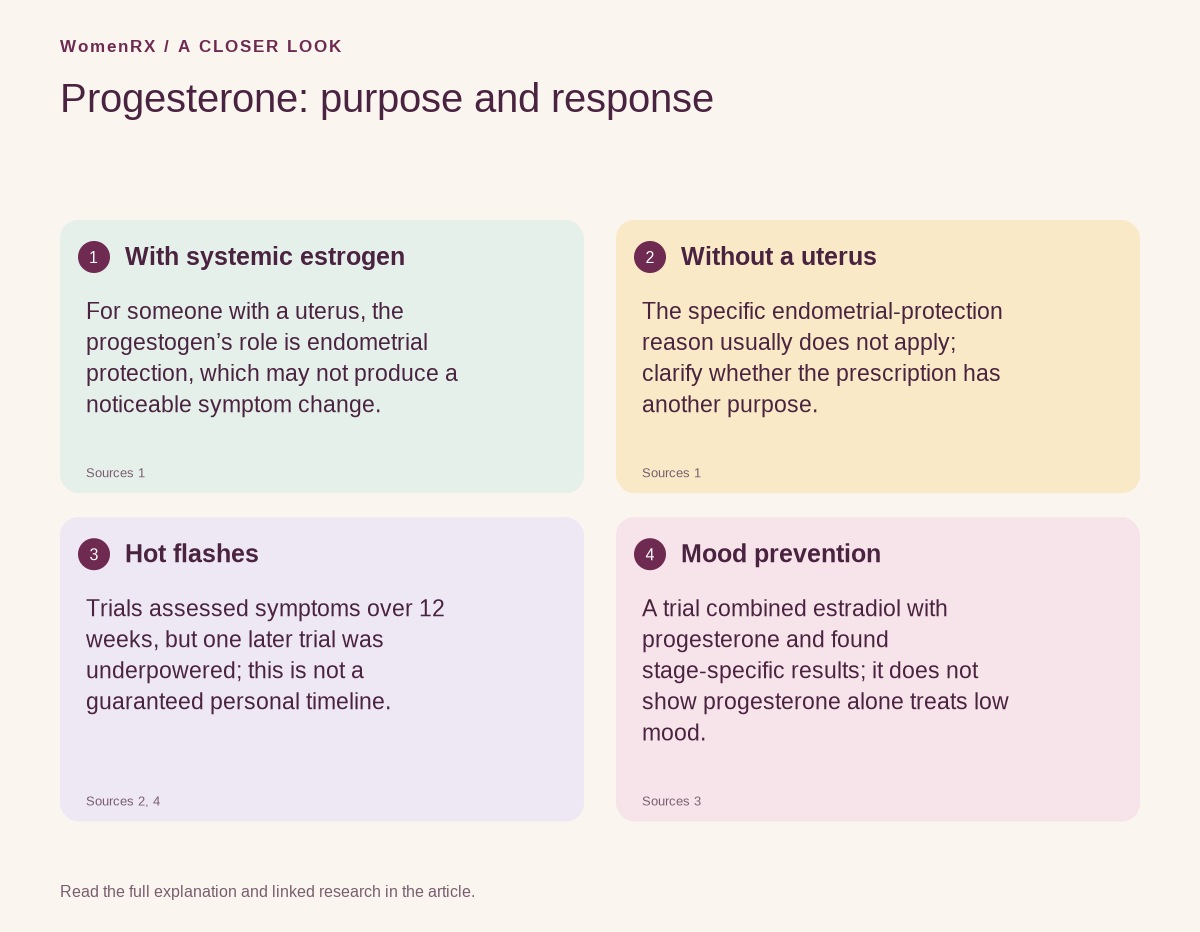
Progesterone: purpose and response
With systemic estrogen: For someone with a uterus, the progestogen’s role is endometrial protection, which may not produce a noticeable symptom change.1
Without a uterus: The specific endometrial-protection reason usually does not apply; clarify whether the prescription has another purpose.1
Hot flashes: Trials assessed symptoms over 12 weeks, but one later trial was underpowered; this is not a guaranteed personal timeline.24
Mood prevention: A trial combined estradiol with progesterone and found stage-specific results; it does not show progesterone alone treats low mood.3
Read the figure as text
The reason for prescribing progesterone determines what to look for; symptom change is not the measure for every use.- With systemic estrogen: For someone with a uterus, the progestogen’s role is endometrial protection, which may not produce a noticeable symptom change.1
- Without a uterus: The specific endometrial-protection reason usually does not apply; clarify whether the prescription has another purpose.1
- Hot flashes: Trials assessed symptoms over 12 weeks, but one later trial was underpowered; this is not a guaranteed personal timeline.24
- Mood prevention: A trial combined estradiol with progesterone and found stage-specific results; it does not show progesterone alone treats low mood.3
More questions, answered
If progesterone is for uterine-lining protection, should I feel a difference?
Not necessarily. Endometrial protection is a preventive role, so feeling no symptom change doesn’t by itself show whether the regimen is providing that protection. Ask which treatment plan you’re on and how it will be reviewed. 1
Sources you can check
- Progestogens for endometrial protection in combined menopausal hormone therapy: A systematic review.Stute P, Walker LJ, Eicher A, Pavicic E, Kolokythas A, Theis S, von Gernler M, von Wolff M, Vollrath S. · Best practice & research. Clinical endocrinology & metabolism · 2024Return to first citation
- Effects of Progesterone on Vasomotor Symptoms in Postmenopausal Women (PROGEST) - a Prospective Multi-Center Randomized Double-Blind Placebo-Controlled Trial (RDPCT).Beinert SV, Kleinsorge F, Worm J, Tropschuh KV, Seifert-Klauss V. · Geburtshilfe und Frauenheilkunde · 2024Return to first citation
- Efficacy of Transdermal Estradiol and Micronized Progesterone in the Prevention of Depressive Symptoms in the Menopause Transition: A Randomized Clinical Trial.Gordon JL, Rubinow DR, Eisenlohr-Moul TA, Xia K, Schmidt PJ, Girdler SS. · JAMA psychiatry · 2018Return to first citation
- Oral micronized progesterone for vasomotor symptoms--a placebo-controlled randomized trial in healthy postmenopausal women.Hitchcock CL, Prior JC. · Menopause (New York, N.Y.) · 2012Return to first citation