How Does Micronized Progesterone Work, and What Is It Used For?
In menopause care, micronized progesterone is most often paired with estrogen to protect the uterine lining, while the combination, not progesterone alone, has evidence for easing hot flashes.
Micronized progesterone is progesterone prepared in a way that increases its absorption when taken by mouth. In menopausal hormone therapy, its main role is to counter estrogen’s stimulation of the uterine lining in people who still have a uterus. When combined with estradiol, the treatment can ease hot flashes, but that benefit can’t be attributed to progesterone alone. 1 2 5
What “micronized” means
Progesterone is a hormone that acts through progesterone receptors. “Micronized” describes how the hormone is prepared: reducing its particle size increases oral absorption. The progesterone in oral micronized capsules is chemically identical to progesterone made by the ovaries. That describes the molecule, not a guarantee that every product or hormone regimen has the same effects. 1 5
Its clearest role in menopause therapy
Estrogen can stimulate the uterine lining, also called the endometrium. If you still have a uterus and use systemic estrogen for menopause symptoms, a progestogen is generally added to protect that lining from overgrowth. Micronized progesterone is one option; its purpose here is endometrial protection, not simply adding another hormone. 5 6
That role matters even if you don’t notice a symptom changing when you take progesterone. It is different from treating hot flashes. A randomized trial in postmenopausal women with a uterus found that a combined estradiol-and-progesterone capsule improved hot flashes compared with placebo. Because the study tested both hormones together, it does not show that progesterone by itself treats hot flashes. 2 The menopause society’s position statement likewise describes hormone therapy as an effective treatment for vasomotor symptoms, while noting that benefits and risks depend on the treatment and the person using it. 4
What about mood or memory?
There is some research on mood, but it does not establish micronized progesterone alone as a treatment for depression. In a 12-month randomized trial, initially euthymic women in the menopause transition or early postmenopause received transdermal estradiol plus intermittent micronized progesterone, or placebo. Across the trial participants, 17.3% in the hormone-treatment group and 32.3% in the placebo group had a clinically significant depressive-symptom score at least once. The researchers also found lower average symptom scores with treatment in the early-transition subgroup, but not in the late-transition or postmenopausal subgroups. These results concern the combined treatment, and the subgroup finding is about symptom scores, not the trial’s overall incidence result. 3
Cognitive effects are less settled. A small study of 20 postmenopausal participants found differences on some cognitive tasks when micronized progesterone was combined with estradiol during medication-induced cholinergic blockade. Other tasks did not differ, and the study does not establish that progesterone improves or harms everyday memory. The researchers describe progesterone’s cognitive effects as inconsistent. 5
The practical distinction
When a clinician discusses micronized progesterone as part of menopause therapy, ask what job it is meant to do in your regimen: protect the uterine lining, contribute to a combined treatment for hot flashes, or something else. Those purposes should not be treated as interchangeable. Evidence that a hormone acts on a receptor, or that a combination helps a symptom, does not prove that progesterone alone treats that symptom.
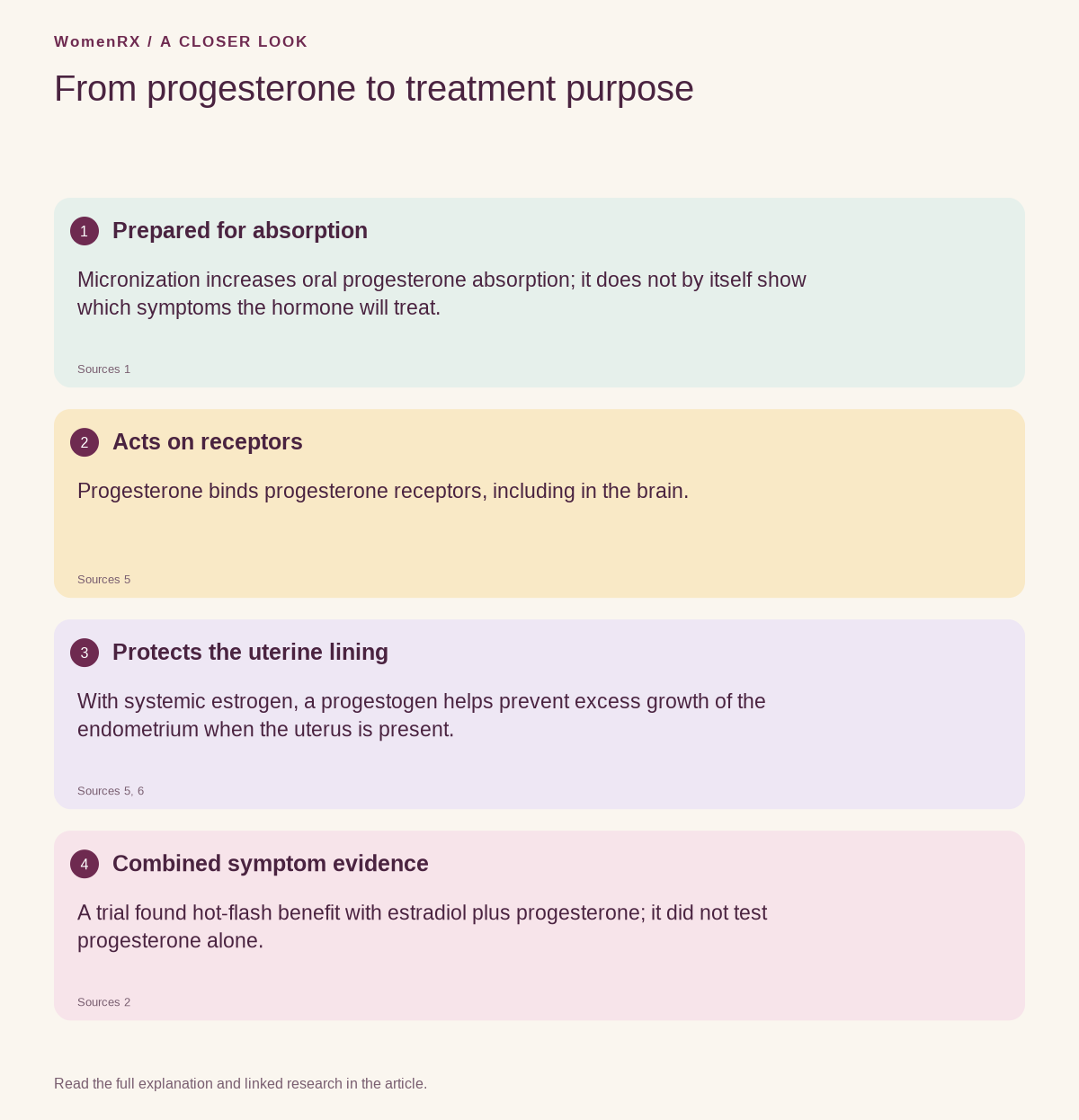
From progesterone to treatment purpose
Prepared for absorption: Micronization increases oral progesterone absorption; it does not by itself show which symptoms the hormone will treat.1
Acts on receptors: Progesterone binds progesterone receptors, including in the brain.5
Protects the uterine lining: With systemic estrogen, a progestogen helps prevent excess growth of the endometrium when the uterus is present.56
Combined symptom evidence: A trial found hot-flash benefit with estradiol plus progesterone; it did not test progesterone alone.2
Read the figure as text
The same hormone can have different practical roles in menopause care. This flow separates its biological action from the benefits shown for combined treatment.- Prepared for absorption: Micronization increases oral progesterone absorption; it does not by itself show which symptoms the hormone will treat.1
- Acts on receptors: Progesterone binds progesterone receptors, including in the brain.5
- Protects the uterine lining: With systemic estrogen, a progestogen helps prevent excess growth of the endometrium when the uterus is present.56
- Combined symptom evidence: A trial found hot-flash benefit with estradiol plus progesterone; it did not test progesterone alone.2
More questions, answered
Does micronized progesterone alone treat hot flashes?
The trial cited here tested estradiol and micronized progesterone together, not progesterone alone. It supports the combination for hot flashes, but doesn’t establish progesterone by itself as a hot-flash treatment. 2
Does micronized progesterone improve memory?
That hasn’t been established. A small study found differences on some tasks under medication-induced cholinergic blockade, but results across studies are inconsistent and don’t show a reliable everyday memory benefit. 5
Sources you can check
- PROMETRIUM (PROGESTERONE) CAPSULE [ACERTIS PHARMACEUTICALS, LLC] | US prescribing information and patient instructionsAccessed 2026-09-25Return to first citation
- Oral 17β-estradiol/progesterone (TX-001HR) and quality of life in postmenopausal women with vasomotor symptoms.Simon JA, Kaunitz AM, Kroll R, Graham S, Bernick B, Mirkin S. · Menopause (New York, N.Y.) · 2019Return to first citation
- Efficacy of Transdermal Estradiol and Micronized Progesterone in the Prevention of Depressive Symptoms in the Menopause Transition: A Randomized Clinical Trial.Gordon JL, Rubinow DR, Eisenlohr-Moul TA, Xia K, Schmidt PJ, Girdler SS. · JAMA psychiatry · 2018Return to first citation
- The 2022 hormone therapy position statement of The North American Menopause Society.“The 2022 Hormone Therapy Position Statement of The North American Menopause Society” Advisory Panel. · Menopause (New York, N.Y.) · 2022Return to first citation
- Effect of estradiol with or without micronized progesterone on cholinergic-related cognitive performance in postmenopausal women.Conley AC, Vega JN, Johnson JV, Dumas JA, Newhouse PA. · Frontiers in neuroscience · 2024Return to first citation
- The Effects of Menopausal Hormone Therapy on Serum Level of C-reactive Protein in Postmenopausal Korean Women.Shin W, Kim SE, Lee JY, Seo JW, Hyun HS, Suh JH, Choi D, Yoon BK. · Journal of menopausal medicine · 2019Return to first citation