Is progesterone used for sleep, and how is dosing decided?
Small menopause studies suggest possible sleep benefits, but the regimens they tested don’t establish a personal dose.
Oral micronized progesterone has been studied for sleep during and after menopause, both by itself and alongside estrogen. The trials used different amounts and combinations, and none compared doses to find an ideal sleep dose. A prescriber first needs to clarify whether the goal is sleep, another menopause symptom, or a separate role in an estrogen-containing plan, then weigh the exact formulation and how you feel on it. 1 2 3 4
The sleep evidence is promising, but narrow
Some small studies have found changes in sleep measures with progesterone-containing treatments. They don’t show that progesterone will solve every menopause-related sleep problem, or identify a best dose.
In a randomized crossover study, 10 healthy postmenopausal women took oral micronized progesterone at 300 mg for a 21-day treatment period. Sleep recordings showed less intermittent time awake, and REM sleep increased during the first third of the night. These are findings from a small, short sleep-lab study, not proof of a lasting or noticeable improvement for every person. 1
A separate trial of 21 postmenopausal women compared two regimens that both included estrogen. One included oral micronized progesterone at 200 mg; the other included medroxyprogesterone acetate at 5 mg. After six months, sleep efficiency increased by 8% in the micronized progesterone group, with no such increase observed in the other group. Because both groups received estrogen, the study can’t show what progesterone alone would do. 2
In another trial, 100 Thai women with insomnia during the peri- or postmenopausal years received daily estradiol alongside either micronized progesterone at 100 mg or dydrogesterone at 10 mg. Sleep scores improved in both groups over three months. With no group that received no hormone treatment, the trial can’t isolate the effect of either progestogen. 3
The studies differed in who took part, what else was taken, how long treatment lasted, and how sleep was measured. They tested specific research regimens; they did not compare a range of doses to establish an optimal dose for sleep. 1 2 3
What a dosing conversation needs to sort out
What is progesterone meant to do? If the main goal is sleep, say what that means for you: trouble staying asleep, for example, is not the same measure as feeling rested during the day. The studies used sleep recordings or questionnaires, and those results don’t guarantee a person will feel better. 1 3
If estrogen is also part of the plan, ask whether progesterone has a role beyond sleep. Progesterone and estradiol work together in the endometrium, or uterine lining, and help regulate its cyclic changes and menstrual bleeding. That purpose is separate from trying to improve sleep. The research summarized here does not provide a dosing schedule for that role, so a dose used in a sleep study shouldn’t be assumed to apply. 4
Which hormone and formulation are being considered? Micronized progesterone is not the same as synthetic progestins. The trials tested different forms, sometimes in combination with estrogen, so a result for one treatment can’t simply be transferred to another. 2 3 4
How does it affect you? Oral micronized progesterone can be associated with drowsiness or dizziness. Those effects are not the same as better sleep or feeling well the next day, so tolerability and daytime experience matter alongside the original sleep concern. 4
Together, these are the concrete questions behind a regimen choice: Is sleep the main target, or does progesterone serve another purpose in the plan? Is estrogen included? Which formulation is being used? And is the balance of sleep and daytime effects acceptable? The available trials don’t supply a formula that turns those answers into a personal dose.
Keep the sleep problem distinct from the hormone plan
A menopause-related sleep change may be one part of a broader symptom picture, but these trials don’t establish the cause of an individual’s insomnia or compare progesterone with other sleep treatments. If sleep trouble continues, it’s reasonable to revisit whether the treatment is aimed at the problem you’re actually experiencing, rather than assuming that a higher amount is the next answer.
A focused question for your prescriber is: “What is progesterone meant to do in my plan, and how will we judge whether it’s helping my sleep without causing unwanted daytime effects?”
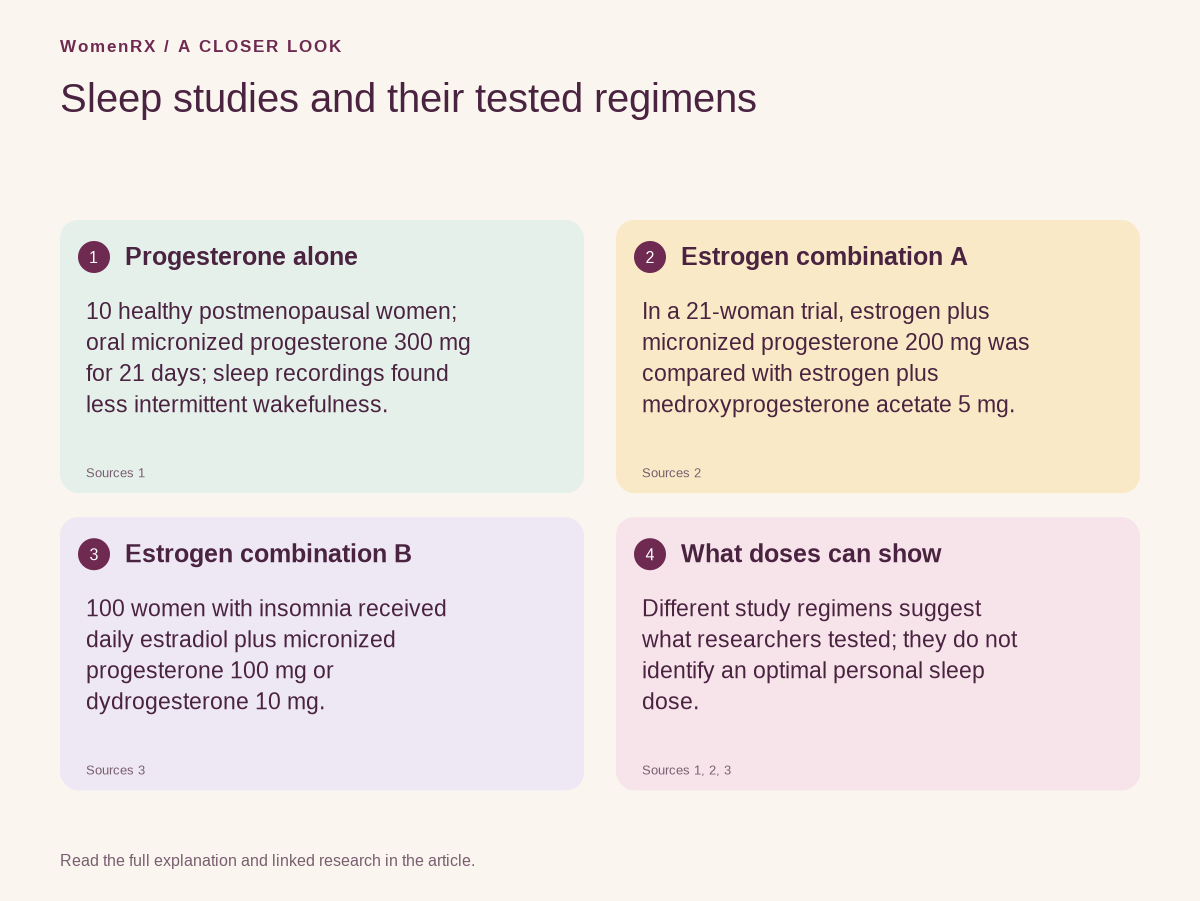
Sleep studies and their tested regimens
Progesterone alone: 10 healthy postmenopausal women; oral micronized progesterone 300 mg for 21 days; sleep recordings found less intermittent wakefulness.1
Estrogen combination A: In a 21-woman trial, estrogen plus micronized progesterone 200 mg was compared with estrogen plus medroxyprogesterone acetate 5 mg.2
Estrogen combination B: 100 women with insomnia received daily estradiol plus micronized progesterone 100 mg or dydrogesterone 10 mg.3
What doses can show: Different study regimens suggest what researchers tested; they do not identify an optimal personal sleep dose.123
Read the figure as text
These trials used different progesterone amounts and combinations. Their research regimens show what was studied, not what an individual should take.- Progesterone alone: 10 healthy postmenopausal women; oral micronized progesterone 300 mg for 21 days; sleep recordings found less intermittent wakefulness.1
- Estrogen combination A: In a 21-woman trial, estrogen plus micronized progesterone 200 mg was compared with estrogen plus medroxyprogesterone acetate 5 mg.2
- Estrogen combination B: 100 women with insomnia received daily estradiol plus micronized progesterone 100 mg or dydrogesterone 10 mg.3
- What doses can show: Different study regimens suggest what researchers tested; they do not identify an optimal personal sleep dose.123
More questions, answered
Are the doses used in sleep studies recommendations?
No. The studies tested different regimens, including micronized progesterone at 300 mg alone for a short period, and 200 mg or 100 mg in estrogen-containing combinations. They weren’t designed to compare doses and find a personal or optimal sleep dose. 1 2 3
Does drowsiness mean progesterone is improving sleep?
Not by itself. Drowsiness or dizziness can occur with oral micronized progesterone, but that doesn’t establish better sleep or better daytime functioning. 4
Sources you can check
- Progesterone reduces wakefulness in sleep EEG and has no effect on cognition in healthy postmenopausal women.Schüssler P, Kluge M, Yassouridis A, Dresler M, Held K, Zihl J, Steiger A. · Psychoneuroendocrinology · 2008Return to first citation
- Sleep in menopause: differential effects of two forms of hormone replacement therapy.Montplaisir J, Lorrain J, Denesle R, Petit D. · Menopause (New York, N.Y.) · 2001Return to first citation
- The effect of different progestogens on sleep in postmenopausal women: a randomized trial.Leeangkoonsathian E, Pantasri T, Chaovisitseree S, Morakot N. · Gynecological endocrinology : the official journal of the International Society of Gynecological Endocrinology · 2017Return to first citation
- Diagnostic and therapeutic use of oral micronized progesterone in endocrinology.Memi E, Pavli P, Papagianni M, Vrachnis N, Mastorakos G. · Reviews in endocrine & metabolic disorders · 2024Return to first citation