Why Is Micronized Progesterone Used in Menopause Care, and What Are Its Risks?
When systemic estrogen is used by someone with a uterus, progesterone may be added to protect the uterine lining, but the route, schedule, and risks depend on the full treatment plan.
Micronized progesterone is one type of progestogen that may be paired with systemic estrogen to counter estrogen’s growth effect on the uterine lining. The schedule matters: one systematic review describes protection with a particular oral, part-of-the-month regimen, not a universal prescription. Breast and clot risks also deserve discussion, and evidence about micronized progesterone is limited for some comparisons and longer use. 1 4 3
The reason it may be paired with estrogen
Estrogen can stimulate the endometrium, the lining inside the uterus. For someone with a uterus using systemic menopausal estrogen, a progestogen is generally included to counter that effect and help protect the lining from overgrowth. Micronized progesterone is one option; other progestogens are also used. Its role in this combination is not simply to add another hormone, but to balance estrogen’s effect on the endometrium. 1 5
The estrogen and progesterone routes are separate parts of the plan. An estrogen patch, for example, does not by itself tell you whether endometrial protection is included. And progesterone applied through the skin should not be assumed to protect the lining: a systematic review concluded that transdermal micronized progesterone does not provide endometrial protection. 4
Schedule and route are part of the treatment
Some menopausal hormone therapy plans use a progestogen continuously; others use it for a defined part of the month. A review describes continuous use as an approach for progestogens generally, but that does not establish a continuous micronized-progesterone schedule for every estrogen combination. The evidence for micronized progesterone depends on the formulation and regimen. 2 4
As one specific example, a systematic review reported endometrial protection with oral micronized progesterone taken sequentially for 12 to 14 days per month at 200 mg per day, for up to five years. That is a finding about a particular regimen, not a dosing instruction or a schedule that fits everyone. The same review described possible protection from certain vaginal regimens, but vaginal use was off-label in that review. 4
This distinction helps explain why a prescription’s exact route and schedule matter. A review also raises a possible tradeoff: micronized progesterone may have a more favorable breast-risk profile than some synthetic progestogens, while possibly being less effective at protecting the endometrium. The comparison is not settled, so the relevant question is whether the whole prescribed regimen provides appropriate endometrial protection, not just which hormone name appears on the label. 6
What’s known about breast and clot risks
For breast cancer risk, one systematic review reported no increase for up to five years with estrogen combined with oral micronized progesterone, or with vaginal micronized progesterone used off-label. It described evidence beyond five years as limited and recommended discussing breast cancer risk with combined hormone therapy regardless of the progestogen chosen. Those findings are not a guarantee of no risk for an individual. 1
Clot risk also belongs in the conversation. Menopause guidance says hormone-therapy risks vary with factors including formulation, dose, duration, route, timing, and whether a progestogen is used; it also notes greater absolute risks of venous thromboembolism among people starting therapy more than 10 years after menopause onset or after age 60. A separate review reports increased deep-vein-thrombosis risk with progestogens as a group, but its summary does not establish a specific risk estimate for micronized progesterone. 2 3
These risks cannot be reduced to “micronized is safe” or “all progestogens are the same.” Evidence reviews suggest possible differences between progestogens, while the guidance emphasizes that the overall benefit-risk balance depends on the person and treatment plan. Menopause guidance recommends individualizing hormone therapy and periodically reviewing its benefits and risks. 1 2 3
Questions that clarify your plan
If you’re discussing or reviewing treatment, these questions can make the reasoning more concrete:
- Is my estrogen systemic, and what is protecting my uterine lining?
- Which progesterone route and schedule are part of my plan, and what evidence supports that combination?
- If progesterone is used for only part of the month, how was that schedule selected for my estrogen regimen?
- How do my health history and the expected duration of treatment affect the breast and clot-risk discussion?
- When should we revisit whether the benefits still match my reasons for using hormone therapy?
The purpose is to understand how the parts fit together. A regimen that protects the endometrium, helps address the reason for taking estrogen, and reflects your personal risk factors is a more useful basis for discussion than choosing a progesterone by name alone. 3 4
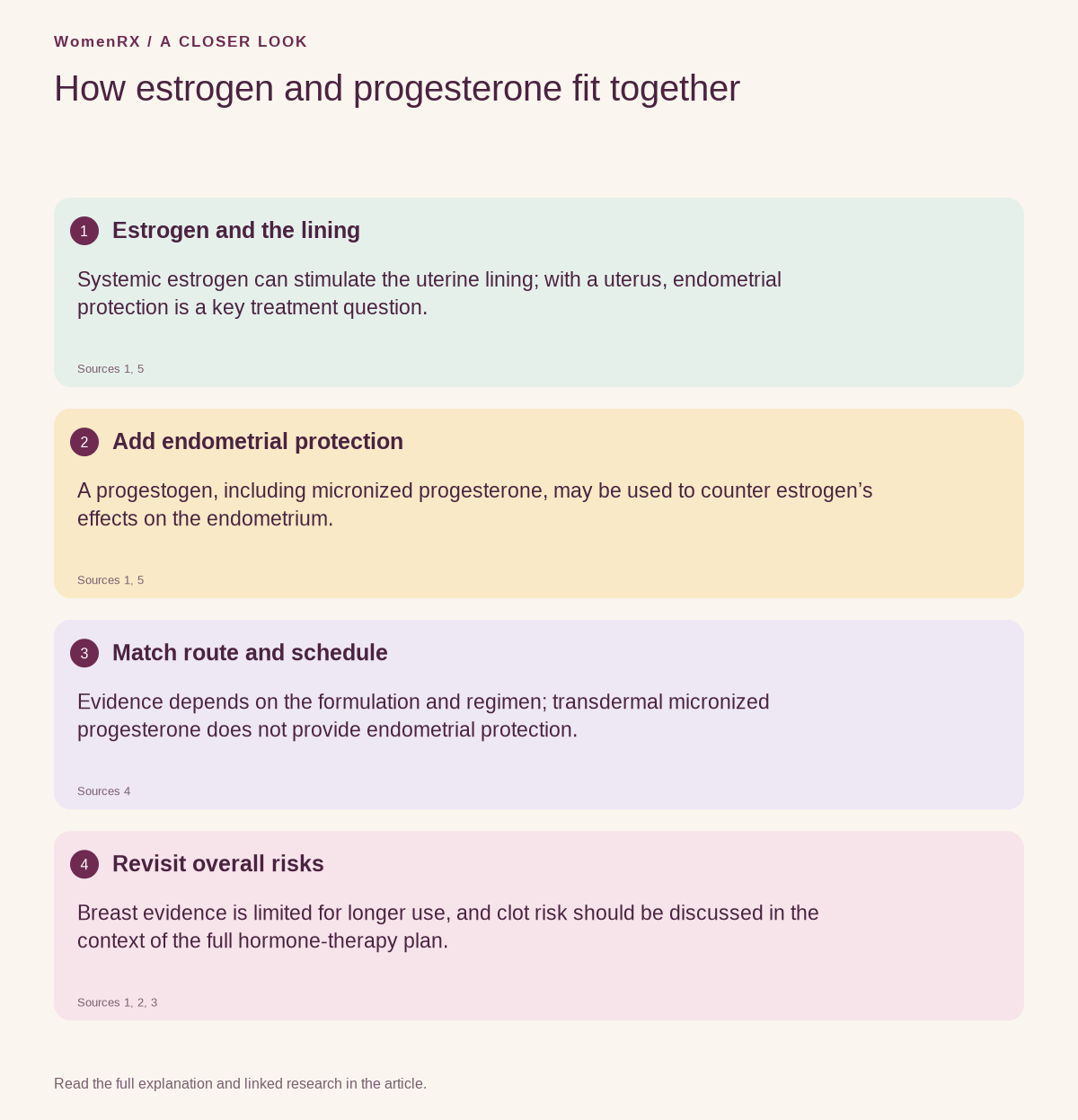
How estrogen and progesterone fit together
Estrogen and the lining: Systemic estrogen can stimulate the uterine lining; with a uterus, endometrial protection is a key treatment question.15
Add endometrial protection: A progestogen, including micronized progesterone, may be used to counter estrogen’s effects on the endometrium.15
Match route and schedule: Evidence depends on the formulation and regimen; transdermal micronized progesterone does not provide endometrial protection.4
Revisit overall risks: Breast evidence is limited for longer use, and clot risk should be discussed in the context of the full hormone-therapy plan.123
Read the figure as text
This map links the treatment goal to why route, schedule, and risk review matter.- Estrogen and the lining: Systemic estrogen can stimulate the uterine lining; with a uterus, endometrial protection is a key treatment question.15
- Add endometrial protection: A progestogen, including micronized progesterone, may be used to counter estrogen’s effects on the endometrium.15
- Match route and schedule: Evidence depends on the formulation and regimen; transdermal micronized progesterone does not provide endometrial protection.4
- Revisit overall risks: Breast evidence is limited for longer use, and clot risk should be discussed in the context of the full hormone-therapy plan.123
More questions, answered
Does an estrogen patch mean I can skip progesterone?
Not by itself. The patch is an estrogen route; the need for endometrial protection depends on your uterus and the treatment plan. Ask how your regimen protects the uterine lining, and don’t assume progesterone applied through the skin provides that protection. 1 4
Is micronized progesterone proven safer than other progestogens?
Not across every risk or regimen. Reviews suggest it may have a more favorable breast-risk profile than some alternatives, but also raise a possible endometrial-protection tradeoff. Breast-risk evidence is limited for longer use, and clot findings reported for progestogens as a group do not give a micronized-progesterone-specific estimate. 1 2 6
Sources you can check
- The impact of micronized progesterone on breast cancer risk: a systematic review.Stute P, Wildt L, Neulen J. · Climacteric : the journal of the International Menopause Society · 2018Return to first citation
- Progestogens in Menopausal Hormone Therapy: A Double-Edged Sword.Ylikorkala O, Joensuu JM, Siitonen H, Mikkola TS. · Seminars in reproductive medicine · 2025Return to first citation
- The 2022 hormone therapy position statement of The North American Menopause Society.“The 2022 Hormone Therapy Position Statement of The North American Menopause Society” Advisory Panel. · Menopause (New York, N.Y.) · 2022Return to first citation
- The impact of micronized progesterone on the endometrium: a systematic review.Stute P, Neulen J, Wildt L. · Climacteric : the journal of the International Menopause Society · 2016Return to first citation
- Estradiol and Micronized Progesterone: A Narrative Review About Their Use as Hormone Replacement Therapy.Foschi M, Groccia G, Rusce ML, Medaglia C, Aio C, Sponzilli A, Setti V, Battipaglia C, Genazzani AD. · Journal of clinical medicine · 2025Return to first citation
- Progesterone, progestins and the endometrium in perimenopause and in menopausal hormone therapy.Gompel A. · Climacteric : the journal of the International Menopause Society · 2018Return to first citation